Blogia

On Poetry and Culture Shock

Mr Money (Poderoso Caballero es Don Dinero)

I said some time ago that “Mr Money” sounded like such a good name that I had to find the original poem for you. This is one of Quevedo’s satirical masterpieces; Francisco de Quevedo was a Spanish poet from the 17th century who wrote one picaresque novel, and poetry (love, satirical and romantic), mostly in sonnet form. Something like a Spanish John Donne but with a wild sense of humour. Take away the sense of humour and add Latin syntax and you have Góngora). This is a very free translation of the first stanza; the others have jokes and puns so local or historically bound that they would need footnotes. I stopped there so I don't go to the Hell of Translators, where people have to translate Finnegans Wake for eternity in punishment for their translating mistakes. The complete original can be read here.

Madre, yo al oro me humillo,
Él es mi amante y mi amado,
Pues de puro enamorado
Anda continuo amarillo.
Que pues doblón o sencillo
Hace todo cuanto quiero,
Poderoso caballero
Es don Dinero.

Mother, I kneel before money,
My one and only, my beloved,
Though, fearful of my waywardness
He is forever green-eyed.
And since in all size and colour
Always does what I demand,
Such a powerful gentleman
is my Mister Money.
Ai sh'teruu (ai shiteru?)

In a campus as multicultural as Cornell, these sweet, small, amusing things must happen all the time, although we rush so much thinking of our own worlds, looking down to the ground, that we miss nearly all of them. This is what I saw this morning:

Two Asian girls, one of them vocalising to teach the other, who repeated tentatively, how to say "I love you" in Japanese.

I have no idea if they were flirting, or on a date. I hope so. Maybe I found it so touching and fun because it remindd me of two drastically diferent people, one who trusted my love teaching me to say exactly that, and another one who hd no idea of my feelings teaching me to say "i love you" in Russian. A very nerdy seduction strategy, isn't it?

The Poet with his face in his hands

Suzanne passed on to me this poem by Mary Oliver, not knowing that I' m so much against "the Therapy Effect". I like Oliver's take on it not just because I agree with her but also because of her interesting images, although I dislike the broken-line effect.

You want to cry aloud for your
mistakes. But to tell the truth the world
doesn't need anymore of that sound.

So if you're going to do it and can't
stop yourself, if your pretty mouth can't
hold it in, at least go by yourself across

the forty fields and the forty dark inclines
of rocks and water to the place where
the falls are flinging out their white sheets

like crazy, and there is a cave behind all that
jubilation and water fun and you can
stand there, under it, and roar all you

want and nothing will be disturbed; you can
drip with despair all afternoon and still,
on a green branch, its wings just lightly touched

by the passing foil of the water, the thrush,
puffing out its spotted breast, will sing
of the perfect, stone-hard beauty of everything.

El Poeta con la cara entre las manos.

Quieres gritar por tus
errores. Pero la verdad es que el mundo
ya no necesita ese sonido.

Así que si vas a hacerlo y no puedes
impedirlo, si esa boquita no puede
contenerse, por lo menos ve solo, por

cuarenta praderas y cuarenta caídas oscuras
de agua y rocas hasta el lugar donde
las cataratas arrojan sábanas blancas

como locas, y hay una cueva detrás de todo ese
júbilo y diversión acuática y puedes
estar de pie allí debajo y chillar todo lo que

quieras y no molestar; puedes
mojarte en tu desesperación toda la tarde y aún así,
en una rama verde, con las alas apenas rozadas

por el brillo del agua, el tordo,
sacando pecho, le cantará
a la perfecta, durísima belleza universal.

The Therapy Effect

Therapy should remain between you and your therapist. I am not your therapist. If you write to vent things out, good. That’s fantastic. Just don’t show it to anyone else later. I like the Elusive Poet (I mean as a person) because he doesn’t go around rubbing our noses into his feelings. Thank you, Poet.

I’ll say that again in case it’s not clear: writing is great, but showing it to others is not always so. I know people who think that since creative writing is very hard (or because they say they have no talent for it) they can only admire, never criticise or comment, on amateur work. Wrong. Amateurs are to be praised for trying, and then dissected if they dare showing their work in public. It is part of the process (am I being arrogant? Sure, but I’m fair. The comments section is there, and I’d love any feedback on my poetry).

Every time I write a therapeutic piece, something to help me get rid of a feeling, I tell myself I will hate it in two weeks. Then I put it into the quarantine folder and when some time has passed, I go back to it, thinking I will hate it. The prose is always horrible, no exceptions; most of the poetry can be saved with a bit of editing.

Of course I don’t mean that any poetry written “therapeutically” or anything that deals with very personal feelings is necessarily bad. But writing, like any craft, tends to need polishing, and it is harder to have the necessary distance when writing about our own emotions while they are still fresh. We all love our own feelings and it is very hard to see them, and the art they inspire, as different things.

Cornell's literary life (once more)

I repeat that I use "poetry" to mean "art". Ysterday I went to a reading of the brilliant Misty Urban, who just won a prize for her short story "The Keeping of the Counts". If that's not poetry I don't know what is. I thought I would cry on a couple of occasions.

It was in a way very typical, predictable in its starting point and suject matter (I don't mean to say that this is a bad thing!!), considering it is coming from an MFA student. As I have said before, Cornell's student literary magazines include a disproportionate number of pieces about families. Pieces that cannot possibly be autobiographical, sometimes. But the main theme seems to be fear of loss or incommunication between close relatives. I don't think that anyone at all on Misty's position in Spain would have even thought of writing about a woman with a 4-year-old very sick son. We prefer to write about peer relationships, or love stories. We rarely find families that interesting, unless they are absolutely hellish, and then we are using them as an excuse for social realism.

Those stories on perfectly normal, slightly tense families (are you reading this from Spain? think of the first half of American Beauty, but without the climax) might be caused by the American sense of isolation and incommunication you get in a country that wants everything bigger better faster now, where people are made to choose between meaningful relationships and competitive careers, with relationships losing (I'm paraphrasing the lovely Autumn Watts here). if that is so, then.why is it that Spaniards on Misty Urban position always write love stories?

Men and Middle Eastern dance.

Since lately I have been even more enthusiastic than usual on the topic of Middle Eastern dance ("belly dance", if you wish), a few people from the real world have asked me if there is any place in it for men. My experience with flamenco, instinct and common sense told me yes, and an article by Tarik Sultan in Morocco's website tells the surprising truth.

Come on guys, dancing is fun. And last time I checked men had two hips and two shoulders. Go on and do something with them more interesting than jogging.

Almost like a haiku

Pink Floyd gave the feel and texture of the winter. This spring belongs to e. e. cummings. This cute little poem reminds me a lot of the topics and mood of haikus.

Tumbling-hair
.............Picker of buttercups
........................................violets
dandelions
And the big bullying daisies
..............................through the field wonderful
with eyes a little sorry
Another comes
..............also picking flowers

Pelorrevuelto
.............buscador de ranúnculos
........................................violetas
diente de león
y las margaritas grandes bravuconas
..............................por la pradera maravillosa
con los ojos un poco tristes
Viene alguien
..............también cogiendo flores.

The Almudena Grandes effect (How Not to Write 2)

I’m being a bit unfair because as time goes by, Grandes writes better and better, but there we go. Almudena Grandes is a Spanish novelist. As far as I’ve read, all her novels have first person narrators: one of them has four alternating narrators (each narrator a chapter). The problem is that all her narrators, all of them, even the four women in Atlas de Geografía Humana, have the exact same voice.

If you are going to write narrative, please don’t make a teenager and his grandmother use the same register. Don’t be Almudena Grandes and don’t make your readers confused about who is telling what. The moment one of my characters opens his or her mouth, I want the reader to know who’s talking.

Someone criticised my short stories because the female characters are far more articulate than the male ones. I don’t do that on purpose, and I don’t think my women are better or more intelligent/educated than my men; it simply came naturally to make the women resemble me, but with a more ornate expression. The men are a bit like some of my male friends, precisely the ones who express themselves very differently from me. All I have been able to manage so far is to make characters that don’t have all the same voice, although I don’t think my dialogue is good.

The T. S. Eliot effect (How Not To Write, 1)

I am going to repeat myself here. Every artist that has stopped to theorise about the creative process, about What Art Ought to Be, reaches a simple and easy conclusion. Art ought to be what I do. Of course, I have no intention of being an exception. When I have written about why I like what I like, the result has been in the negative: instead of a list of things to do, I have a list of things that kill poetry. When I write (poetry or prose: it doesn’t matter) there are a few things I always try to avoid. Good writing is often a matter of leaving things out; most of the stuff I’ve read by bad or mediocre writers was so because of what was superfluous, not because of what was missing.

It probably sounds destructive, but in the hope of offending someone (oh yes, please, disagree), I’m going to blog a number of “effects”, flaws to be avoided like the plague. This is the first one: the T. S. Eliot effect is a double-edged sword. It is impossible to write without having influences. Really impossible. Sometimes those influences are evident, sometimes less so. Influences are good. But if your work has influences that are both obvious _and_ obviously better than your creations, be careful. T.S. Eliot’s The Wasteland is a poem I used to hate because it screams

I WANT TO BE DANTE BUT I’M NOT GOOD ENOUGH.

And what’s the point of that?

(Brought to you by the composer of haikus who has stolen quotes straight out of Shakespeare, T. S. Eliot, Pink Floyd, Beowulf, William Butler Yeats and Amaral).

A tall man.

One tree in the desert,
A tall man waiting.
He has never seen the flowers.

Un árbol en el desierto,
Un hombre alto que espera.
Nunca ha visto las flores.


Flower woman asks an innocent question.
A green smile and no answer.

Mujer-flor hace una pregunta inocente.
Una sonrisa verde, y ninguna respuesta.


Two of my oldest haikus. They were not meant to go together, although they are about the same man.

On libraries both sides of the ocean, Part One

I found out y chance that there is an excellent collection of children’s literature and a good collection of comics in Uris Library. I quickly borrowed everything by Neil Gaiman,little by little, since they were often taken. The discovery was a big surprise, since our University libraries are more technical, and what I wonder, do we have those books in the library for the Popular Culture Studies types or simply because it is good that I can take Roald Dahl’s Matilda or Gaiman’s Preludes and Nocturnes as comfort reading after a hard day of Derrida?

(Mental picture of Cultural Studies clever one doing a dissertation on the influence of French Deconstructionism in contemporary comic writers).

Unavoidable: April is the cruellest month.

Imagine this. May in Southern Spain. Heat, 40 first-year University students taking a survey course in English Literature. Understanding plain English is sometimes a challenge. And about three lectures before the end of the semester, T. S. Eliot's The Wasteland is presented. General hostility follows. It makes no sense.

Although I disliked it initially, it was the second time in my life that someone introdued me to such elegant, fluid free verse, the first time being Pedro Salinas' La Voz a Ti Debida (The Voice I owe to you). Today, a sunny April day with the crocuses starting to bloom, is a perfect occasion to post the opening of The Wasteland.

I. THE BURIAL OF THE DEAD

APRIL is the cruellest month, breeding
Lilacs out of the dead land, mixing
Memory and desire, stirring
Dull roots with spring rain.
Winter kept us warm, covering
Earth in forgetful snow, feeding
A little life with dried tubers.
Summer surprised us, coming over the Starnbergersee
With a shower of rain; we stopped in the colonnade,
And went on in sunlight, into the Hofgarten,
And drank coffee, and talked for an hour.
Bin gar keine Russin, stamm' aus Litauen, echt deutsch.
And when we were children, staying at the archduke's,
My cousin's, he took me out on a sled,
And I was frightened. He said, Marie, 15
Marie, hold on tight. And down we went.
In the mountains, there you feel free.
I read, much of the night, and go south in the winter.

1. ENTERRAR A LOS MUERTOS.

Abril es el mes más cruel, criando
lilas en el yermo, mezclando
memoria y deseo, revolviendo
raíces moribundas con lluvia primaveral.
El invierno nos dio calor, cubriendo
la tierra con nieve olvidadiza, alimentando
un poco de vida con tubérculos secos.
El verano nos sorprendió, llegando al Starnbergersee
con un chaparrón; nos detuvimos en la columnata
y salimos al sol, al Hofgarten,
y tomamos café, y charlamos una hora.
Bin gar keine Russin, stamm' aus Litauen, echt deutsch.
Y cuando éramos pequeños, en casa del archiduque,
mi primo, me llevó en trineo
y yo tenía miedo. Él decía, Marie,
Maríe agárrate fuerte. Y allá que fuimos.
En las montañas te sientes libre.
Paso leyendo casi toda la noche, y viajo al sur en invierno.

A linguistic curiosity

I thought that in English, “no strings attached” meant “no need to make any further commitment”. I just found out what it really means (in a word, “flawless”).

The Jewelry Shop is ready for spring colours.

See that link there? It takes you to my online jewelry shop, which is more a shop window than a shop because I have so many different things that if I showed them all you’d get tired of browsing.

A note on the prices: I have been making a selling jewelry for about nine years. In my hometown, you get the same quality from shops, from authorised street vendors and from unlicensed ones. I like to keep the prices a little bit below the prices of shops; most people that I know that sell more or less as a hobby have always done the same as me. Also, I want to be inexpensive for students out of principle. So, when I came to the US I worked on the same principle. I could easily double my prices and still be cheaper than most shops. Buying the beads yourself might be even more expensive than buying from me (definitely so, if it’s one of my pieces with real semiprecious stones). I don’t care. I can afford to sell at students prices, so I don’t have any reasons not to. But I would hate it if anyone suspected that there something wrong with my jewelry or the materials I use just because I keep things affordable.

The North African dance conference

In case you wanted to know how many hours of dancing I can accumulate in these two hips before they collapse: 15. I have done about 15 hours of dancing in three days. First shock: many people organise this sort of thing, it happens very often. It is a wonderful way of getting first-hand knowledge of other people’s techniques, but I wouldn’t want to do this sort of demanding physical work more than once or twice a year. But then, I’m not a professional dancer, and I guess that for people like June, three to ten hours of dance a day are just like my three to ten hours a day at the library.

It was wonderful to see dancers of all abilities, shapes and sizes have fun and learn new things. It was, in a way, a very geeky atmosphere: like a convention of extremely dedicated fans of a very obscure sci-fi series, although instead of talking of characters, actors, and whether the original comic book was better, we talked about the advantages of coin belts over hip scarves or about belly roll techniques (I want to be Émiline when I grow up). There may be a few divas, but the professionals have all the time in the world to talk to the newbies.

In spite of all the fun, something that I find very sad about Middle Eastern dance now is that even though there are many things I cannot do yet, I hardly ever watch a belly dancer and think “How the did she do that!?”; I know the theory behind nearly everything. Now it gives a different level of enjoyment, but there isn’t any mystery and that’s sad. I need to see the “How the did she do that!?” look in other people’s faces to remember that there is magic in it.

Free verse on homesickness

Raíces

No sólo los árboles tienen raíces.
Es raíz lo que te sujeta.
Raíz lo que apoya.
Raíz, origen.
Hasta los números tienen raíces,
quien diría que algo tan frío
tiene un principio.
También los dientes tienen sus raíces.
Algunas
sólo se pueden recordar cuando duelen.
Cuando no se tienen.
Si las rompes.
Si se van.

Decido separarme de mis raíces, marcharme, y dejarlas aquí.
Que les vaya bien.

Roots


Not only the trees have roots.
Root is what supports you.
Root what holds you.
Root, origin.
Even numbers have their roots,
who would’ve thought that something so cold
has a beginning.
Teeth are born from roots too.
Some
are remembered only when they hurt.
when you lose them.
When broken.
When gone.

I decide to sever off my roots, go away, and leave them here.
Fare them well.

I wrote this one very soon before coming to Ithaca. I still don’t know it is good enough to compensate for being so self-indulging.

Belly Dancing! Yay!

Precisely after the server has been down for a whole day, now I'm abandoning you to go to a Middle Eastern Dance seminar. 12 hours of workshops and four hours of shows in two days. If Plan A (for Academia) doesn't work, I can always give a try to Belly Dancing...

If you are reading this from in Ithaca, the Saturday show is open to the public. Unmissable.

Forges

Forges

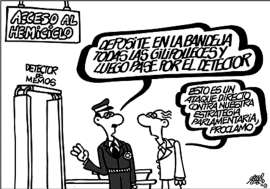
When I say "Other people's poetry" I mean "other people's art". I adore Forges. It’s a family tradition, I think. His cartoons are very much culture-specific so it’s not just a question of translating words but of expressing stuff that you wouldn’t understand if you had not in Spain for the last months or years.

This one expresses wonderfully well the impression that I’m getting from the Spanish conservatives as I read what they do on online newspapers:

NOTICE: ACCESS TO PARLIAMENT. FOOL DETECTOR.

Security guy: Place all bullshit on the tray and then pass through the detector.
Conservative Politician: This is a direct attack against our debating strategy, I swear!

Shipbuilding

The Spanish government has just arranged to sell ships and other military equipment to Venezuela. Spanish conservatives yell and despair. The Socialist government points out that the deal will create or secure plnty of employment at the shipyards that the last (Conservative) government endangered. I think it is all very sad.

Elvis Costello wrote this song about the situation of unemployed shipbuilders when England went to war against Argentina over control of the Malvines.

Shipbuilding.

Is it worth it?
A new winter coat and shoes for the wife
And a bicycle on the boy's birthday
It's just a rumour that was spread around town
By the women and children
Soon we'll be shipbuilding.......
Well I ask you
The boy said "Dad they're going to take me to task, but I'll be back by Christmas"
It's just a rumour that was spread around town
Somebody said that someone got filled in
For saying that people get killed in
The result of this shipbuilding
With all the will in the world
Diving for dear life
When we could be diving for pearls
It's just a rumour that was spread around town
A telegram or a picture postcard
Within weeks they'll be re-opening the shipyards
And notifying the next of kin
Once again
It's all we're skilled in
We will be shipbuilding........

¿Merece la pena?
Un abrigo nuevo y zapatos para la parienta
y una bici para el cumple del chico
No es más que un rumor que dicen por ahí
las mujeres y los niños
pronto volveremos a construir barcos
pues verás,
el mayor me dice “Papá, me han cogido pero vuelvo a casa por Navidad”
No es más que un rumor que dicen por ahí,
alguien dijo que a alguien lo ficharon
por decir que hay gente que se muere
cuando construimos barcos
Con toda la voluntad del mundo
Zambúllete para salvar la vida
cuando podríamos estar buscando perlas
No es más que un rumor que dicen por ahí
un pésame oficial, una postal,
En pocas semanas reabre el astillero
y empiezan las notificaciones a las familias
Otra vez
No valemos pa otra cosa
A construir barcos....

Damn you!

Curse your uniqueness.
After you left me,
Each passing face looked like yours.

Maldita seas, por ser distinta.
Desde que te fuiste,
Cada cara que pasa se te parece.


Heh. This one was a tanka, which means it was twice as long. It was an embarrassing mess that no shuffling about of synonyms would mend (desperation in poems, à la Gustavo Adolfo Bécquer, is a very poisonous thing). It took me quite a lot of drafting and ruthless criticism from someone else (thanks, Jhoe) to realise that the problem was that the speaker should hate the beloved. No ambiguity there.