Blogia

On Poetry and Culture Shock

White and black

White and black

This Seen in Washington: a shop that only sells clothes in black and white. Their website says they do sizes 0 to 14,so it's not just for stik insect-shaped women. Yay. Even if it _is_ expensive, this brand should have shops in Spain! Pleeeeease!!!!!!!!

On the other hand, it shouldn't. Because then all I'd wear would be their clothes with brightly coloured scarfs and shoes.

Barthes, e. e. cummings, a lover and a redhead

Mis palabras te tocan,
hablo,
hablamos,
y mis palabras se enredan entre tus dedos.
No sé qué tienes que me hace hablar.
No sé qué haces que me tiene presa.
Es algo rojo y suave,
frágil,
es algo que cambia cuando lo describo.
(si hablarte es tocarte,
si mis dedos te tocan, te cuentan un cuento)

My words touch you,
I talk,
we’re talking,
and my words get tangled between your fingers.
I don’t know what you have that makes me talk.
I don’t know what you make that has me enthralled.
It’s something red and soft,
fragile,
it’s something that changes as I describe it.
(if talking to you is touching you,
when my fingers touch you they tell you a story).


Yesterday a poem by cummmings, today one of mine that he inspired. I think this poem is the densest collection of allusions I’ve ever done. Most of them are too subtle to point out, but there they are. That is partly why I like it.

Vietnam Women's Memorial

Vietnam Women's Memorial

The Vietnam Memorial is very abstract so a few people were not too happy with it, and years after its construction they erected a statue of three soldiers, one black, two white, all men. Then, many years later, as the usual afterthought, they made a separate statue for the women. Instead of considering that they were sufficiently well represented by the abstract, original memorial, they thought it best to underline the differences between men and women (bleh) giving females a separate statue.

From an artistic point of view, I think it is a military version of the Renaissance "Pietà" theme. I've seen much better ones.

e. e. cummings on love and death

The trip to Washington is giving me plenty of opportunities to rant on this insane country, so let's compensate that with some beautiful American poetry. What I like the best from e. e. cummings is the originality of his love poems. Many of the others are good too, and the extremely short ones are very original, but to me nothing beats the love declarations, such as this one. Even so, its defence of the value of love above, beyond, after, and in spite of death is better understood in the context of his sadder poems on mortality.

Thy fingers make early flowers of
all things.
thy hair mostly the hours love:
a smoothness which
sings,saying
(though love be a day)
do not fear,we will go amaying.

thy whitest feet crisply are straying.
Always
thy moist eyes are at kisses playing,
whose strangeness much
says;singing
(though love be a day)
for which girl art thou flowers bringing?

To be thy lips is a sweet thing
and small.
Death,Thee i call rich beyond wishing
if this thou catch,
else missing.
(though love be a day
and life be nothing,it shall not stop kissing).

Los dedos de vos hacen flores tempranas de
todas las cosas.
El cabello de vos lo aman especialmente las horas:
una suavidad que
canta,diciendo
(aun si el amor es un día)
no tengas miedo,iremos a la feria.

los blanquísimos pies de vos vagabundean frescamente.
Siempre
vuestros húmedos ojos juegan a los besos,
cuya rareza mucho
dice,cantando
(aun si el amor es un día)
¿para qué chica traéis flores?

Ser los labios de vos es algo dulce
y pequeño.
Muerte,a Vos os llamo rica más allá de todo lo deseable
si atrapas esto,
lo demás perdiendo.
(aun si el amor es un día
y la vida nada,no dejará de besar).

Terrorists

Terrorists

This is an image I found through Google of another poster on sale at those little stalls near the Vietnam and Korean war memorials in Washigton D. C. I think it's creepy.

The equivalent that comes to mind is someone selling stuff with svastikas or with the Spanish fascist flag (it used to be a little different than it is now, when we were not a democracy) right next to the Bosque de los Ausentes. Creepy and sad.

Does love kill the Muse?

After knowing that the atmosphere in Mars is less that 1% as dense as the Earth’s, so even the fastest winds can hardly be felt at all.
Wild, fast and pointless.
Looking for a cheap love cure.
Like the winds in Mars.

Cuando supe que la atmósfera de Marte tiene menos del 1% de densidad que la de la Tierra, por lo que los vientos huracanados ni se sienten.
Rápido, salvaje, sin sentido.
Buscando un vulgar remedio amoroso.
Como los vientos de Marte.


Some time ago I said that "last summer I attended a sort of conference for poets, which publishers and other interested people attended too". Actually, I lied. I didn't attend the conference, I was only there because I won a prize in a poetry by text message competition and I'll give you that poem on another occasion (you find a fraction of it if you google my full name, Eugenia Andino Lucas, but I hate that website's layout). Anyway, there was a dinner and I had the chance to talk with a few professionals, amateurs like me, and publishers, and someone quite ruthless said a way of telling apart the bad amateurs from the promising ones:

Lots of young people write poetry. They are easy to sort out because the mediocre ones stop writing when they get into a steady relationship.

That fits nicely into the usual male-oriented explanations of the creative impulse as something nearly sexual. There is the Sheherezade model: being creative makes you sexy. There is the Sublimation model: you put into creating the energies that you'd put into sex if there was an available partner. There is the Oedipal model, the idea that you write because you want to beat your influences (your influences are your ather and Art is your mother: apply Oedipus to the triangle)

I haven’t had the opportunity to see if that critic's theory applies to me, but I doubt it. Not because I believe I am above mediocrity, but because I think I write faster and better when I have an audience. I think it's very funny (in the "strange" and in the "amusing" senses) how some of my most creative spells, the ten-poems-a-week fits, have taken place in that bubbling ground at the very earliest stages of relationships. I am curious about whether, if I ever have a steady relationship again, that person (or me getting lazy and comfortable) will kill my Muse. I hope not.

By the way, is anybody interested in a post about the Muses? Any fans of obscure mythology reading this?

The darkest what??

The darkest what??

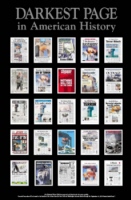
In Washington D.C. a guided tour took us to see the Lincoln Memorial, and the Korean War and Vietnam War memorials that are very close to it. In the short stretch between the two war memorials there are a few stalls selling not exactly souvenirs, but badges and replicas and posters ad such, either military, "patriotic", or xenophobic. I was shocked, not culture-shocked but raged-shocked, when I saw that poster there. The photos are not very clear; they are the Twin Towers.

I would have thought that the genocide of Native Americans was the darkest page of American History. No, maybe slavery was. No, maybe the Civil War was (the guide told us that more people died in that war that in all the others put together). Even maybe, the Vietnam War was (sixteen years of war, were they crazy or what?), considering what a wreck they did of the place.

Oh, no. The darkest page in American History is not Americans being senselessly cruel to other people or to each other. It is other people being cruel to them. I see.

Another haiku about hands

Our tangled hands are dry
but they hold a slippery love,
Too fragile to last.

Manos entrelazadas,
Secas aunque sostengan un amor resbaladizo
demasiado frágil para durar.


Hmmm... this one doesn’t say everything I want it to say. It should be more ambiguous, or more sensuous, or both.

The Canon as interpreted by the Library of Congress

I went to the Library of Congress on a guided tour, so I didn’t have time to see much, really. Something must be said about Americans: our guide said that the Library is such an ornate, beautiful building because when it was built, this was a very young country and the Congressmen wanted an splendid building that Americans could be proud of. The Pharaohs built tombs, European kings built castles, and early Americans built a library.

So. There is a ceiling decorated with names that represent what the builders of this paradise considered the peak of Literature. Nowadays, to that we add Western Literature, because we are aware of the existence of The Monkey’s Journey to the West, or Issa Kobayashi’s haikus, and other masterpieces not from Europe or North America. When the Library was built, they didn’t know or care much about those things.

It was fascinating to see the designer’s version of the Canon (the Canon is the list of works or authors that an expert considers classic). A few names are lined up together without a heading, so the watcher has to guess that each wall is dedicated to a genre. This is what they have:

Novel: Miguel de Cervantes, Victor Hugo, Walter Scott, James Fennimore Cooper.
Poetry: Henry Longfellow, Alfred Tennyson.
Epic: Dante, Homer, John Milton.
Drama: Goethe, Shakespeare, Molière
Philosophy: Bacon, Aristotle.
History: Moses, Herodotus. Edward Gibbon and George Bancroft are put next to Longfellow and Tennyson.

In the choice of genres, I’m surprised there is no lyrical poetry. Where are Catullus and Petrarch? (Someone mention Bécquer and I’ll puke). Now about the choice of authors. First, the inventor of novels and someone American are a given. Cervantes is definitely in, but then, what about the American? Who cares about Cooper these days? That’s not a rhetorical question. Herman Melville is a lot more relevant nowadays, and Hawthorne… well, I have a soft spot for Nathaniel Hawthorne. So, if the designer was trying to see the future, he failed a bit there. Or maybe he had a preference for historical novels.

I cannot say anything about Victor Hugo. The idea is to take novelists from different countries, good idea, but then, what is Walter Scott doing up there? Representing Britain? Where is Jane Austen? Where is George Elliot? Americans in the 19th century had mixed feelings about Charles Dickens because he satirised them very harshly, so I understand his absence. Maybe is just my feminism (or my love of novels of manners), but Scott up there instead of Elliot or Austen, oh please.

The poetry one is funny because although Longfellow and Tennyson were wildly popular a bit more than a century ago, no one reads them anymore outside universities. And again, Petrach and Catullus??

Of course, the only thing I have to say about Epic is that if there were four columns instead of three, Ovid should’ve been in there. And Drama… what the heck were they thinking of when they left Sophocles out? Come on, Oedipus Rex, guys!

The Philosophy wall is too presumptuous. How can anybody pretend to choose just two philosophers to represent the best of human knowledge? Why not Kant and Plato? And History… Moses is just stuck up there in the ridiculous assumption that he’s the author of the Pentateuch (should I say, the Torah), and only the fact that he’s next to Herodotus suggests that he is considered an historian. Smash down that mosaic and put Caesar or Herodotus instead. And who are Bancroft and Gibbon? I don’t think I had ever heard of them before! The whims of fame and time are very cruel to some people.

So that’s it. Rather than just giving my opinion, I wanted to show how arbitrary the Canon can be, and how anyone that takes up the task of devising one is often doomed to (partial) failure. Blogs are very ethereal things, just bytes on a plane outside space, but if my entries were preserved somehow for someone to read in a century or two, I wonder if they will think me naïve and presumptuous.

No, actually, no “if”. I wonder in what aspects they will consider me naïve and presumptuous.

Banana Tree

Banana Tree

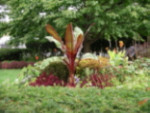
A flame, a firework,
Red fans, a surprise.
Banana tree in a garden.

Una llama, fuegos artificiales,
Abanicos rojos, una sorpresa.
Una platanera en un jardín.


I love trees. A childhood in an industrial town without trees makes you appreciate them better later. When I came back to Spain from my first trip to Scotland, I summarised my misery as “No cherry trees here and no palm trees there”. Later, I have learnt to enjoy living in two or three countries at once, but I still associate certain trees (bananas, citrus, palm trees) with home.

So imagine my happiness when I saw that a beautiful garden in Cornell had a banana tree.

Back from Washington D.C.

Hello again! I'm back! And I have a lot to comment on in the culture-shock department. Since I have been defending lately that a blog is not a journal, and that this is definitely not a journal, instead of writing a chronicle of my trip to Washington D. C. I will write the usual very short pieces on individual, surprising things I have seen. This is just for starters...

If you have been in Ithaca for too long, when you travel...

- you are surprised and annoyed when restaurants have hardly any vegetarian options and no vegan ones.
- You keep looking in vain for recycling bins.
- Parents with small children don't smile back at you and touch their kids nervously.
- You suddenly find yourself the lightest-skinned person around. Then you realise that blacks and occasional Latinos make up 90% of security staff, police, receptionists, and similar jobs that involve zero power and little decision-making, but which are very visible from the outside (I did not see one black person in a suit). The Black Receptionist Syndrome does not happen at Cornell, since the admin staff is white, although to tell the truth there aren't many black students.

More fun!

More fun!

I have a week of holidays and I'll be in Washington until Wednesday, so don't expect any updates in a few days. These days are important in my hometown, so rather than talking about the hows and whys here you have (again) a poem about it.

El Río de Norte a Sur (para ciudades que tengan el norte a la izquierda).


1.
“Presos del suelo”,
Me envidian si patino.
¡Mira cómo vuelo!
(Grafitti anónimo en el puente de Chapina)

“Prisoners of the ground”
They envy me when I skate
Watch me fly!


2.
Sobre el río, paz verde,
Cruzan tres flechas.
Piraguas blancas.

On the river, green stillness,
Three arrows crossing.
White kayaks.


3.
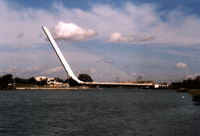
Los siete puentes
abrazando la ciudad,
a todos nosotros.

Our seven bridges
Hugging the city,
hugging us all.


4.
Jardines del Cristina.
Mi abuelo no está.
Pero yo sí.

Cristina Gardens.
My grandfather’s gone.
But here I am.


5.
Niebla y gorrillas.
Siete de la mañana,
Lunes de frío.

Beggars on heroin.
Fog, seven a. m.
As cold as Mondays can be.

Some Irish fun

Excuse me if I give you something appropriate for St Patrick’s Day two days too late, but my St. Patrick’s celebration started on Wednesday and finished yesterday(heh heh), so to me this still counts. I could give you Yeats but I don’t like it that much. I could give you James Joyce, but after these days’ fun, I’m in the mood for parties and song. So, I offer you some Irish music. It's Father's Day in Spain and my father likes to compile different versions of the same song, so this is perfect for today.This is a traditional Irish song that I know in five versions: Kate Rusby, The Corrs, Marianne Faithful, Sinéad O’Connor and Martyn Bennett sampling someone from a couple generations back. I’d like to have more variations on the same theme, but singers have the habit of recording just a fragment of the song and changing the name every time. Mine are called I Wish, I Know my Love, Love is Teasin’, The Butcher Boy and Blackbird! Versions can be dramatically different. Marianne Faithful and Martyn Bennett’s singer sound sad and bitter; Kate Rusby is sad, but her changes in the lyrics and the way she sings underline, ehem, how she stopped being a maid. The Corrs sound as if they were having so much fun they don’t believe for one second the boy doesn’t love them; Sinead sings about a suicide. Of course, mine is my own personal version, a recycling of the bits I like in the others with one or two extra changes. To me, this is a drunken, party song: a translation into Spanish would have to be in slang or dialect, and I don’t dare.

I wish I was, I wish in vain,
I wish I was a maid again
But a maid again I can never be
Until oak was to grow up an ivy tree.

For love is teasin’, and love is pleasin’,
And love is a treasure when first it’s new
But as love grows older, then love grows colder,
And it fades away like the morning dew.

There is an alehouse on yonder town
where my love goes and there sits down,
he takes a strange girl on his knee
well don’t you think that vexes me?

There is a blackbird on yonder tree,
Some say it’s blind and it cannot see,
I wish it was the same with me,
And then of love I would be free.

The Creative Process is an Oedipal triangle.

Some literary critics, like Harold Bloom, say that the creative impulse is the wish of outshining your influences. It’s very Oedipal: the artist is the child, the influence is the father, and Art is the mother. Yes: you want to kill your father and possess your mother. It would be more appealing if it wasn’t such a male-oriented scheme.

Regarding poetry, that Oedipal triangle is exactly the way I feel. I often write because somebody got there first and said it better than I could. I used to despise T.S. Eliot’s The Wasteland because in each line I read “I want to be Dante, and I can’t”. My own personal list of Dantes is a long one, but we could start with e. e.cummings. I have posted this poem before, but it won't hurt you to read it again, and besides now it comes with a Spanish translation.

somewhere i have never travelled, gladly beyond
any experience, your eyes have their silence:
in your most frail gesture are things which enclose me,
or which i cannot touch because they are too near

your slightest look easily will unclose me
though i have closed myself as fingers,
you open always petal by petal myself as Spring opens
(touching skilfully, misteriously) her first rose

or if your wish be to close me, i and
my life will shut very beautifully, suddenly,
as when the heart of this flower imagines
the snow carefully everywhere descending;

nothing we are to perceive in this world equals
the power of your intense fragility: whose texture
compels me with the colour of its countries,
rendering death and forever with each breathing

(i do not know what it is about you that closes
and opens; only something in me understands
the voice of your eyes is deeper than all roses)
nobody, not even the rain, has such small hands

algún lugar por el que nunca he viajado, felizmente más allá
de toda experiencia, tus ojos tienen su silencio:
en el más débil gesto tuyo hay cosas que me engloban,
o que no puedo tocar porque están demasiado cerca

tu menor mirada fácilmente me descerrará
aun si me he cerrado a mí mismo como a dedos,
tú me abres siempre pétalo a pétalo como la Primavera abre
(tocando hábilmente, misteriosamente) su primera rosa

o si es tu deseo cerrarme, yo y
mi vida nos cerraremos espléndidamente, de repente,
como cuando el corazón de esta flor imagina
la nieve cuidadosamente en todas partes cayendo;

nada que podamos percibir en este mundo iguala
el poder de tu intensa fragilidad: cuya textura
me incita con el color de sus países,
representando la muerte y el parasiempre con cada aliento

(no sé qué es lo que tienes que cierra
y abre; sólo algo en mí entiende
que la voz de tus ojos es más profunda que todas las rosas)
nadie, ni siquiera la lluvia, tiene unas manitas tan pequeñas.

Shoes

Marian Keyes, a writer of excellent comedy of manners, says that there are three types of women: handbag-and-shoes women, pretty underwear women and cosmetics-and-bath-stuff women. I belong firmly in the last category, and I hate to go shoe-shopping. I need summer shoes right now (why I do is another story), so I went to the Mall thinking that I would get the first pair of black strappy sandals I saw and get the ordeal out of the way quickly.

There are three or four places to buy shoes, not counting sports shoes, at the Mall. And I had two surprises: one, sizes. In Spain, women’s clothes come in erratic sizes: you’re never sure of what is yours, because there is no standardisation among manufacturers. I have two jackets from the same “good”, relatively fancy and expensive brand, the fit is good, and one is a 42 and the other a 44. But shoes are not like that: my size is always and ever the same. I thought I would scream in despair when I realised that American shoes are like Spanish clothes! I am anything between a 6 and a 9, depending on the model! I thought I had died and gone to a hell designed especially for women who hate to buy shoes.

The second surprise was that every single shoe was made of plastic, never leather. All of them. And they weren’t even pretty shoes, the type of shoe that makes you think the design is so good you’ll buy them any way. I can’t wear plastic shoes. So, then I went to the Commons, to drown my sorrows in books. I had gone out shopping and rather that come home empty-handed, I might as well buy a novel and not consider the morning wasted (can you see my impeccable logic?)

There was a shop with cute clothes at the window and I took a look. And there I saw Camper shoes. Camper shoes!? In Ithaca!? Now, this is sophisticated. I have seen Camper shoes in two places: Spain, and British fashion mags. As I told the shop-assistant, I felt like an American would feel if they found peanut butter cookies in a café in Italy.

Its easy to just say that in Spain, there is a tradition of good quality shoes. You only realise the full extent of that when you try to buy shoes abroad. It also means that in Spain, Camper has hundreds of competitors for quality and dozens of competitors for design, and they are a little bit overpriced. But here in Ithaca, it fills me with a weird sort of patriotic pride to see that my choices for shoes are limited to junk and Camper.

Alan Spence gets it right as usual

First warmth of spring.
I feel as if
I have been asleep.

Primer rayo tibio de la primavera.
Una sensación como
haber estado dormido.

No, not spring yet, not officially. But in this grey snowy winter, if it is sunny it is a nice day, even when the temperature is close to 0º C. And that’s a happy poem, and I’m happy. So there you go.

Poetry and feelings

I say that I don’t like exhibitionism in poetry. Mar says that all literature is somehow exhibitionist, since I want my works to be read. The easiest way of explaining where is our disagreement is that my exhibitionism is “Look! Look what I wrote!” while the exhibitionism that I dislike goes “Look! These are my feelings! I wrote a poem about them, too!” Writing poetry about your own feelings is great. Showing it to others is often embarrassing.

But Mar’s comment prompts me to talk of something I had meant to for a while. A famous definition of poetry in Wordsworth’s:

Poetry is the overflow of powerful feelings recollected in tranquillity.

La poesía son sentimientos intensos y descontrolados, rememorados en calma.

Our friend Wordsworth, a bit of a sentimental Romantic (not as bad as Bécquer, though), identified poetry with lyrical poetry. Evidently, the Iliad is poetry, but it doesn’t count. Verse satire doesn’t count either. And so on. So we are left with lyrical poetry, including religious poetry too. The powerful feelings: it assumes you have powerful feelings. Can detached people write good poetry? Can you write, for example, good love poetry if you are not in love, or even in you have never been? My answer would be yes. It seems that for Wordsworth, lyrical poetry has to be autobiographical: if it was so, he was wrong. Who the hell cares if Garcilaso’s Elisa (reading in English? Elisa is the Spanish equivalent of Stella, from Astrophel and Stella) was based on a flesh-and-bone woman? Who cares if I wrote a poem in the first person about a friend’s feelings?

I’m being too hard on poor Wordsworth. Lyrical poetry needs feeling after all. Then there is the second part: recollected in tranquillity. Hey, that’s like haikus! You have a powerful experience, whatever it is. “Recollected in tranquillity” means that your feeling becomes poetry by treating it with care and a bit of discipline. It is not enough to just throw it on the page. I call “exhibitionist” the poetry that I dislike because it is both confessional, intimate (in Spanish I would say “intimista”) and at the same time too simple, too unoriginal, bad in some way that makes me think that the main purpose of the poet was to get their feelings written down rather than creating something special and separate from himself or herself.

Massage and boundaries

So, the massage course is over. I came to Cornell to do research and I’ve ended up learning how to give massage (shiatsu, Thai, and your standard kneading-rubbing massage). The instructors were great and the other students were amazing too: I have received professional massage four times in my life, and in two of them I felt worse the morning after. Here at Cornell I’ve been massaged six times by six beginners like me and my back is still in one piece.

The culture-shocking bit about the class was that the instructors seemed easygoing and at the same time very concerned about the possibility of students feeling uncomfortable about being touched by other people. There were many things, too visual or too technical to tell here, that we were supposed to do or not to do (mostly about how to touch or avoid the thighs). One of them said more than once that an advantage of shiatsu over Western massage is that you’re not be uncomfortable about taking off your clothes (Eastern massage is received while fully dressed). Is it really so awkward to be touched? Are people really so prudish?

Maybe. Or maybe it is a question of perspective. We were taught how to massage the face; it was my turn to work on another person. As the teacher dictated the instructions, I massaged my partner’s head. Weird if you want, I’m comfortable about everything else including the partial nudity, but touching a stranger’s face is way too intimate.

There are three types of artists

There are three types of artists

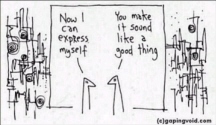
Cartoons drawn in the back of business cards.

There are three ways of being creative. I don’t mean ways of creating, since those are nearly infinite. I mean there are three ways of being a creative person. I know three people that exemplify each way.

The Elusive Poet writes poetry. It is personal, hard to understand, and surrealist. It is very important to him but no one is allowed to read it; sometimes he'll recite a bit to a very close friend. What is important to him is creation. Plenty of people create so that they can “let out” something trapped inside; of course the results can be too personal to show.

My second example is a rapper. Spanish rap has a tiny but fanatical audience, apart from the yearly sudden success created by the whims of the record companies. Toteking has published 2 CDs, one with his brother and the other one solo. Some of his lyrics are personal, some aren’t, and in many, content is next to irrelevant (as opposed to form, which is everything). I haven’t seen him in ages, but as far as I know, he's given at least one concert if not more every week of the last three years. He despises the attitude of creative people who don't try to make money out of their art, which is why he said I should write a novel instead of short stories and poetry. To him everyone who does not try to make a profit from their creativity is either very stupid, or hypocritical, o snobbish. I wonder in which category he puts me.

I don't think either of them is wrong. Guy One enjoys what he does and no one these days is going to become suddenly rich by publishing poetry. Tote has lots of fun, and a bit of money is never a bad thing. Now the third example. That’s me. I don’t know or care if I can make money with what I do. I don’t know very well why I do it. What I do know is that I need it to be seen. I work a lot better and faster with audience and feedback, even if it is negative. Sometimes as I write I think, "is this good enough to show to this or that person?" Other times, someone’s comments on my work inspires even more work.

That's one of the reasons to blog: It seems a wonderful way to let others read me. And you can just click there and say anything, from “your haikus are trash” or recommendations or critiques or anything. Like a public poetry reading without the snobbery (I hope) and the free food (but if you live in Ithaca, that can be fixed: do you want to go out for lunch sometime? Heh).

Come on, let's cut us all into pieces

OK, this is not culture shock as in "Americans are weird" but as in "Some people don't have any feelings at all". I don't think it has anything to do with nationality.

Preventive removal of both breasts reduces chance of breast cancer in women at elevated risk. Women with a moderately elevated risk of breast cancer who underwent surgery to have both breasts removed reduced their risk of getting the disease by about 95 percent, a recent study concludes.

Fine. Just damn fine. And also, people whose legs are cut off do not run any risks of tripping over. I cannot understand who would even think that anyone would go through major, very invasive surgery, that leaves permanent scars for life in a sensitive and emotionally charged part of the body, for prevention.

Are they going to recommend preventive hysterectomy to teenagers? After all, they are at risk of unwanted pregnancy. And, are they going to recommend preventive castration to men who are at high risk of testicle or prosthatic cancer? Yeah. Right. No, I didn't think so either. But one of the side effects of being born with breasts and ovaries, worse than the risk of cancer, is that medicine just does not take you, your needs or your feelings seriously.