
Other people\'s poetry
Villains
To keep up with todays theme, here you have a bit of Shakespeare. I leave you in the very dark company of Richard III and Iago. Richard III enjoys his evil actions, and he can be witty and funny, and you like him even though youre not supposed to. And in most cases, hes evil because that brings him material gain. Iago is bitter and sombre and you dont know or care why hes evil. Hes scary as hell, among other things because making others suffer brings him no real relief. Sometimes I think that all villains in Western literature are nothing more than copies of one or the other. the translations, as usual, are mine.
Richard III, Act I scene 2, 241-251
Was ever woman in this humour woo'd?
Was ever woman in this humour won?
I'll have her; but I will not keep her long.
What! I, that kill'd her husband and his father,
To take her in her heart's extremest hate,
With curses in her mouth, tears in her eyes,
The bleeding witness of her hatred by;
Having God, her conscience, and these bars against me,
And I nothing to back my suit at all,
But the plain devil and dissembling looks,
And yet to win her, all the world to nothing! Ha! (...)
¿Quién sedujo a una mujer de esta manera?
¿Quién conquistó a una mujer de esta manera?
Será mía, pero no por mucho tiempo.
Yo, que maté a su padre y a su hermano,
la he hecho mía cuando más me odiaba,
boca injuriosa, ojos llorosos,
testigos sangrantes de su odio pasado.
Con Dios, su conciencia, y mis fallos contra mí,
y yo sin nada que me diese apoyo,
simple diablo de mirada esquiva,
¡y aún así ganarla, a doble o nada! ¡Ja!
Othello, Act I scene 3 406-423
But for my sport and profit. I hate the Moor:
And it is thought abroad, that 'twixt my sheets
He has done my office: I know not if't be true;
But I, for mere suspicion in that kind,
Will do as if for surety. He holds me well;
The better shall my purpose work on him.
Cassio's a proper man: let me see now:
To get his place and to plume up my will
In double knavery--How, how? Let's see:--
After some time, to abuse Othello's ear
That he is too familiar with his wife.
He hath a person and a smooth dispose
To be suspected, framed to make women false.
The Moor is of a free and open nature,
That thinks men honest that but seem to be so,
And will as tenderly be led by the nose
As asses are. I have't. It is engender'd. Hell and night
Must bring this monstrous birth to the world's light.
Richard III, Act I scene 2, 241-251
Was ever woman in this humour woo'd?
Was ever woman in this humour won?
I'll have her; but I will not keep her long.
What! I, that kill'd her husband and his father,
To take her in her heart's extremest hate,
With curses in her mouth, tears in her eyes,
The bleeding witness of her hatred by;
Having God, her conscience, and these bars against me,
And I nothing to back my suit at all,
But the plain devil and dissembling looks,
And yet to win her, all the world to nothing! Ha! (...)
¿Quién sedujo a una mujer de esta manera?
¿Quién conquistó a una mujer de esta manera?
Será mía, pero no por mucho tiempo.
Yo, que maté a su padre y a su hermano,
la he hecho mía cuando más me odiaba,
boca injuriosa, ojos llorosos,
testigos sangrantes de su odio pasado.
Con Dios, su conciencia, y mis fallos contra mí,
y yo sin nada que me diese apoyo,
simple diablo de mirada esquiva,
¡y aún así ganarla, a doble o nada! ¡Ja!
Othello, Act I scene 3 406-423
But for my sport and profit. I hate the Moor:
And it is thought abroad, that 'twixt my sheets
He has done my office: I know not if't be true;
But I, for mere suspicion in that kind,
Will do as if for surety. He holds me well;
The better shall my purpose work on him.
Cassio's a proper man: let me see now:
To get his place and to plume up my will
In double knavery--How, how? Let's see:--
After some time, to abuse Othello's ear
That he is too familiar with his wife.
He hath a person and a smooth dispose
To be suspected, framed to make women false.
The Moor is of a free and open nature,
That thinks men honest that but seem to be so,
And will as tenderly be led by the nose
As asses are. I have't. It is engender'd. Hell and night
Must bring this monstrous birth to the world's light.
Anacreon
To fit into the day's theme, here is a greek poem, anonymous but in Anacreon's style. Anacreon is one of the earliest authors of lyrical poetry in Western literature and he specialised in poems to erotism, partying and drinking. Sex 'n drugs 'n rock'n'roll indeed. I stle the Spanish translation, and the english one is mine.
Entretejía una vez una guirnalda
y hallé a Amor entre las rosas.
Por las alas lo atrapé,
lo eché en mi vino
y con él me lo bebí.
Y ahora en mi cuerpo aquí por dentro
siento las cosquillas de sus alas.
¿Por qué me enseñas tantas leyes
y argumentaciones de retórica?
¿Qué se me da de tanta verborrea
sin beneficio alguno?
Más bien enséñame a beber
el licor suave de Dionisio,
más bien enséñame a jugar
con Afrodita la dorada.
I weaved a garland once
and found Love among the roses.
I caught him by his wings,
threw him in my wine and drank him.
And now, deep inside me
I feel His tickling wings.
Why do you teach the the Law
and rhetorical argumentation?
What do I care for so many words
that I don't profit from?
I'd rather be taught how to drink
Dyonisus's gentle liquor,
I'd rather be taught how to play
with golden Aphrodite.
Entretejía una vez una guirnalda
y hallé a Amor entre las rosas.
Por las alas lo atrapé,
lo eché en mi vino
y con él me lo bebí.
Y ahora en mi cuerpo aquí por dentro
siento las cosquillas de sus alas.
¿Por qué me enseñas tantas leyes
y argumentaciones de retórica?
¿Qué se me da de tanta verborrea
sin beneficio alguno?
Más bien enséñame a beber
el licor suave de Dionisio,
más bien enséñame a jugar
con Afrodita la dorada.
I weaved a garland once
and found Love among the roses.
I caught him by his wings,
threw him in my wine and drank him.
And now, deep inside me
I feel His tickling wings.
Why do you teach the the Law
and rhetorical argumentation?
What do I care for so many words
that I don't profit from?
I'd rather be taught how to drink
Dyonisus's gentle liquor,
I'd rather be taught how to play
with golden Aphrodite.
Moon River
Today would be Audrey Hepburn's birthday, had she been alive. I looooove her movies. Since this is a poetry blog and I'd rather stay on track, until I write an Ode to Audrey Hepburn, Moon River's lyrics will have to do.
Moon River, wider than a mile,
I'm crossing you in style some day.
Oh, dream maker, you heart breaker,
wherever you're going I'm going your way.
Two drifters off to see the world.
There's such a lot of world to see.
We're after the same rainbow's end--
waiting 'round the bend,
my huckleberry friend,
Moon River and me.
Moon River, wider than a mile,
I'm crossing you in style some day.
Oh, dream maker, you heart breaker,
wherever you're going I'm going your way.
Two drifters off to see the world.
There's such a lot of world to see.
We're after the same rainbow's end--
waiting 'round the bend,
my huckleberry friend,
Moon River and me.
Gabriel Celaya
I could have called the Pamphlet Effect the Celaya effect. I admire Celaya, his poetry and his ideas; the ones who make disasters are his disciples. He wrote this:
Maldigo la poesía concebida como un lujo
cultural por los neutrales
que, lavándose las manos, se desentienden y evaden.
I curse poetry understood as a luxury,
Culture in the hands of the neutrals,
Who look the other way, and get away, and flee.
He was defending the need of writing politically. Good for him.
Maldigo la poesía concebida como un lujo
cultural por los neutrales
que, lavándose las manos, se desentienden y evaden.
I curse poetry understood as a luxury,
Culture in the hands of the neutrals,
Who look the other way, and get away, and flee.
He was defending the need of writing politically. Good for him.
Inga Muscio's Cunt (an example of How Not To Write)
If English is not your native language, you should know that "cunt" is the stronger swearword in the land and it means a womans sexual organs or a person the speaker hates. English, contrary to European Spanish, has some words so strong that very few people uses them, so no Spanish blasphemy can get close. Therefore, giving that word as a book's title, and including a brief explanation of why you prefer to use the word cunt instead of vagina, has a shock value that I cannot translate or understand.
I started reading Inga Muscios Cunt: A Declaration of Independence out of curiosity; I thought it would be a story of swearwords, of how perfectly ordinary words like huswyf (Old English for woman) degenerated into misogynistic ones like hussy (modern English to insult a woman). I forced myself to read it through because something so badly written, so full of stupid generalisations, of dangerous advice, and the occasional good joke, has a perverse appeal. Whatever you do, dont read Cunt. It is a confused mix of opinions on issues such as contraception, abortion, prostitution, menstrual products, sex, rape and the like, that gives feminism a bad name.
I started reading Inga Muscios Cunt: A Declaration of Independence out of curiosity; I thought it would be a story of swearwords, of how perfectly ordinary words like huswyf (Old English for woman) degenerated into misogynistic ones like hussy (modern English to insult a woman). I forced myself to read it through because something so badly written, so full of stupid generalisations, of dangerous advice, and the occasional good joke, has a perverse appeal. Whatever you do, dont read Cunt. It is a confused mix of opinions on issues such as contraception, abortion, prostitution, menstrual products, sex, rape and the like, that gives feminism a bad name.
Book Day!!
I dont like to have purely bilingual posts apart from poetry translations, but Book Day is special. Scroll down for the English version of this entry.
Mi madre siempre ha celebrado el día del libro como si fuera Navidad o el cumpleaños de un miembro honorario de la familia (la biblioteca, claro). Tengo recuerdos borrosos de Días del Libro cuando yo era muy, muy chica. Como mi madre salía del trabajo un par de horas antes de que mi hermano y yo saliéramos del colegio, iba al centro, compraba libros para ella y para nosotros, y al llegar a casa a comer era como una mañana de Reyes. Mis padres no nos hacían regalos fuera de ocasiones señaladas, y mi cumpleaños es casi en Navidad, así que esos libros eran aún más especiales por lo extraordinario de la ocasión.
Años más tarde, mi madre esperaba a la tarde del 23 de Abril o al fin de semana más cercano para llevarnos a mi hermano y a mí de librerías. Yo no devoraría libros como lo hago si no fuera por mi madre. Ahora nos recomendamos libros. Yo le digo cuáles de mis novelones victorianos le pueden gustar y ella me persiguió hasta que me leí Falsa Identidad de Sarah Waters. Que mi propia madre me dé a conocer a Sarah Waters es una buena medida de lo estupenda que es (¿cuántas madres recomiendan a sus hijas novelas de amor de escritoras lesbianas militantes?).
El sábado es el Día del Libro, y yo no voy a estar por aquí un par de días. ¿Qué le puedo recomendar hoy? Pienso en los autores que me gustan, descarto los que ya conoce, y los que no creo que sean de su estilo. Le gustó Caramelo (se lo leyó en español y le gustó tanto que me lo compró en inglés: me tiene malcriada), de una autora chicana que no recuerdo, así que allá van un par de frases de The House on Mango Street de Sandra Cisneros, también chicana:
Siempre nos dijeron que algún día nos mudaríamos a una casa, una casa de verdad que sería nuestra para siempre, y que no nos tendríamos que volver a mudar de año en año. Y nuestra casa tendría agua corriente y las tuberías funcionarían. Y por dentro habría escaleras de verdad, no para llegar a la casa, sino escaleras dentro de la casa, como en la tele. Y tendríamos un sótano y por lo menos tres cuartos de baño, para que cuando fuéramos a bañarnos no tuviéramos que avisar a todo el mundo. La casa sería blanca con árboles alrededor, un patio enorme y césped, pero sin verja. Papa hablaba de esta casa cuando tenía un billete de lotería, y Mama hablaba de la casa cuando nos contaba cuentos antes de ir a dormir.
^^^^^^^^^^^
My mother has always celebrated Book Day as if it was Christmas, or the birthday of an honorary family member (the library, that is). I have vague memories of Book Days when I was a wee child. My mother finished work about two hours before my brother and me finished school, so she would go shopping, buy loads of books for herself and for us, and when we got home it was just like Christmas morning. My parents never gave us presents outside special occasions, and my birthday is in December, so those books were more special because gifts were so rare.
Years later, my mother would wait until the late afternoon or until the weekend to take my brother and me book-shopping. I wouldnt feed on books the way I do now without my mothers influence. Now we recommend books to each other. I tell her which of my Victorian novels shed enjoy and she kept insisting until I read Sarah Waters Fingersmith, which is a good measure of my moms coolness (how many mothers recommend lesbian authors to their daughters?)
Book Day falls on Saturday this year and Im not going to be around for the next couple of days. What can I recommend her today? I think of the authors I like, take out the ones she knows, and the ones that wouldnt be her style. She likes Chicana writers (she read Caramelo in Spanish translation and got it in English for me, isnt she a love?), so here it goes a little fragment of The House on Mango Street:
Thy always told us that one day we would move into a house, a real house with that would be ours for always so we wouldnt have to move each year. And our house would have running water and pipes that worked. And inside it would have real stairs, not hallway stairs, but stairs inside like houses on TV. And wed have a basement and at least three washrooms so when we took a bath we wouldnt have to tell everybody. Our house would be white with trees around it, a great big yard and grass growing without a fence. This was the house Papa talked about when he held a lottery ticket and this was the house Mama dreamed up in the stories she told us before we went to bed.
Mi madre siempre ha celebrado el día del libro como si fuera Navidad o el cumpleaños de un miembro honorario de la familia (la biblioteca, claro). Tengo recuerdos borrosos de Días del Libro cuando yo era muy, muy chica. Como mi madre salía del trabajo un par de horas antes de que mi hermano y yo saliéramos del colegio, iba al centro, compraba libros para ella y para nosotros, y al llegar a casa a comer era como una mañana de Reyes. Mis padres no nos hacían regalos fuera de ocasiones señaladas, y mi cumpleaños es casi en Navidad, así que esos libros eran aún más especiales por lo extraordinario de la ocasión.
Años más tarde, mi madre esperaba a la tarde del 23 de Abril o al fin de semana más cercano para llevarnos a mi hermano y a mí de librerías. Yo no devoraría libros como lo hago si no fuera por mi madre. Ahora nos recomendamos libros. Yo le digo cuáles de mis novelones victorianos le pueden gustar y ella me persiguió hasta que me leí Falsa Identidad de Sarah Waters. Que mi propia madre me dé a conocer a Sarah Waters es una buena medida de lo estupenda que es (¿cuántas madres recomiendan a sus hijas novelas de amor de escritoras lesbianas militantes?).
El sábado es el Día del Libro, y yo no voy a estar por aquí un par de días. ¿Qué le puedo recomendar hoy? Pienso en los autores que me gustan, descarto los que ya conoce, y los que no creo que sean de su estilo. Le gustó Caramelo (se lo leyó en español y le gustó tanto que me lo compró en inglés: me tiene malcriada), de una autora chicana que no recuerdo, así que allá van un par de frases de The House on Mango Street de Sandra Cisneros, también chicana:
Siempre nos dijeron que algún día nos mudaríamos a una casa, una casa de verdad que sería nuestra para siempre, y que no nos tendríamos que volver a mudar de año en año. Y nuestra casa tendría agua corriente y las tuberías funcionarían. Y por dentro habría escaleras de verdad, no para llegar a la casa, sino escaleras dentro de la casa, como en la tele. Y tendríamos un sótano y por lo menos tres cuartos de baño, para que cuando fuéramos a bañarnos no tuviéramos que avisar a todo el mundo. La casa sería blanca con árboles alrededor, un patio enorme y césped, pero sin verja. Papa hablaba de esta casa cuando tenía un billete de lotería, y Mama hablaba de la casa cuando nos contaba cuentos antes de ir a dormir.
^^^^^^^^^^^
My mother has always celebrated Book Day as if it was Christmas, or the birthday of an honorary family member (the library, that is). I have vague memories of Book Days when I was a wee child. My mother finished work about two hours before my brother and me finished school, so she would go shopping, buy loads of books for herself and for us, and when we got home it was just like Christmas morning. My parents never gave us presents outside special occasions, and my birthday is in December, so those books were more special because gifts were so rare.
Years later, my mother would wait until the late afternoon or until the weekend to take my brother and me book-shopping. I wouldnt feed on books the way I do now without my mothers influence. Now we recommend books to each other. I tell her which of my Victorian novels shed enjoy and she kept insisting until I read Sarah Waters Fingersmith, which is a good measure of my moms coolness (how many mothers recommend lesbian authors to their daughters?)
Book Day falls on Saturday this year and Im not going to be around for the next couple of days. What can I recommend her today? I think of the authors I like, take out the ones she knows, and the ones that wouldnt be her style. She likes Chicana writers (she read Caramelo in Spanish translation and got it in English for me, isnt she a love?), so here it goes a little fragment of The House on Mango Street:
Thy always told us that one day we would move into a house, a real house with that would be ours for always so we wouldnt have to move each year. And our house would have running water and pipes that worked. And inside it would have real stairs, not hallway stairs, but stairs inside like houses on TV. And wed have a basement and at least three washrooms so when we took a bath we wouldnt have to tell everybody. Our house would be white with trees around it, a great big yard and grass growing without a fence. This was the house Papa talked about when he held a lottery ticket and this was the house Mama dreamed up in the stories she told us before we went to bed.
This is what I mean when I say "good free verse"
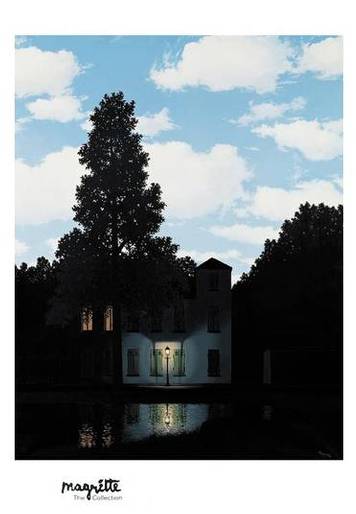 Poem by e. e. cummings, painting by René Magritte.
 the hours rise up putting off stars and it is
dawn
into the street of the sky light walks scattering poems
on earth a candle is
extinguished the city
wakes
with a song upon her
mouth having death in her eyes
and it is dawn
the world
goes forth to murder dreams....
i see in the street where strong
men are digging bread
and i see the brutal faces of
people contented hideous hopeless cruel happy
and it is day,
in the mirror
i see a frail
man
dreaming
dreams
dreams in the mirror
and it
is dusk on earth
a candle is lighted
and it is dark.
the people are in their houses
the frail man is in his bed
the city
sleeps with death upon her mouth having a song in her eyes
the hours descend,
putting on stars....
in the street of the sky night walks scattering poems
Las horas se levantan apagando estrellas y
amanece
en la calle del cielo la luz camina esparciendo poemas
en la tierra una vela se
apaga la ciudad
despierta
con una canción en la
boca tiene la muerte en sus ojos
Y amanece
el mundo
sale a asesinar sueños...
Veo por las calles donde fuertes
hombres están cavando pan
y veo las caras brutales de
gente contenta horrible desesperada cruel feliz
y es de día,
en el espejo
veo un hombre
débil
soñando
sueños
sueños en el espejo
y está
anocheciendo en la tierra
se enciende una vela
y está oscuro.
la gente está en sus casas
el hombre débil está en la cama
la ciudad
duerme con la muerte en la boca tiene una canción en los ojos
Las horas caen,
encendiendo estrellas...
en la calle del cielo la noche camina esparciendo poemas.
And the daffodils look lovely today
 In Aberdeen (Scotland), daffodils are wild flowers, growing like weeds in unexpected places. I have seen them in a dumpster next to the railroad tracks. In Ithaca they are in the process of becoming wild, but it is still possible to guess where people planted them initially. They mostly bloom in polite lines along sidewalks, and they remind me of Aberdeen, making me homesick of a place where I never belonged.
 Wordsworths famous daffodil poem, stereotypically Romantic, verges on Bécquers nauseating sentimentality. Even so, it supported me at one of the toughest times in my life. Here you have a bunch of pretty daffodils, because things are never as hard as they seem. Enjoy.
I wandered lonely as a cloud
That floats on high o'er vales and hills,
When all at once I saw a crowd,
A host, of golden daffodils;
Beside the lake, beneath the trees,
Fluttering and dancing in the breeze.
Continuous as the stars that shine
And twinkle on the milky way,
They stretched in never-ending line
Along the margin of a bay:
Ten thousand saw I at a glance,
Tossing their heads in sprightly dance.
The waves beside them danced; but they
Out-did the sparkling waves in glee:
A poet could not but be gay,
In such a jocund company:
I gazed--and gazed--but little thought
What wealth the show to me had brought:
For oft, when on my couch I lie
In vacant or in pensive mood,
They flash upon that inward eye
Which is the bliss of solitude;
And then my heart with pleasure fills,
And dances with the daffodils.
Mary Dorcey and the problem of minority authors
The cover of Mary Dorceys The River that Carries Me, lying misplaced at the library, looked inviting. The back used words like love and the struggle of women. So I took it, and once at home I read the authors biography inside: it said that Mary Dorcey is a lesbian.
The problem with minority authors that aren't gloriously original, classic and perfect is that the nagging question always remains: would this person be famous in their own right if he or she was not a feminist/ not white/ not Christian? Sometimes the answer is not easy: Id rather read Christopher Marlowe than Aemilia Lanyer, but she was one of a tiny handful of Elizabethan women poets and I have to read her if only for historical reasons (meaning Im more interested in her writings as expression of a female point of view than as art). Other times the reverse is true and a work is disregarded because it was written by a minority writer even though it is brilliant. Zora Neale Hurstons Their Eyes Were Watching God is an example. The world was not ready for a black woman writer in the early 20th century.
Here is something by Mary Dorcey so that you can judge if she belongs to the special point of view group or to the this is good no matter who wrote it select club. It is a bit long, but I didnt want to edit it to give you a better picture. I picked on purpose a poem without obvious lesbian or feminist themes.
This Day I have Turned my Back on Sorrow.
Enough of this.
I have had enough of repining,
Of loss and lament.
Enough.
I want to dance in the street.
I want laughter
Loud days and wild nights.
I will make it up,
If I have to
Until it happens.
I will make it happen
If I have to.
I have had enough of repenting
Of loss
And lament.
I want
Dancing in the streets,
Laughter.
I will go into the fields
And under a white hawthorn tree
Dig a grave
Six foot deep.
Into it I will put
Regret and remorse.
I will cover it up,
Shovel the clay
And lay down my cross.
I have had enough
Of lament
And loss.
After all
I wrote my own story,
Chose my course.
I brought myself
To this edge of the river.
Enough.
It is over;
the sad times
the bleak.
Put behind me.
I have taken what I need
The few things of value
Salvaged from the wreck.
I carry the in my flesh and blood
Until the last day.
Enough of loss and lament.
I want to dance in the street
I want laughter
Luminous mornings, long nights.
It is over,
Finished,
Remorse and lament
I have buried them,
Turned the clay
Six foot deep, under
The white hawthorn tree.
This day
I have turned my back
On sorrow.
The problem with minority authors that aren't gloriously original, classic and perfect is that the nagging question always remains: would this person be famous in their own right if he or she was not a feminist/ not white/ not Christian? Sometimes the answer is not easy: Id rather read Christopher Marlowe than Aemilia Lanyer, but she was one of a tiny handful of Elizabethan women poets and I have to read her if only for historical reasons (meaning Im more interested in her writings as expression of a female point of view than as art). Other times the reverse is true and a work is disregarded because it was written by a minority writer even though it is brilliant. Zora Neale Hurstons Their Eyes Were Watching God is an example. The world was not ready for a black woman writer in the early 20th century.
Here is something by Mary Dorcey so that you can judge if she belongs to the special point of view group or to the this is good no matter who wrote it select club. It is a bit long, but I didnt want to edit it to give you a better picture. I picked on purpose a poem without obvious lesbian or feminist themes.
This Day I have Turned my Back on Sorrow.
Enough of this.
I have had enough of repining,
Of loss and lament.
Enough.
I want to dance in the street.
I want laughter
Loud days and wild nights.
I will make it up,
If I have to
Until it happens.
I will make it happen
If I have to.
I have had enough of repenting
Of loss
And lament.
I want
Dancing in the streets,
Laughter.
I will go into the fields
And under a white hawthorn tree
Dig a grave
Six foot deep.
Into it I will put
Regret and remorse.
I will cover it up,
Shovel the clay
And lay down my cross.
I have had enough
Of lament
And loss.
After all
I wrote my own story,
Chose my course.
I brought myself
To this edge of the river.
Enough.
It is over;
the sad times
the bleak.
Put behind me.
I have taken what I need
The few things of value
Salvaged from the wreck.
I carry the in my flesh and blood
Until the last day.
Enough of loss and lament.
I want to dance in the street
I want laughter
Luminous mornings, long nights.
It is over,
Finished,
Remorse and lament
I have buried them,
Turned the clay
Six foot deep, under
The white hawthorn tree.
This day
I have turned my back
On sorrow.
Mr Money (Poderoso Caballero es Don Dinero)
I said some time ago that Mr Money sounded like such a good name that I had to find the original poem for you. This is one of Quevedos satirical masterpieces; Francisco de Quevedo was a Spanish poet from the 17th century who wrote one picaresque novel, and poetry (love, satirical and romantic), mostly in sonnet form. Something like a Spanish John Donne but with a wild sense of humour. Take away the sense of humour and add Latin syntax and you have Góngora). This is a very free translation of the first stanza; the others have jokes and puns so local or historically bound that they would need footnotes. I stopped there so I don't go to the Hell of Translators, where people have to translate Finnegans Wake for eternity in punishment for their translating mistakes. The complete original can be read here.
Madre, yo al oro me humillo,
Él es mi amante y mi amado,
Pues de puro enamorado
Anda continuo amarillo.
Que pues doblón o sencillo
Hace todo cuanto quiero,
Poderoso caballero
Es don Dinero.
Mother, I kneel before money,
My one and only, my beloved,
Though, fearful of my waywardness
He is forever green-eyed.
And since in all size and colour
Always does what I demand,
Such a powerful gentleman
is my Mister Money.
Madre, yo al oro me humillo,
Él es mi amante y mi amado,
Pues de puro enamorado
Anda continuo amarillo.
Que pues doblón o sencillo
Hace todo cuanto quiero,
Poderoso caballero
Es don Dinero.
Mother, I kneel before money,
My one and only, my beloved,
Though, fearful of my waywardness
He is forever green-eyed.
And since in all size and colour
Always does what I demand,
Such a powerful gentleman
is my Mister Money.
The Poet with his face in his hands
Suzanne passed on to me this poem by Mary Oliver, not knowing that I' m so much against "the Therapy Effect". I like Oliver's take on it not just because I agree with her but also because of her interesting images, although I dislike the broken-line effect.
You want to cry aloud for your
mistakes. But to tell the truth the world
doesn't need anymore of that sound.
So if you're going to do it and can't
stop yourself, if your pretty mouth can't
hold it in, at least go by yourself across
the forty fields and the forty dark inclines
of rocks and water to the place where
the falls are flinging out their white sheets
like crazy, and there is a cave behind all that
jubilation and water fun and you can
stand there, under it, and roar all you
want and nothing will be disturbed; you can
drip with despair all afternoon and still,
on a green branch, its wings just lightly touched
by the passing foil of the water, the thrush,
puffing out its spotted breast, will sing
of the perfect, stone-hard beauty of everything.
El Poeta con la cara entre las manos.
Quieres gritar por tus
errores. Pero la verdad es que el mundo
ya no necesita ese sonido.
Así que si vas a hacerlo y no puedes
impedirlo, si esa boquita no puede
contenerse, por lo menos ve solo, por
cuarenta praderas y cuarenta caídas oscuras
de agua y rocas hasta el lugar donde
las cataratas arrojan sábanas blancas
como locas, y hay una cueva detrás de todo ese
júbilo y diversión acuática y puedes
estar de pie allí debajo y chillar todo lo que
quieras y no molestar; puedes
mojarte en tu desesperación toda la tarde y aún así,
en una rama verde, con las alas apenas rozadas
por el brillo del agua, el tordo,
sacando pecho, le cantará
a la perfecta, durísima belleza universal.
You want to cry aloud for your
mistakes. But to tell the truth the world
doesn't need anymore of that sound.
So if you're going to do it and can't
stop yourself, if your pretty mouth can't
hold it in, at least go by yourself across
the forty fields and the forty dark inclines
of rocks and water to the place where
the falls are flinging out their white sheets
like crazy, and there is a cave behind all that
jubilation and water fun and you can
stand there, under it, and roar all you
want and nothing will be disturbed; you can
drip with despair all afternoon and still,
on a green branch, its wings just lightly touched
by the passing foil of the water, the thrush,
puffing out its spotted breast, will sing
of the perfect, stone-hard beauty of everything.
El Poeta con la cara entre las manos.
Quieres gritar por tus
errores. Pero la verdad es que el mundo
ya no necesita ese sonido.
Así que si vas a hacerlo y no puedes
impedirlo, si esa boquita no puede
contenerse, por lo menos ve solo, por
cuarenta praderas y cuarenta caídas oscuras
de agua y rocas hasta el lugar donde
las cataratas arrojan sábanas blancas
como locas, y hay una cueva detrás de todo ese
júbilo y diversión acuática y puedes
estar de pie allí debajo y chillar todo lo que
quieras y no molestar; puedes
mojarte en tu desesperación toda la tarde y aún así,
en una rama verde, con las alas apenas rozadas
por el brillo del agua, el tordo,
sacando pecho, le cantará
a la perfecta, durísima belleza universal.
Cornell's literary life (once more)
I repeat that I use "poetry" to mean "art". Ysterday I went to a reading of the brilliant Misty Urban, who just won a prize for her short story "The Keeping of the Counts". If that's not poetry I don't know what is. I thought I would cry on a couple of occasions.
It was in a way very typical, predictable in its starting point and suject matter (I don't mean to say that this is a bad thing!!), considering it is coming from an MFA student. As I have said before, Cornell's student literary magazines include a disproportionate number of pieces about families. Pieces that cannot possibly be autobiographical, sometimes. But the main theme seems to be fear of loss or incommunication between close relatives. I don't think that anyone at all on Misty's position in Spain would have even thought of writing about a woman with a 4-year-old very sick son. We prefer to write about peer relationships, or love stories. We rarely find families that interesting, unless they are absolutely hellish, and then we are using them as an excuse for social realism.
Those stories on perfectly normal, slightly tense families (are you reading this from Spain? think of the first half of American Beauty, but without the climax) might be caused by the American sense of isolation and incommunication you get in a country that wants everything bigger better faster now, where people are made to choose between meaningful relationships and competitive careers, with relationships losing (I'm paraphrasing the lovely Autumn Watts here). if that is so, then.why is it that Spaniards on Misty Urban position always write love stories?
It was in a way very typical, predictable in its starting point and suject matter (I don't mean to say that this is a bad thing!!), considering it is coming from an MFA student. As I have said before, Cornell's student literary magazines include a disproportionate number of pieces about families. Pieces that cannot possibly be autobiographical, sometimes. But the main theme seems to be fear of loss or incommunication between close relatives. I don't think that anyone at all on Misty's position in Spain would have even thought of writing about a woman with a 4-year-old very sick son. We prefer to write about peer relationships, or love stories. We rarely find families that interesting, unless they are absolutely hellish, and then we are using them as an excuse for social realism.
Those stories on perfectly normal, slightly tense families (are you reading this from Spain? think of the first half of American Beauty, but without the climax) might be caused by the American sense of isolation and incommunication you get in a country that wants everything bigger better faster now, where people are made to choose between meaningful relationships and competitive careers, with relationships losing (I'm paraphrasing the lovely Autumn Watts here). if that is so, then.why is it that Spaniards on Misty Urban position always write love stories?
Almost like a haiku
Pink Floyd gave the feel and texture of the winter. This spring belongs to e. e. cummings. This cute little poem reminds me a lot of the topics and mood of haikus.
Tumbling-hair
.............Picker of buttercups
........................................violets
dandelions
And the big bullying daisies
..............................through the field wonderful
with eyes a little sorry
Another comes
..............also picking flowers
Pelorrevuelto
.............buscador de ranúnculos
........................................violetas
diente de león
y las margaritas grandes bravuconas
..............................por la pradera maravillosa
con los ojos un poco tristes
Viene alguien
..............también cogiendo flores.
Tumbling-hair
.............Picker of buttercups
........................................violets
dandelions
And the big bullying daisies
..............................through the field wonderful
with eyes a little sorry
Another comes
..............also picking flowers
Pelorrevuelto
.............buscador de ranúnculos
........................................violetas
diente de león
y las margaritas grandes bravuconas
..............................por la pradera maravillosa
con los ojos un poco tristes
Viene alguien
..............también cogiendo flores.
Unavoidable: April is the cruellest month.
Imagine this. May in Southern Spain. Heat, 40 first-year University students taking a survey course in English Literature. Understanding plain English is sometimes a challenge. And about three lectures before the end of the semester, T. S. Eliot's The Wasteland is presented. General hostility follows. It makes no sense.
Although I disliked it initially, it was the second time in my life that someone introdued me to such elegant, fluid free verse, the first time being Pedro Salinas' La Voz a Ti Debida (The Voice I owe to you). Today, a sunny April day with the crocuses starting to bloom, is a perfect occasion to post the opening of The Wasteland.
I. THE BURIAL OF THE DEAD
APRIL is the cruellest month, breeding
Lilacs out of the dead land, mixing
Memory and desire, stirring
Dull roots with spring rain.
Winter kept us warm, covering
Earth in forgetful snow, feeding
A little life with dried tubers.
Summer surprised us, coming over the Starnbergersee
With a shower of rain; we stopped in the colonnade,
And went on in sunlight, into the Hofgarten,
And drank coffee, and talked for an hour.
Bin gar keine Russin, stamm' aus Litauen, echt deutsch.
And when we were children, staying at the archduke's,
My cousin's, he took me out on a sled,
And I was frightened. He said, Marie, 15
Marie, hold on tight. And down we went.
In the mountains, there you feel free.
I read, much of the night, and go south in the winter.
1. ENTERRAR A LOS MUERTOS.
Abril es el mes más cruel, criando
lilas en el yermo, mezclando
memoria y deseo, revolviendo
raíces moribundas con lluvia primaveral.
El invierno nos dio calor, cubriendo
la tierra con nieve olvidadiza, alimentando
un poco de vida con tubérculos secos.
El verano nos sorprendió, llegando al Starnbergersee
con un chaparrón; nos detuvimos en la columnata
y salimos al sol, al Hofgarten,
y tomamos café, y charlamos una hora.
Bin gar keine Russin, stamm' aus Litauen, echt deutsch.
Y cuando éramos pequeños, en casa del archiduque,
mi primo, me llevó en trineo
y yo tenía miedo. Él decía, Marie,
Maríe agárrate fuerte. Y allá que fuimos.
En las montañas te sientes libre.
Paso leyendo casi toda la noche, y viajo al sur en invierno.
Although I disliked it initially, it was the second time in my life that someone introdued me to such elegant, fluid free verse, the first time being Pedro Salinas' La Voz a Ti Debida (The Voice I owe to you). Today, a sunny April day with the crocuses starting to bloom, is a perfect occasion to post the opening of The Wasteland.
I. THE BURIAL OF THE DEAD
APRIL is the cruellest month, breeding
Lilacs out of the dead land, mixing
Memory and desire, stirring
Dull roots with spring rain.
Winter kept us warm, covering
Earth in forgetful snow, feeding
A little life with dried tubers.
Summer surprised us, coming over the Starnbergersee
With a shower of rain; we stopped in the colonnade,
And went on in sunlight, into the Hofgarten,
And drank coffee, and talked for an hour.
Bin gar keine Russin, stamm' aus Litauen, echt deutsch.
And when we were children, staying at the archduke's,
My cousin's, he took me out on a sled,
And I was frightened. He said, Marie, 15
Marie, hold on tight. And down we went.
In the mountains, there you feel free.
I read, much of the night, and go south in the winter.
1. ENTERRAR A LOS MUERTOS.
Abril es el mes más cruel, criando
lilas en el yermo, mezclando
memoria y deseo, revolviendo
raíces moribundas con lluvia primaveral.
El invierno nos dio calor, cubriendo
la tierra con nieve olvidadiza, alimentando
un poco de vida con tubérculos secos.
El verano nos sorprendió, llegando al Starnbergersee
con un chaparrón; nos detuvimos en la columnata
y salimos al sol, al Hofgarten,
y tomamos café, y charlamos una hora.
Bin gar keine Russin, stamm' aus Litauen, echt deutsch.
Y cuando éramos pequeños, en casa del archiduque,
mi primo, me llevó en trineo
y yo tenía miedo. Él decía, Marie,
Maríe agárrate fuerte. Y allá que fuimos.
En las montañas te sientes libre.
Paso leyendo casi toda la noche, y viajo al sur en invierno.
Forges
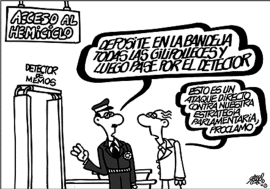 When I say "Other people's poetry" I mean "other people's art". I adore Forges. Its a family tradition, I think. His cartoons are very much culture-specific so its not just a question of translating words but of expressing stuff that you wouldnt understand if you had not in Spain for the last months or years.
 This one expresses wonderfully well the impression that Im getting from the Spanish conservatives as I read what they do on online newspapers:
NOTICE: ACCESS TO PARLIAMENT. FOOL DETECTOR.
Security guy: Place all bullshit on the tray and then pass through the detector.
Conservative Politician: This is a direct attack against our debating strategy, I swear!
Shipbuilding
The Spanish government has just arranged to sell ships and other military equipment to Venezuela. Spanish conservatives yell and despair. The Socialist government points out that the deal will create or secure plnty of employment at the shipyards that the last (Conservative) government endangered. I think it is all very sad.
Elvis Costello wrote this song about the situation of unemployed shipbuilders when England went to war against Argentina over control of the Malvines.
Shipbuilding.
Is it worth it?
A new winter coat and shoes for the wife
And a bicycle on the boy's birthday
It's just a rumour that was spread around town
By the women and children
Soon we'll be shipbuilding.......
Well I ask you
The boy said "Dad they're going to take me to task, but I'll be back by Christmas"
It's just a rumour that was spread around town
Somebody said that someone got filled in
For saying that people get killed in
The result of this shipbuilding
With all the will in the world
Diving for dear life
When we could be diving for pearls
It's just a rumour that was spread around town
A telegram or a picture postcard
Within weeks they'll be re-opening the shipyards
And notifying the next of kin
Once again
It's all we're skilled in
We will be shipbuilding........
¿Merece la pena?
Un abrigo nuevo y zapatos para la parienta
y una bici para el cumple del chico
No es más que un rumor que dicen por ahí
las mujeres y los niños
pronto volveremos a construir barcos
pues verás,
el mayor me dice Papá, me han cogido pero vuelvo a casa por Navidad
No es más que un rumor que dicen por ahí,
alguien dijo que a alguien lo ficharon
por decir que hay gente que se muere
cuando construimos barcos
Con toda la voluntad del mundo
Zambúllete para salvar la vida
cuando podríamos estar buscando perlas
No es más que un rumor que dicen por ahí
un pésame oficial, una postal,
En pocas semanas reabre el astillero
y empiezan las notificaciones a las familias
Otra vez
No valemos pa otra cosa
A construir barcos....
Elvis Costello wrote this song about the situation of unemployed shipbuilders when England went to war against Argentina over control of the Malvines.
Shipbuilding.
Is it worth it?
A new winter coat and shoes for the wife
And a bicycle on the boy's birthday
It's just a rumour that was spread around town
By the women and children
Soon we'll be shipbuilding.......
Well I ask you
The boy said "Dad they're going to take me to task, but I'll be back by Christmas"
It's just a rumour that was spread around town
Somebody said that someone got filled in
For saying that people get killed in
The result of this shipbuilding
With all the will in the world
Diving for dear life
When we could be diving for pearls
It's just a rumour that was spread around town
A telegram or a picture postcard
Within weeks they'll be re-opening the shipyards
And notifying the next of kin
Once again
It's all we're skilled in
We will be shipbuilding........
¿Merece la pena?
Un abrigo nuevo y zapatos para la parienta
y una bici para el cumple del chico
No es más que un rumor que dicen por ahí
las mujeres y los niños
pronto volveremos a construir barcos
pues verás,
el mayor me dice Papá, me han cogido pero vuelvo a casa por Navidad
No es más que un rumor que dicen por ahí,
alguien dijo que a alguien lo ficharon
por decir que hay gente que se muere
cuando construimos barcos
Con toda la voluntad del mundo
Zambúllete para salvar la vida
cuando podríamos estar buscando perlas
No es más que un rumor que dicen por ahí
un pésame oficial, una postal,
En pocas semanas reabre el astillero
y empiezan las notificaciones a las familias
Otra vez
No valemos pa otra cosa
A construir barcos....
e. e. cummings on love and death
The trip to Washington is giving me plenty of opportunities to rant on this insane country, so let's compensate that with some beautiful American poetry. What I like the best from e. e. cummings is the originality of his love poems. Many of the others are good too, and the extremely short ones are very original, but to me nothing beats the love declarations, such as this one. Even so, its defence of the value of love above, beyond, after, and in spite of death is better understood in the context of his sadder poems on mortality.
Thy fingers make early flowers of
all things.
thy hair mostly the hours love:
a smoothness which
sings,saying
(though love be a day)
do not fear,we will go amaying.
thy whitest feet crisply are straying.
Always
thy moist eyes are at kisses playing,
whose strangeness much
says;singing
(though love be a day)
for which girl art thou flowers bringing?
To be thy lips is a sweet thing
and small.
Death,Thee i call rich beyond wishing
if this thou catch,
else missing.
(though love be a day
and life be nothing,it shall not stop kissing).
Los dedos de vos hacen flores tempranas de
todas las cosas.
El cabello de vos lo aman especialmente las horas:
una suavidad que
canta,diciendo
(aun si el amor es un día)
no tengas miedo,iremos a la feria.
los blanquísimos pies de vos vagabundean frescamente.
Siempre
vuestros húmedos ojos juegan a los besos,
cuya rareza mucho
dice,cantando
(aun si el amor es un día)
¿para qué chica traéis flores?
Ser los labios de vos es algo dulce
y pequeño.
Muerte,a Vos os llamo rica más allá de todo lo deseable
si atrapas esto,
lo demás perdiendo.
(aun si el amor es un día
y la vida nada,no dejará de besar).
Thy fingers make early flowers of
all things.
thy hair mostly the hours love:
a smoothness which
sings,saying
(though love be a day)
do not fear,we will go amaying.
thy whitest feet crisply are straying.
Always
thy moist eyes are at kisses playing,
whose strangeness much
says;singing
(though love be a day)
for which girl art thou flowers bringing?
To be thy lips is a sweet thing
and small.
Death,Thee i call rich beyond wishing
if this thou catch,
else missing.
(though love be a day
and life be nothing,it shall not stop kissing).
Los dedos de vos hacen flores tempranas de
todas las cosas.
El cabello de vos lo aman especialmente las horas:
una suavidad que
canta,diciendo
(aun si el amor es un día)
no tengas miedo,iremos a la feria.
los blanquísimos pies de vos vagabundean frescamente.
Siempre
vuestros húmedos ojos juegan a los besos,
cuya rareza mucho
dice,cantando
(aun si el amor es un día)
¿para qué chica traéis flores?
Ser los labios de vos es algo dulce
y pequeño.
Muerte,a Vos os llamo rica más allá de todo lo deseable
si atrapas esto,
lo demás perdiendo.
(aun si el amor es un día
y la vida nada,no dejará de besar).
Some Irish fun
Excuse me if I give you something appropriate for St Patricks Day two days too late, but my St. Patricks celebration started on Wednesday and finished yesterday(heh heh), so to me this still counts. I could give you Yeats but I dont like it that much. I could give you James Joyce, but after these days fun, Im in the mood for parties and song. So, I offer you some Irish music. It's Father's Day in Spain and my father likes to compile different versions of the same song, so this is perfect for today.This is a traditional Irish song that I know in five versions: Kate Rusby, The Corrs, Marianne Faithful, Sinéad OConnor and Martyn Bennett sampling someone from a couple generations back. Id like to have more variations on the same theme, but singers have the habit of recording just a fragment of the song and changing the name every time. Mine are called I Wish, I Know my Love, Love is Teasin, The Butcher Boy and Blackbird! Versions can be dramatically different. Marianne Faithful and Martyn Bennetts singer sound sad and bitter; Kate Rusby is sad, but her changes in the lyrics and the way she sings underline, ehem, how she stopped being a maid. The Corrs sound as if they were having so much fun they dont believe for one second the boy doesnt love them; Sinead sings about a suicide. Of course, mine is my own personal version, a recycling of the bits I like in the others with one or two extra changes. To me, this is a drunken, party song: a translation into Spanish would have to be in slang or dialect, and I dont dare.
I wish I was, I wish in vain,
I wish I was a maid again
But a maid again I can never be
Until oak was to grow up an ivy tree.
For love is teasin, and love is pleasin,
And love is a treasure when first its new
But as love grows older, then love grows colder,
And it fades away like the morning dew.
There is an alehouse on yonder town
where my love goes and there sits down,
he takes a strange girl on his knee
well dont you think that vexes me?
There is a blackbird on yonder tree,
Some say its blind and it cannot see,
I wish it was the same with me,
And then of love I would be free.
I wish I was, I wish in vain,
I wish I was a maid again
But a maid again I can never be
Until oak was to grow up an ivy tree.
For love is teasin, and love is pleasin,
And love is a treasure when first its new
But as love grows older, then love grows colder,
And it fades away like the morning dew.
There is an alehouse on yonder town
where my love goes and there sits down,
he takes a strange girl on his knee
well dont you think that vexes me?
There is a blackbird on yonder tree,
Some say its blind and it cannot see,
I wish it was the same with me,
And then of love I would be free.
Alan Spence gets it right as usual
First warmth of spring.
I feel as if
I have been asleep.
Primer rayo tibio de la primavera.
Una sensación como
haber estado dormido.
No, not spring yet, not officially. But in this grey snowy winter, if it is sunny it is a nice day, even when the temperature is close to 0º C. And thats a happy poem, and Im happy. So there you go.
I feel as if
I have been asleep.
Primer rayo tibio de la primavera.
Una sensación como
haber estado dormido.
No, not spring yet, not officially. But in this grey snowy winter, if it is sunny it is a nice day, even when the temperature is close to 0º C. And thats a happy poem, and Im happy. So there you go.