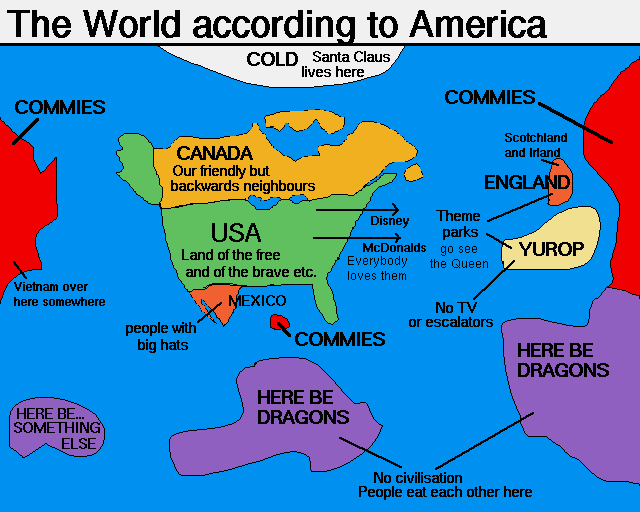
Because the blogosphere needs haikus.
On Poetry and Culture Shock
Se muestran los artículos pertenecientes al tema Culture Shock (Comedy of manners).
La agencia EFE cuenta que dos españolas han quedado segundas en un concurso de disfraces en Japón. A muchos japoneses les encanta el "cosplay", que consiste simplemente en disfrazarse de muñecos de manga o anime. Lo primero que me sorprende es que se insista en que "disfrazarse de personaje manga o anime" sea una actividad muy distinta de "disfrazarse", y requiera complicados nombres, aunque supongo que me estoy perdiendo los detalles.
Me hace gracia que se disfrazaran de Candy Candy, una serie que estaba muy de moda cuando yo era una niña pequeña. Quizá las ganadoras son de mi generación. Pero no es que tengan una mentalidad muy de ganadoras, más bien de mendigas. Demuestran una actitud tristemente muy española cuando dicen: "Hemos recibido alguna ayuda, pero la mayor parte de la participación nos la hemos costeado nosotras. Otros muchos países dan apoyo económico".
Ah. Sí, claro. No es justo que te tengas que pagar los hobbies tú sola, ¿no, bonita? Necesitas una subvención del Ministerio de Cultura. Me parece muy necesario que las instituciones públicas subvencionen y ayuden a los artistas, pero harta que todo el que tenga una actividad remotamente relacionada con el ocio crea que hay que pagarle por ello.
****
EFE reports that two Spanish women have ended in second position in a costume contest in Japan. Many Japanese people enjoy "cosplay", which consists simply of dressing up as manga characters. The first thing I find shocking is that anyone would think that "dressing up as a manga character for fun" is a different activity than simply "dressing up", although I’m probably missing the fine details.
What makes me post this and what shows the extremely Spanish mentality of the cosplayers, is this quote (I translate): "We have received some help, but we’ve paid for most of our participation. Many other countries give economic support".
Oh. Yeah. Right. It is not fair that you have to pay for your hobbies yourself. You need state support, and a grant from the Ministry of Culture. I’m all for public support of the arts, but it is so tiring and discouraging that everyone who wants to do something remotely connected to leisure and culture feels entitled to public help.
A definite sign that I spend way too much time working on the computer is that when I made a small mistake in the kitchen I visualised the Undo button in the upper-left of my field of view.
^^^^^^^^^^^^^^^^^^^^^^^^^^^^
La señal clara y definitiva de que paso demasiado tiempo al ordenador es que cuando hoy me equivoqué en algo en la cocina, visualicé el botón de Deshacer, arriba a la izquierda en mi campo de visión.
Overheard a second ago; it's hard to translate this into English, but you get the idea:
-Bastard!! Faggot!! Immigrant!!
^^^^^^^^^^^^^^^^^^^^^^^^^^^^^^^^^^
Oído hace un momento, tal cual:
-¡Hijo de puta! ¡Maricón! ¡Inmigrante!
On a cafe's toilet door:
IF I HAD THE TIME,
I WOULD LOVE YOU.
^^^^^^^^^^^^^^^^^^^^^^^^
En la puerta del servicio de una cafetería:
SI TUVIERA TIEMPO
TE QUERRÍA.
From PC Bloggs, but the emphasis is mine.
1.
Incident: Caller reporting her
17-year-old daughter was raped last night by two named offenders after going out drinking at her local pub. Daughter is very distressed and sore.
Update from supervisor: Officers to attend and establish the following:
1. Is the daughter making an allegation?
2. Names and descriptions of alleged offenders.
3. How much alcohol was consumed?
4. If allegation is being made, locate scene.
5. Will the victim attend court?
6. If allegation could be true, will she consent to a medical?
2.
Incident:Caller reporting her
18-year-old son was raped last night by a male known to him, following a party at his house. Son is in pain and upset.
Update from supervisor:Officers to attend and establish the following:
1. Locate the crime scene.
2. Arrange medical examination and take victim to rape suite.
3. Name/description of offender.
4. Preserve forensic evidence, seize clothing.
It's not the first time that I'm shocked by British attitudes on rape, and I know that things are worse in other parts of the world, but seriously guys, you invented the modern police and the modern detective story. We want to believe that the British police, of all security forces in the world, is doing some sort of a decent job. This is such a disappointment.
^^^^^^^^^^^^^^^^^^^^^^^^^^^^^^^^^^^^^^^^^^^^
Esto es de PC Bloggs, pero el énfasis es mío.
1. Incidente:
El denunciante declara que su hija de 17 años fue violada la noche anterior por dos hombres, a los que nombra, tras haber acudido a un pub de la zona. La hija presenta lesiones y daño emocional.
Del Supervisor:
Los agentes deben personarse y establecer lo siguiente:
1. ¿La hija va a presentar una denuncia?
2. Nombre y descripción de los supuestos agresores.
3. ¿Cuánto alcohol se consumió?
4. Si se va a presentar denuncia, localizar lugar de los hechos.
5. ¿La víctima asistiría al juicio?
6. Si la denuncia es verdadera, ¿va a someterse voluntariamente a reconocimiento médico?
2. Incidente.
El denunciante declara que su hijo de 18 años fue violado la noche anterior por un conocido, después de una fiesta en su casa. El hijo presenta lesiones y daño emocional.
Del Supervisor:
Los agentes deben personarse y establecer lo siguiente:
1. Localización de la escena del crimen.
2. Pedir hora para examen médico y llevar a la víctima al mismo.
3. Nombre/Descripción del agresor.
4. Conservar pruebas forenses, incautar la ropa.
No es la primera vez que me escandalizo con la actitud británica hacia las violaciones, y sé que la cosa está peor en otras partes del mundo, pero en serio, tíos, ¡que os inventasteis la policía moderna! ¡y las novelas de detectives! ¡No me decepcionéis así a estas alturas!
A photo has caused Microsoft to close down a Window Live Space, "El ojo de Guadix" because they considered that it was pornographic. The photograph, a close-up of the face of a woman breastfeeding, has recently won a prize on a photographic competition on breastfeeding by a hospital in Spain.
The moral of the story to me is not, as Zifra's source point out (links in Spanish), that Americans have dirty minds. The moral is that before you get a blog, you should read the terms and conditions of the blog provider you're considering, and if they say that partial nudity equals pornography and that they don't allow pornography in their blogs, please go and get a blog somewhere else. Not because you want to post porn, but because maybe one day you will want to post an arty photograph and the blog will be killed for that reason.
The conditions in this blog are ideal because all I have to do is comply with Spanish law. I can't promote terrorism, any sort of discrimination, or show child porn. That's about it. I'm not so happy about my other blog, because the conditions are too vague.
On a more visceral level, news like this make me want to have a baby ASAP and breastfeed her in public just to annoy dirty minded people.
UPDATE: The photographer gave up all rights on the picture to the organisers of the price she won, but now that bloggers have made her famous she demands we pay reproduction rights. That is why I have taken out the picture and her name.
^^^^^^^^^^^^^^^^^^^^^^^^^^^^
Una foto ha hecho que Microsoft cerrara el Window Live Space "El Ojo de Guadix" porque consideraron que era pornográfico. La foto ha ganado un premio de un hospital español por su promoción de la lactancia materna.
La moraleja no es, como dice la fuente de esto, que los Americanos tienen mentes sucias. La moraleja es que antes de hacerte un blog más te vlae que leas las condiciones generales no vaya a ser que por poner fotos de la playa con el bikini te cierren el quiosco. Infórmate antes de firmar, en esto como en todo.
Por lo que pueda servir, las condiones de Blogia son inmejorables porque lo único que hay que hacer es cumplir las leyes españolas: ni porno infantil, ni apología del terrorismo ni promoción de la discriminación. Lo demás es campo libre. Sin embargo, reconozco que las condiciones de mi otro blog son malas porque son demasiado vagas.
A un nivel más visceral, esta clase de noticias me dan ganas de tener un bebé y darle el pecho en público para fastidiar a la mente de mente retorcida.
NOTA: la fotógrafa cedió los derechos de la foto a los organizadores de la competición que ganó, pero ahora que los blogueros la hemos hecho famosa, quiere que le paguemos derechos a ella, por lo que prefiero eliminar su nombre y la imagen.
I have been to many clubs and many concerts in my life. Isn't it shocking that the only time someone apologised for spilling a drink on me and made sure the damage was minimal was yesterday, at a gothic rock / heavy metal concert? Gothics are such lovely polite babies.
^^^^^^^^^^^^^^^^^^^^^^^^
Después de haber estado en muchos bares, discotecas y conciertos, ayer me quedé sorprendida cuando por primera vez en mi vida alguien se disculpó por echarme encima su bebida y comprobó que no me había manchado mucho. Lo raro es que fue en un concierto doble, de rock gótico y de heavy. Qué bien educaditos están los góticos, ¿no?
The problem of believing in epic, soulmate-type frienship is that it can be easily dissapointed. That has happened to me several times in the last few months. One of my disappointments is as epic as the friendship used to be; another one is a rather silly series of very small accumulated offenses. It was refreshing to listen to these words a couple of days ago:
You can't choose your friends; the most you can do is to choose who you refuse to go for a coffee with, and that's an awkward thing to do because it is very convenient to have many people available for a coffee with you.
Edited to add: I wanted you to read those words without prejudices and that's why I didn't mention the speaker. I heard them from Felipe González, former Spanish President.
^^^^^^^^^^^^^^^^^^^^^^^^^^^^^^
El problema de creer en amistades épicas para toda la vida es que más dura será la caída cuando salen mal. He pasado por dos de esas decepciones en los últimos meses: una tan épica como lo fue la amistad (aunque haya quien diga que se veía venir) y otra que es más bien una serie muy larga de ofensas pequeñísimas (aunque habrá quien diga que la que es inaguantable soy yo). Fue un respiro escuchar estas palabras tan inteligentes hace un par de días.
No se escoge a los amigos; como mucho se escoge con quién no se toma café, y eso es incómodo porque es práctico tener mucha gente con la que tomar café.
Postdata: no indiqué el autor de tan sabias palabras porque quería que las leyerais sin ideas preconcebidas. Son de Felipe González.
In Spain, there are many monasteries and convents dedicated to comtemplation. Traditionally, the nuns and monks never went out, but currently, depending on their Order, they can leave the building for justified causes that aren't always emergencies. For the last century or so, they have had to support themselves because people didn't give them big donations anymore. So, the nuns often turned an activity that provided gifts for big donors in important occasions into full-time jobs. This is why many sweets made by nuns are well-known in my area. Certain recipes tend to be associated with certain Orders or convents who have done them for decades.
You can go and buy a box of biscuits or marzipan at a convent, but today I have discovered a new way to get a sugar fix. A website selling only convent-made food. Rose petal jam, anyone?
^^^^^^^^^^^^^^^^^^^^^^^^^^^^
Me imagino que todo el mundo sabe que aunque estén bastante escondidos y sean discretos, aún quedan muchos monasterios y conventos de clausura en España. Tradicionalmente las monjas y monjes no salían nunca a la calle, pero desde hace años, dependiendo de la Orden, sí salen si lo necesitan, no necesariamente en una emergencia grave. Desde hace más o menos un siglo, necesitan mantenerse económicamente con su trabajo (antes les bastaba con donaciones y limosnas). Los dulces de las monjas que se pueden comprar en lugares con esa tradición son recetas que antes sólo preparaban para hacer regalos a sus grandes benefactores.
Ahora puedes ir a un convento y llevarte una caja de mazapanes, pero hoy he descubierto por casualidad una nueva manera de endulzarse la vida: una página web dedicada exclusivamente a comida elaborada en conventos. ¿alguien quiere una mermelada de azahar , por ejemplo?
There is a Spanish saying, "to mix speed and bacon", where speed means velocity not a drug, which means "to draw very wrong conclusions because you assume that unrelated things are related". This is something that maybe RaveN or the Testblog guys would have blogged, since weirdness-and-computers is more their field than mine, but I can't resist.
A website for the Christian geek. Hey, they can't be that bad, they use Linux!
^^^^^^^^^^^^^^^^^^^^^^^^
Esto sí que es mezclar la velocidad con el tocino. Es la clase de cosa que bloguearían RaveN o los chicos de Testblog, que están más puestos que yo en líos frikis, pero no me resisto:
Una web frikocatólica. Como lo oyes. No pueden ser tan malos, si están usando y promocionando Linux, ¿no? (y la verdad es que quiero una o dos camisetas, pero no os voy a decir cuáles)
I don't measure this blog's birthday according to a day of the month because it's easier to remember that I started in on Thanksgiving Day, 2004. So we are two years old today, two years that started with a lot more culture shock and a horrible template. The proportion of commedy of manners and poetry and this template have been the only major changes. It makes sense because I had considered the idea of a blog for long enough, so when I started I had a clear Idea of what I wanted to do with it.
Happy Thanksgiving to those who celebrate it, and to everyone, thanks for coming.
^^^^^^^^^^^^^^^^^^^^^^^^^^
No mido los cumpleaños del blog según el día del mes porque es más fácil recordar que empecé el Día de Acción de Gracias del 2004. Así que hoy cumplimos dos añitos, que empezaron con muchos más posts sobre choque cultural y con una plantilla espantosa. La proporción de comedia / poesía y esa plantilla son los únicos cambios grandes que ha habido, quizá porque pensé en hacerme un blog durante mucho tiempo y así, cuando lo hice, tenía una idea clara de qué quería hacer con él.
Feliz Día de Acción de Gracias a quienes lo celebren, y a todos, gracias por venir.
The way Spanish women have children, and the way the work market treats them during and after the process, could be culture-shocking to foreign readers. Americans, for example, might be envious that we get four full months of maternity leave. Great, isn't it? The problem is that it's very hard to keep a job if you get pregnant, because your bosses will fire you if they can. Spanish Law says that they need a good cause to do so, so they normally allude to "low performance", a legitimate cause to fire people. Of course, if you get a job that pays you enough to kmake you think that you can afford a baby, and they fire you on grounds of low performance immediately after you come back from your maternity leave, you can consider yourself lucky that you got a job in the first place, being a young and therefore marriageable, fertile woman. Friends of mine in their twenties have been asked if they had boyfriends, husbands, plans of having babies, in job interviews. It's supposed to be illegal, I think.
For the last year or so, Spanish law allows the father of a baby to take a paternity leave of 10 weeks. This means that now, according to my newspaper, Miquel Mitjans has the chance of knowing how it feels being a woman: that is, being punished for having a family.
Mr Mitjans got a rise immediately before the summer. He had his holidays in the month he applied for (the law says you can have your holidays but the company decides when, unless they are very happy with your work). The company he works for sent flowers to his wife at hospital, in July. Before his holidays, he applied for paternity leave. The first work day after his holidays, he was fired for "low performance" and he was accused of having missed work three days in June, a claim that can be easily proved false because there is an attendance diary. Do you see a few incoherences here?
I'm very sorry for Mr. Mitjans, and sorry for the way his bosses think. The problem is that the law wanted to make people more equal, giving men a women's right so that companies wouldn't discriminate against either. But it turns out this is no longer discrimination about women, but against people who behave like women traditionally do, and against families, and against men who want to be more that the breadwinner, and against people who think that their jobs come after their lives and not the other way around. Shame.
^^^^^^^^^^^^^^^^^^^^^^^^^^^^^^
Un rápido resumen de la situación de las mujeres trabajadoras en España: es estupendo contra con una baja por maternidad de cuatro meses, pero claro, es difícil conservar un trabajo si te quedas embarazada, porque tus jefes te echarán si pueden, aludiendo a “bajo rendimiento”. Aunque bueno, si tienes un trabajo que puedas perder ya tiene suerte, porque difícil será que te contraten si eres una mujer en edad fértil. Damos miedo. Tengo amigas de ventimuchos a las que preguntan en las entrevistas de trabajo si tienen novios, maridos, y planes de tener hijos.
Desde hace más o menos un año, la ley española permite a los padres cogerse un permiso de paternidad de diez semanas. Eso quiere decir que desde ahora, según mi periódico, Miquel Mitjans ha tenido la oportunidad de saber qué se siente cuando se es una mujer: es decir, cuando el mundo te castiga por tener una familia.
Este señor consiguió un ascenso antes del verano. Se fue de vacaciones el mes que pidió (sabéis que las empresas te dan las vacaciones cuando a ellos les da la gana, a menos que les caigas bien), y la empresa para la que trabajan¡ba le mandó flores a su mujer al hospital, en Julio. Antes de las vacaciones, pidió permiso de paternidad. El primer día de trabajo, lo echaron por bajo rendimiento, y lo acusaron de haber faltado al trabajo tres días de Junio, algo falso y fácilmente demostrable porque hay un control. ¿Veis unas cuantas incoherencias, o soy sólo yo?
Lo siento muchísimo por Miquel Mitjans, y por la forma en la que piensan sus jefes. El problema es que la ley quería igualar a la gente, dándole a los hombres un derecho de las mujeres para que las empresas ya no pudieran discriminar. Pero ahora resulta que la discriminación no es sólo contra las mujeres, sino contra hombres que se porten como tradicionalmente lo han hecho las mujeres, y contra las familias, y contra los hombres que quieran ser más que el que trae dinero a casa, y contra la gente que intenta que primero venga la vida y luego el trabajo y no al revés. Qué triste.
Yesterday I was listening to Sting's classic song (yes, classic: I was born in 1977 and my father was a Sting / Police fan in the early eighties, so everything Sting did up to the year 2000 is canonical rock history, right?) Russians and it struck me how little the world has changed in some respects... and how much in some others. This song, about the futility of Cold War and the hoarding of nuclear weapons, was released in 1985, twenty years ago and four years before the end of the Cold War. Back then, I was old enough to watch the news but not old enough to understand much of what had gone on in the previous thirty years. The central issue was that we on the West side of the divide seriously believed that if one day, the American or the Russian president woke up in the wrong kind of mood, a bomb would make us all burst in the air in little bits. We also thought that the rulers on our side of the divide took the matter too seriously and that it was just not possible that the people at the other side was as monstruous as the media sometimes presented them. I have no idea of how normal people felt in the UK or in North America, but I guess their view were a little more polarised and less sympathetic to Russians than ours.
Let's jump to 2006. We have even scarier worries than the nuclear bomb, at least to me. A nuclear bomb would come with some sort of warning, but the current version of the cold war, the absurd war between some practitioners of Islam and Western countries, has taken the form of a constant threat of terrorism, coming without warning, and attacking the most vulnerable and powerless people with the intention of intimidating the powerful. Shockingly useless.
I think there is hope because the biggest difference between the Cold War, 1945-1989, and the War on Terrorism, 2001-present, is that in the 21st century there are lots of people on both sides of the divide with a serious interest on the other side's culture. Twenty or thirty years ago it would have been hard to show an interest in Russian culture in the West, and doing so would have been a brave political act; nowadays, at least in some circles, we can talk about many fascinating cultural aspects of Islam and Islamic countries. That much we have learnt.
"Russians"
In Europe and America, there's a growing feeling of hysteria
Conditioned to respond to all the threats
In the rhetorical speeches of the Soviets
Mr. Krushchev said we will bury you
I don't subscribe to this point of view
It would be such an ignorant thing to do
If the Russians love their children too
How can I save my little boy from Oppenheimer's deadly toy
There is no monopoly in common sense
On either side of the political fence
We share the same biology
Regardless of ideology
Believe me when I say to you
I hope the Russians love their children too
There is no historical precedent
To put the words in the mouth of the President
There's no such thing as a winnable war
It's a lie that we don't believe anymore
Mr. Reagan says we will protect you
I don't subscribe to this point of view
Believe me when I say to you
I hope the Russians love their children too
We share the same biology
Regardless of ideology
What might save us, me, and you
Is that the Russians love their children too.
^^^^^^^^^^^^^^^^^^^^^^^^^^^^^^^^^^^^^^^^^^
Ayer iba yo conduciendo y escuchando el clásico de Sting (sí, clásico: nací en el 77 y mi padre era fan de Sting y de The Police así que todo lo que hiciera Sting hasta el 2000 más o menos es historia del Rock, ¿está claro?) “Russians”, y me llamó la atención lo poco que el mundo ha cambiado en unas cosas, y cuánto en otras. Esta canción, sobre la inutilidad de la Guerra Fría y de los arsenales nucleares, es del 85: hace 20 años, y cuatro antes del fin de la Guerra Fría. Por entonces yo tenía edad de ver las noticias, pero no era lo bastante mayor para poder entender casi nada de lo ocurrido los treinta o cuarenta años anteriores. El problema central parecía ser que los que estábamos al Oeste de la raya creíamos que si el presidente ruso o el americano se levantaban por el lado malo de la cama, una bomba nos haría estallar a todos en cachitos. También creíamos que nuestros gobernantes se tomaban las cosas demasiado en serio y que no era posible que la gente del otro lado de la raya fuera tan terrible como nos la pintaban. No tengo ni idea de cómo se sentía la gente normal en el Reino Unido o en Norteamérica, pero supongo que sus opiniones eran un poco más extremas y menos interesadas en los rusos que las nuestras.
Salto a 2006. Tenemos problemas que a mí al menos me dan más miedo que la bomba atómica. Una bomba nuclear nos imaginamos que vendría con alguna clase de aviso, y la destrucción sería completa e inevitable. En cambio, la situación que tenemos, en forma de una amenaza constante de terrorismo, viene a atacar a las personas más vulnerables y sin poder alguno, con el fin de intimidar a quienes sí tienen poder. Absurdo, inútil.
Sin embargo, creo que hay esperanza porque la mayor diferencia entre la Guerra Fría, 1945-1989, y la Guerra Contra el Terrorismo, 2001-presente, es que en el siglo XIX hay mucha gente a ambos lados de la Raya con un interés serio en la cultura del otro lado. Hace veinte o treinta años habría sido peligroso mostrar un gran interés en la cultura rusa. Hoy día, al menos en algunos círculos, podemos hablar de muchos aspectos fascinantes de la cultura relacionada con el islamismo y los países islámicos. Es una mejora.
I've said it many times and I will say it again: I'm sick and tired of my University's libraries.
Yesterday I went to the English and Spanish Departments' Library, a research library with very few reading space. It works like a pharmacy: you search on a computer for a book's ID code, you give this code number to the librarian, who sometimes is just a student with an internship and maybe a few hours of training (last year there was an unbelivably rude young man and I do hope he was not a professional librarian). The librarian has no idea of the book's title, and doesn't want to know. S/he looks for the ID code you've given, and brings the book to you.
If you think you need to look at the real books because you don't know what exactly you're looking for, a professor can give you an authorisation that the library will file and then you can have relatively free access to the shelves. It is considered a rare privilege. Last year I had such a privilege, and because I am a graduate student, and grad students tend to be around for a long time working on the same project, I assumed that last year's authorisation would still be valid.
Hah.
The librarian believed I had had a permit, but she said it needs renovation, and she said that from now on the librarian will always come and chaperone me as I browse the shelves. I explained that I can easily be up there with the books for half an hour at a time, and on the afternoon shift there is only one member of staff for the whole library. Who will deal with the public coming and going if the librarian is watching me? This enlightened young person answered that if I want to be upstairs alone because that was the norm last year, I should speak with the Head Librarian, or the English Literature Librarian (my field), because she is the Spanish Literature librarian and she wouldn't know how to deal with me.
Then I asked to consult a book that cannot be checked out of the library and I took a seat that coincidentally gave me a very good view of her computer screen. She spent the following 50 minutes watching Youtube at full volume. I had felt so troublesome that I didn'tdare asking her to turn it down.
^^^^^^^^^^^^^^^^^^^^^^^^^^^^^^^^^^
Lo he dicho muchas veces y lo volveré a decir. Estoy harta de las bibliotecas de mi universidad. Ayer fui a la biblioteca que comprarten los departamentos de lengua y literatura inglesa con los de española, una librería pensada sólo para sacar libros, on muy poco espacio de consulta. Funciona, como casi todas en la Universidad, como una farmacia: no te dejan ver lo que vas buscando, sino que en un ordenador buscas el código del libro que te interesa, le das este número al bibliotecario, que en ocasiones es un estudiante con una beca y algunas horas de entrenamiento (el año pasado habia un chico increíblemente maleducado y espero que por favor no fuera un profesional). El personal nunca sabe los títulos de los libros, ni falta que les hace. Buscan el libro con el código que les has dado y te lo traen.
Si crees que necesitas mirar los libros en la estantería porque no sabes exactamente qué vas buscando, un profesor te puede hacer una autorización, y entonces tienes un acceso relativamente libre a los estantes. Se considera un privilegio bastante escaso y especial. Yo lo tuve el año pasado, y como soy doctoranda, y los doctorandos suelen estar dnado vueltas por el edificio unos cuantos años, di por hecho que el permiso aún valía.
Ja.
La bibliotecaria creía que yo tenía un permiso, pero dijo que tenía que renovarlo, y dijo que de ahora en adelante el personal subiría a vigilarme mientras yo mirara los estantes. Cuando le dije que puedo pasarme allí mirando libros media hora seguida, y que por las tardes hay una sola persona y que si me vigilaban el mostrador quedaría desatendido, la bibliotecaria me dijo que si quiero que me dejen sola, que hable con la jefa, o con la bibliotecaria de inglés (mi área de investigación), porque ella es del departamento de español así que mejor que la duda la resuelva alguien de inglés.
Entonces pedí consultar un libro que no se puede sacar de la biblioteca, y por casualidad me senté en un sitio donde podía ver perfectamente la pantalla de su ordenador. Se pasó los siguientes 50 minutos viendo Youtube con el volumen al máximo. Me daba tanto corte haberle complicado tanto la tarde que no me atreví a pedirle que lo bajara.

I have nothing else to add.
Anyone would think that Spain woke up one morning to find that all the women had become nordic. At least that's what you'd guess if you saw the news over here. For a while now, there are two types of faces you can see on TV news:
The Letizia: Long face, long nose, fine chin, slightly Greco-like, with dark blond, highlighted hair. Long hair with long layers is a must. There was Letizia, but also Marta Reyero. And more.
The Helena Resano: Eyes as light as humanly possible, ice green or ice-blue. Hair MUST be short, and sprayed stiff in all directions (the effect you're looking for is fingers-on-electric-socket). There's María Casado, and also Raquel Martínez (can't find a recent photo)
I'm exaggerating a bit; in the page I'm linking for Marta Reyero (blandness personified as a news anchor) there are a couple women with darker, more normal hair (even so, they can't escape the Letizia haircut), but it's summer and my three neurones can't do much more.
^^^^^^^^^^^^^^^^^^^^^^^^^^^^
Se diría que las mujeres españolas se levantaron una mañana y resultaron ser todas nórdicas. Al menos es lo que se puede deducir si se ve cualquier noticiario. Hace algún tiempo que en las noticias de televisión se ven dos clases de presentadoras:
El modelo Letizia : Cara larga, nariz larga, barbilla fina, una pintura del Greco toda ella, con el pelo castaño claro y mechas rubias. Es imprescindible el corte de pelo laaargo y con capas largas. Estaba Leticia, pero también Marta Reyero. Hay más.
El modelo Helena Resano: Los ojos tan claros como permita la naturaleza, azul agua o verde agua, y además el pelo tiene que ser necesariamente corto y peinado de punta, estilo dedos en un enchufe. Además de María Casado, y alguna más como Raquel Martínez (no encuentro fotos recientes).
Bueno, estoy exagerando un poquito porque mismo en la página donde veis a Marta Reyero (la sosez hecha presentadora) hay un par de presentadoras con el pelo oscuro, más normal (eso sí, el capeado largo Letiziario es inevitable), pero es verano y las tres neuronas que me quedan no dan mucho de sí.
I have talked before of how hard it is to shop for a bra in Spain if you do have breasts (because most bras do not take into account that the wearer is tridimensional); I also talked about how in Spain, most women wear bikinis and full swimsuits are an exception. I have a nicely tridimensional bra size (which is in no way extreme, I can assure you), and I need a bikini in order to swim, run, walk and jump around on the beach. You would imagine that such a relatively modest aspiration, that is, a nicely fitting bikini, the shops in town would be eager to tempt me with offers I could not refuse.
Not so.
Shop number one didn't have a single model in my size. I don't mean models I liked. I mean models my size. So I thought, let's go to the Corte Inglés sports department: I can get myself a sports two-piece. Yeah, right. Will you believe me if I tell you that all the two-pieces there were triangle bikinis? Why? Can anyone explain to me why a sports shop is selling bikinis that give zero supports? The only sport practice I know that uses them is bodybuilding.... will it go suddenly in fashion?
So I go to the swimwear section of El Corte Inglés. I try on not one, not two, but seven different models. And at last I find one that doesn't strangle me, doesn't leave me to take a walk in the direction of my waist, and hides all the bits that shouldn't see the light. The surprise comes when I look at the label, and I read:
PROSTHETIC.
That's it. The only bikini in town that comes in my size was meant for mastectomised women. I don't know if I want to laugh or cry.
^^^^^^^^^^^^^^^^^^^^^^^^^^^^^^^^
Ya he hablado en alguna otra ocasión de lo difícil que es comprar un sujetador en España, porque los fabricantes no tienen en cuenta que quien lleva puesto un sujetador es una persona tridimensional, que tiene un ancho de espalda proporcional al ancho del pecho (es decir, a mayor tamaño de las copas es necesario aumentar el tamaño del contorno). Y como todo el mundo sabe, las españolas llevamos bikinis, y los bañadores enterizos son una excepción. Yo, que tengo una talla de sujetador tridimensional (y os puedo asegurar que no es ninguna locura sino algo más bien normalito), y necesito un bikini para correr, andar, nadar, y saltar si hace falta. Cualquiera pensaría que teniendo una necesidad tan razonable, es decir, una prenda de vestir que sea de mi talla, que no es muy grande ni muy pequeña, las tiendas de la ciudad estarían llenas de ofertas que yo no podría rechazar. ¿verdad?
Pues no.
La primera tienda no tenía ni un solo modelo de mi talla. No quiero decir que me gustaran, no. Digo simplemente de mi talla. Así que pensé que podía irme a la sección de deportes del Corte Inglés y comprarme un dos piezas deportivo. Sí, claro. ¿Me creéis si os digo que todos los dos piezas eran de triangulitos? ¿Por qué? ¿Alguien me explica qué hacen en una tienda de deportes un par de cientos de bikinis que no sirven para sujetar nada? Que yo sepa, el único “deporte” en el que se utiliza es el culturismo... ¿habrá en Sevilla una repentina moda culturista?
Así que me voy a la sección de baño del cortinglés. No me probé ni uno ni dos, sino siete bikinis. Por fin encuentro uno que no me estrangula, no se marcha de paseo a la cintura, y oculta todos los cachitos de mí que no deberían ver la luz. La sorpresa viene cuando miro la etiqueta de este bikini milagroso y leo:
PROTESIS.
Ya está. El único bikini de la ciudad que viene en mi talla está pensado para mujeres con una mastectomía. No sé si reír o llorar.
Fanshawe has written an excellent essay rant essay on the nature of power . It is true that having a great power over a small area can be a very dangerous thing. Reducir al mínimo, his blog, is in Spanish, and I like that entry so much that here you have my translation.
^^^^^^^^
I was wondering why I had such a violent, furious reaction against all this Wikipedia business*. The previous post's title, the addenda, everything, shows I was raging in a situation which, at least in theory, doesn't affect me that much. I mean, I don't know Cisne Negro (well, now I know him a little bit more) and I have nothing to do with Lovie's cartoon (beyond the fact that I'm a reader), therefore it would have been a logical reaction to report on the case and show my disagreement with Wikipedia's management.
But it wasn't so. I was angry; furious. It has become a personal issue and I would like to know why.
A few days ago, my boss, a short-sighted, bad-mannered guy, ordered me to change my seat at work. I began to tell him why I preferred to stay where I was and he cut me short saying, "here, we do as I say", and left, leaving me mid-sentence. I went out after him, like a hyena, and I accused him of having bad manners, of not respecting me, of being unable to talk to anybody to their faces, of being authoritarian, of power having gone to his head. Anyway, he just repeated "do as I say because I say so". It's a comfort to know that he spend a couple days aching about this argument.
But let's stop at the "power going to his head" bit. This is Palazzo Paleotti. A study room and computer lab at [Bologna] University. My boss's domain is... minimal. Tiny. Insignificant. But he's all full of himself, al full of that little bit of power, and he uses and abuses it. I rebel, get angry, give notice (actually, tomorrow's my last day). But it doesn't matter, he thinks he has the right to yell, to bully, and repeat once and again things like "I'm the boss here", "I represent to the outside the study rooms of Bologna [University]". When someone doesn't tolerate his shouting, he gets crazy. He's the boss, period.
There are even smaller areas of power. The bus driver that closes the door on your face just because he can. He is in charge of his bus and he decides you can't go in, even if he saw you running all the way to the bus stop, it doesn't matter. He uses and abuses his power. The University secretary who makes your life hell when you register beecase she doesn't feel like working. When you complain, she gets mad and decides that she's not going to register you. Because she's in charge. It's her area of power and she squeezes it, as abusively as possible. I used to date a girl who got angry with me when I was nice or friendly to restaurant staff, when I helped them to clean up or lifted things so that they coupld wipe underneath. She used to say, "they are working for you, you're his boss".
I realise now that I have reacted like a rabid dog to something that I've considered an abuse of a tiny area of power, Wikipedia. Arrogance, bad manners, condescendence, not listening, not discussing, shutting oneself up in stubborness and using "I am the boss, so shut up" as a weapon. It sounded like an Internet version of nouveau-richness, of someone who has been a nobody all his life and suddenly finds himself with power in his hands, even a tiny bit, such as a bus, a study room or a Wiki. And then I think about how these people, simple and normal with virtues and flaws, with a little bit of extra power become dictators, tyrants, horrible people who try to be always on top, treading on no matter who... just because they can. And in that case, what happens to those who get real power, power over something big? It has always been said that power corrupts, and I begin to worry that it is true in 9 out of 10 cases.
I wonder what would happen to me if I had power, even a little bit, how I would behave, if I would forget my ethics and would bully everyone, as so many others do. I think of the times I have been a teacher, in charge of a class, if I have ever said "because I say so".
Sometimes I am afriad of giving up , either way. Giving up the fight against this and giving up the fight against myself so that I don't fall into the trap.
*To cut a long story short, Fanshawe was angry because a Spanish wikipedia entry on a comic book was deleted by the Wikipowers that be.


Talk about culture shock! I found this on a very good joke site. Not to be taken seriously... or is it?
^^^^^^^^
Anda que, para choques culturales.... encontré esta viñeta en un sitio de humor que está muy bien. Esta viñeta no hay que tomársela muy en serio... ¿verdad que no?
I cannot show you just now the best photograph I've ever been in. I'll describe it to you.
It's in black and white and I'm in a living-room, on a big armchair, next to a balcony, which is on the left of the picture and floods the room (and me) in light. I'm sitting on one of the armchair's arm, feet on the seat, legs open at a right angle for balance. My body is facing the camera, but I'm not at all aware of the photo being taken. I'm eating a yoghourt, looking at the pot, and I look very happy, with a sort of Mona Lisa smile. My memories, other photos, my haircut, allow me to infer that I must be less than ten years-old; almost ten at the most. Nevertheless, since I was a big tall child I look a few years older even though you cannot see or guess the tiniest trace of puberty.
In this photo, I'm stark naked. The picture was taken by my father.
I wish I could show this picture to you; I wish we lived in a world that appreciated innocence as it deserves.
^^^^^^^^^^^^^^^^^^^^^^^^^^^^^^^^^^^^
No os puedo enseñar ahora mismo la mejor foto que nadie me ha hecho nunca, así que os la describiré.
Es en blanco y negro y estoy en un salón, en un sillón grande, al lado de un balcón, que está a la izquierda de la imagen y llena la habitación de luz (y a mí, así que salgo blanca brillante). Estoy sentada en un brazo del sillón, con los pies en el asiento, con las piernas abiertas en ángulo recto para mantener el equilibrio. Tengo el cuerpo dirigido de frente a la cámara, pero no me estoy dando ni cuenta de que el fotógrafo está ahí. Me estoy comiendo un yogur, tengo cara de felicidad y una media sonrisa en plan Mona Lisa. Mis recuerdos, otras fotos, y sobre todo mi corte de pelo me ayudan a determinar que en esa foto tengo como mucho un poco menos de diez años. Sin embargo, como era una niña alta y grande parezco varios años mayor a pesar de que no haya ni rastro de signos de pubertad.
En esta foto, estoy completamente desnuda. La tomó mi padre.
Me gustaría poder enseñárosla. Me gustaría vivir en un mundo que apreciara la inocencia como se merece.
This is worthy of Merece la Pena , the cutest blog in the world, but I saw it first so I'll post it.
Two young people, with mid-teens acne, although they seemed to be slightly older. Both chubby. He had his arms around her shoulders and she had her face cradled on her neck in such a way that she could hardly see the street. Even though their position sounds awkward, they were walking in perfect unison, one of those couples that seem to have been designed so that their bodies fit each other. But the thing that called your attention was that both were wearing matching Blind Guardian T-shirts.
Because geeks also have the right to find love and a shoulder that fits.
^^^^^^^^^^^^^^^^^^^^^^^^^^^^
Esto debería estar en Merece la Pena, mi nuevo blog favorito, pero yo lo vi primero, así que allá va.
Dos adolescentes, con el acné brutal típico de los diecipocos, pero con cara de más mayores. Los dos tirando a gordos. Él tenía un brazo echado por encima del hombro de ella, que tenía la cabeza encajada en el cuello de él de forma que iba andando sin ver nada. Aunque pareciera una posición rara para andar, iban andando perfectamente sincronizados. Una de esas parejas que parece que los han diseñado uno a la medida del otro. Pero lo que llamaba la atención es que los dos llevaban camisetas casi iguales de Blind Guardian.
Porque los frikis también tienen derecho a enamorarse y a encontrar un hombro de su medida.
What I'm going to say doesn't apply to children at all. Some little girls have a preference for active, sporty, or rough games and it is natural that they gravitate towards little boys and "boys' games". This only applies to women over 14.
Sometimes, you find a woman who tells you that it has always, always been easier for her to make friends with men than with women; some even say that they have no female friends at all. The second part of the statement tends to be that they make friends with men more easily because men are more sincere, more honest, more trustworthy and a lot less frivolous than women. These poor male-friendly little things are misunderstood by evil backstabbing women. Sniff.
What I see once and again in women who say this is that they are a very specialised type of attention seeker: to them, only male attention counts. They are mysoginists, not because they assume women to be shallow and treacherous, but because female attention, love or care can never be good enough.
^^^^^^^^^^^^^^^^^^^^^^^^^^^^
Lo que voy a decir a continuación no se cumple en niños. Siempre hay niñas chicas que prefieren deportes, juegos activos o directamente un poco bestias y es natural que se lleven bien con los niños y los "juegos de niños". Esto sólo va para mayores de 14.
A veces te encuentras a una mujer que te dice que para ella siempre ha sido mucho más fácil llevarse mejor con hombres que con mujeres; algunas dicen que no tienen amigas-mujeres. La segunda parte de esa declaración tiende a ser que es asñi porque los hombres son más sinceros, más directos, de mayor confianza, y mucho meons frívolos que las mujeres. Estas pobrecitas chicas tan amistosas son unas incomprendidas, maltratadas por mujeres malas. Sniffff.
Lo que veo una y otra vez en esta clase de mujeres es que son un tipo muy especializado de gente necesitada de llamar la atención. Para ellas, sólo cuenta la atención masculina. Son misóginas, no por dar por sentado que las mujeres son superficiales y traicioneras, que también, sino porque para ellas, la atención o el cariño de las mujeres no es suficiente, ni lo bastante bueno.
I have heard "Art is what makes us human" "humans are the only animals that laugh" and similar proverbs. Today after a long lunch with a lovely friend I ended up thinking that friendship make us human.
In purely animalistic /materialistic terms, there is no need for the existence of friendship. Workmates are necessary: we need to cooperate in order to survive. Families are necessary: we live with other people to make the most of the resources. Love is a glorification of the sex drive. But... friendship? there is no cooperation-in-order-to-survive and no sex involved. So, in animal terms, there isn't much of a point.
Do animals have friends? I don't think so. For that to be possible, a couple of animals wouldn't need to cooperate in order to obtain food. Gregarious birds, or a pack of wolves, even without blood ties, are not friends but workmates, because the essence of friendship is the fact that it is not necessary. Like Art and laughter....
Today is Geek Pride Day, a bit of a joke that some people are taking very seriously. The celebration is today, I think, because it's the anniversary of the 1977 release of Star Wars. I'm never been much of a Start Wars fan; as a child, I associated it with kids older than me. I mean, I was born that year.
Anyway. Zifra gives us a meme to tell what is the geekiest object we own. Do I count? Am I a geek, a "friki" as we say in Spanish? Friki is sometimes used to mean "fan, fanatic, obsessed", even about things that are not tipically related to geeks. Anyway, I'll pretend I count as a geek in several different counts.
Fantasy Literature: I own a photo of Terry Pratchett holding my ID card because someone took the picture as a surprise for me while I was at work. I also have two books signed by the man himself.
Music: I have Peel Slowly and See by the Velvet Underground, a humungous CD set. And I do listen to it, but I'm careful, so the banana is still attached to the front.
Blogosphere: I own a Limited Edition Gapingshirt. Mine is the "I can't take this shit anymore" one. And I have worn it to work. It was a mistake to throw away the limited edition certificate, but I think mine is number 17 or so.
Literature: A very early edition (1943) of T. S. Eliot's Four Quartets; it's identical to the first edition but it doesn't say "First American Edition" on the copyright page.
Random: is a Swiss Army Knife a geeky thing if I carry it on me at all times?
Edited to add: How could I forget my collection of the Cookie Monster stuff? According to Raven, I have the geekiest wallet in the world. It's black and the Cookie Monster is embroidered on it. I also have a cookie monster metal box, two frosted glasses, and a Sesame Street mousepad with the Cookie Monster, Elmo, Ernie and Big Bird on them (el monstruo de las galletas, Elmo, Epi y Caponata).

"Guiri" is local slang for foreigner, especially a tourist. My friends disagree on whether foreigners who aren't Caucasians are guiris. The term is humourous and mildly negative.
The last trend I have seen in guiris: when a family has little girls, they are wearing the traditional dress that us locals only wear on a couple of holidays a year. Definitely not on a normal day out. Besides, the dresses look odd in the children because they are supposed to be very, very tight, but the guiris wear them like you would a normal dress, slightly loose. I still haven't decided if this is all ludicrous or kind of cute.
It's not that I'm the biggest expert on New York City; far from it. But yesterday I was shocked (culture-shocked, of course) when I was driving, listening to the radio, and I heard a truly absurd description of New York in a Spanish pop song. The song was good enough in itself, a bittersweet complaint from a man who has left his life in Spain behind in order to go and live in NYC with the woman he loves. The chorus says:
Iré tan pronto como pueda donde hablen español
estoy viajando, como un tonto que ha llegado a Nueva York
Hay mil tiendas de pistolas, rascacielos de cartón,
y la verdad es que tuve miedo en el avión
I'll go as soon as possible somewhere where people speak in Spanish,
I'm travelling, like a fool in NYC
there are thousands of gun dealers, cardboard skyscrapers,
and the truth is, I was afraid during the flight.
Erm... I didn't see a single gun/weapons shop in my stay in town and I think it's not easy to buy weapons in New York State. Besides, it is obvious to anyone who has spend more than an hour in New York that all you have to do to find people who speak Spanish as a native language is maybe go to the north of Manhattan. It's amazing what people will assume when they apply a stereotype to a whole country.
In a previous Seville bloggers meet, Zifra and Luis taught me The Prisoner's Dilemma. In the most recent one, Zifra made me think again about human relations in challenging ways.
When a couple hugged I said that the more happy couples are there in the world, the more statistically probable it is that single people will end up in a happy couple themselves. Zifra, who happens to be a Math professor, said I was wrong: the more couples there are, the less chances single people have of ending up in a couple because there are less singles available. Who is right?
Both of us are because we were talking about different things. Zifra referred to available, single people: evidently, in a world with plenty of singles it is easier to find a partner. But I was not talking about simply pairing up: I believed that every happy couple is a small piece of evidence of the existence of love. The more loving couples there are, the likeliest it is that true love exists. Zifra never said a word about love, though...
As on a previous occasion, an excepcional bilingual post because this is mostly of interest to local readers but I can't bring myself to make it Spanish only. Scroll down for the English version.
Ayer asistí a la Novena Zifras y Letras, nombre que damos a las reuniones de blogueros de Sevilla porque se convocan en el blog de Zifra. Esta vez había dos convocatorias, día y noche, y se daba por hecho que los mañaneros iríamos a las dos. Lo curioso de una quedada de blogueros como ésta es que lo único que, en principio, todos tenemos en común, es entusiasmo por un tema concreto, entusiasmo bastante como para tener la paciencia de escribir gratis sobre el tema, y por otro lado, exhibicionismo. Si juntas a un montón de gente que es inteligente, entusiasta y exhibicionista es como estar en una fiesta de Hollywood, pero sin la neurosis de la competición por el próximo contrato. Ayer estaba la gente especialmente inspirada y todos teníamos complejo de Oscar Wilde. ¿A quién le damos el premio a la frase más lapidaria?
En fin. Quedada diurna: llego tarde, con Tulio, que conoce a varios pero nunca ha ido a una quedada. Cervecería Macarena: Allí nos esperan Zifra, RaveN, marh (aún sin blog) y Maruja. Luego llegan Hamlet, Luis Rull y la chica que deja que lo acompañe, que está más guapa de lo que yo la recordaba, que ya era mucho. Conversaciones sobre navajas: la de Maruja es más grande pero la mía es más práctica. Sobre tiro con arco: resulta que para practicarlo hay que hacer un ejercicio que te cambia de sitio un músculo del brazo. Ayyyy qué repelús, prefiero seguir practicando los brazos de serpiente. Tulio ha ido de caza una vez en su vida porque hay afición en su familia, y el fantasma de una codorniz que mató aún le persigue. Pobrecito. Se desahoga llamándome fenicia porque estoy vendiendo pendientes. Maruja se va a comer a su casa, prometiendo que vuelve después de comer. Mientras, hay pelea por su mechero, porque es naranja...
Le enseño a Tulio y RaveN qué es el Masmoudi de dos dum (es un ritmo de danza oriental) con una demostración práctica. Zifra dice que la realidad lo supera. Vamos a comer a donde dicen RaveN y Marh. Se equivocan de calle: hemos dado la vuelta a dos barriadas y creado el Trekking y Letras. Se nos unen el Arcángel y Guille. Nos ponemos púos de comer y empezamos a hablar de blogs, un poco, no mucho. De trolls, de Menéame. Decidimos que si son grandes, verdes, y no son dulces, entonces son plátanos macho. Alguien dice "Hay gente muy cochina que son muy guays". No, yo tampoco lo entiendo. Pasamos revista a grándes éxitos de los 80, cuando los presentes teníamos entre 5 y 15 años. Intento convencer a Eva de que se decida a bailar danza oriental ya.
El mendigo que llega y nos dice algo así como que es un día precioso. Se pone a cantar. Cuando acaba, dice que "como nos ha visto así en familia, pues se ha dirigido al cabeza de familia". ¿alguien adivina a quién se refería?
Empezamos a decaer, el calor no perdona. Tetería, cachimbas, siesteo, más frases lapidarias. Casi todos se dispersan, y sólo RaveN, marh, Tulio y yo nos vamos al Utopía. Pufs, más siesta. Y así llegamos a la segunda convocatoria.
Cuando los cuatro Utópicos volvemos a la Cervecería Macarena, ya estaban allí Marcos, Pablo, uno que toma servesita y Coquevas. No sé si fue Coque o quién, que se juntó con Tulio y sacaron a relucir vena friki: recitadores de Les Luthiers. Se pusieron a hablar en su idioma particular y tuvimos que dejarlos solos hasta que se calmaron. Después, la inevitable conversación sobre Lost. ¿por qué los fans de otras series hablan de la serie y los fans de Lost sólo hablan de cuándo van a poder ver más capítulos? ¡Son adictos peligrosos!
Va llegando tanta gente que pierdo la cuenta. Nos disgregamos en grupitos pequeños: los que hablan en un extraño idioma que creo que es linusero, los que han estudiado letras, los que se conocen fuera de la blogosfera. Me quedo fascinada por la acompañante de un bloguero: todos los niños tienen terrores, y uno de los míos cuando chica eran las alergias. Soy hija de médico y de un alérgico a mi fruta favorita, así que pensaba en la posibilidad de que alguien pudiera ser alérgico a todo. Esta chica es alérgica (creo) al contacto de todos los metales y todos los animales. Dice que la reacción cutánea a casi todo se llama "síndrome de piel de princesa". Google no lo sabe. Es como si me hubieran dicho que verdaderamente existen los monstruos de debajo de la cama .
Tardamos un siglo en ir a cenar porque somos casi treinta. Zifra me dice que necesitan un líder y creo que me toca: me junto demasiado con RaveN, ¿esperan de mí la misma decisión? RaveN nos busca dónde cenar. Mientras tanto, lesiono sin querer a JaMaRiEr pero me perdona y se pone a hacernos trucos de magia a Coque, a Maruja y a mí. ¡Le salen muy bien! A RaveN le da envidia y se pone a hacer figuritas con globos (que también le salen muy bien, no se me vaya a poner celoso).
Cenamos por fin. Los recitadores de Les Luthiers se ponen a cantar algo que no es de Les Luthiers pero lo parece sobre uno que quiere ser cura. Panda frikis. Encima se ponen a hablar del Día de la Toalla y a hacer chistes de autoestopista galáctico. Huyo de una conversación sobre el estado de la Universidad española...
y aterrizamos en La Caja Negra, un bar demasiado pequeño para bailar y demasiado ruidoso para hacer otra cosa. Digo que me voy y alguien que no nombraré me hace un chantaje emocional digno de una mujer, y además estoy en medio de un abrazo de oso colectivo, así que me quedo. Nos vamos a Alamey, que tiene unos sofas larguíiiiiiiiisimos. Resulta que la chica de piel de princesa también baila la danza del vientre. Uau. La gente se ha ido marchando poco a poco, a goteo. Cuando yo me voy, quedan menos de diez personas, todas diciendo que se irán enseguida.
La próxima, ¿cuándo?
* * * *
Yesterday I attended the Ninth Zifras y Letras, the name we give to Seville blogguer's meets because they are announced in Zifra's blog. This time there were two meets, day and night, and it was taken for granted that lunch people would go to the dinner. The funny thing about a blogger's meet is that the only thing we had in common, to start with, was enough enthusiasm about one topic to be willing to write about it for free, and exhibitionism. If you get together a lot of intellingent, enthusiastic and exhibitionist people, it's like being at a Hollywod party but without the neurosis of competition for the next big role. Yesteerday everyone was especially inspired and everyone wanted to be Oscar Wilde. ¿Who gets the prize for the wittiest punchline?
Anyway. Day Meet: I get there late, with Tulio, who knows some people but hasn't been to any previous Z & L. Cervecería Macarena: There we find Zifra, RaveN, marh (not a blogger -yet) and Maruja. Later, Hamlet, Luis Rull and the girl who lets him follow her around. She's prettier than I remembered, and that's a lot. Conversation on knives (the sort that bends on itself and you can carry on yourself) Maruja's is the biggest but mine is so practical. On shooting with a bow & arrows: it turns out that to have to do some exercises to change the natural position of a muscle in your upper arms. Eeek, I'd rather keep doing snake arms, thank you. Tulio has gone hunting once in his life and the ghost of the partridge he killed still haunts him. Poor little dear. He takes out the stress on me, calling me phenician because I'm selling jewellery. Maruja leaves and promises she'lll come back in the evening. There's a bit of a row about her lighter, because it's orange...
I show Tulio and RaveN what's a Masmoudi and why it is great (it's a belly dance rhythm) with a practical demonstration. Zifra says we're weirder than any fiction. We go for lunch to the place recommended by RaveN y Marh, but they get lost: we go all the way around a whoe neighborhood, inventing Trekking and Letras. Arcángel and Guille join us. We eat loads and loads of nice food and we start talking about blogs, but not too much. Trolls, Menéame. We review Greatest Hits from the Eighties, when all present were 5 to 15 years old. I try to convince Eva that she should try start bellydancing ASAP.
A beggar comes and sings to us. When he finishes, he says that he thought it appropriate to sing to the head of the family. ¿guess who he meant?
Everyone's sleepy, it's too hot. We go to a Moroccan-themed tearoom, with those funny water-filled smoking things. More laughs. Nearly everyone leaves; only RaveN, marh, Tulio and me go to Utopía. And so we get to the evening meet.
When we four Utopians get back to Cervecería Macarena, Marcos, Pablo, servesita and Coquevas were already there. Maybe it was Coque, I'm not sure, joined Tulio and they sang Les Luthiers songs for a while. Later, they had the obligatory Lost conversation. ¿Why fans of other shows talk about the show, but Lost fans talk about when they'll be able to watch new installements? ¡They dangerous addicts!
So many people arrive that I lose count. People dissolve into small groups: the ones who talk weird foreign languages that sound, I think, like Linux; the ones that know each other from outside the blogosphere; the ones that have studied Humanities. I'm fascinated by a blogger's friend: all small childrne have terrors, and of of mine as a little one was allergies. My mother's a doctor and my father's allergic to my favourite fruit, so I used to think about the possibility of somone who was allergic to everything. This girl is, I think, allergic to the touch of all metals, and all animals. She says that the skin reaction to nearly everything is called "princess skin syndrome". Google doesn't know a word about it. I feel as if I had found out that there actually are monsters under the bed.
We take forever to figure out where we're going to have dinner. Zifra wants me to choose: I'm spending too much time with RaveN and they want me to be like him. RaveN eventually finds us a Mexican. Meanwhile, I inadvertently kick JaMaRiEr, but he forgives me and does some magic tricks for Coque, Maruja and me. ¡He's good! RaveN is envious and makes a few ballon animals. (he is very good at that, I must say, so he doesn't get jealous)
We eat dinner at last. The Les Luthiers fans are singing similar songs about someone who wants to be a priest, and then they talk about Towel Day. What a bunch of geeks. I run away from a conversation on the state of Spanish Universities...
and we land in the Black Box, a bar too small for dancing and too noisy for anything else. When I say I'm leaving, someone I won't mention gives me emotional blackmail as good as a woman's, and then I'm in the center of a group hug, so I have to stay. We go to the Alamey, which has looooooong sofas. It turns out Princess-Skin girl also bellydances. Yay!
People have been leaving in twos and threes. When I go, there's less than ten people left, and all are saying they'll leave very soon.
So, when shall we all meet again?
The stereotype is that young women are not interested in studying Engineering, or, Sciences unless they are Health Sciences.
My town has a Sciences Campus with most of the sciences and engineering degrees, and I told a friend of mine to go to the Pharmacy School. He got lost and he asked a man for directions. The man told him, "Walk straight ahead until you see a crowd of gorgeous babes".
My friend reported he had no trouble at all locating the building.
It feels me with joy that the Alameda, home of the trendy and refuge of alternative types (you know, the sort who is "artistic" in a general, hazy way but is too busy going to the right bars to ever actually make something creative), the Alameda avenue, as I say, now has a bookshop among the bars.
It has been open for a year, it has the quirky name "Punto y Coma" (that's how we say it in Spanish; dot-and-comma is a much nicer name than semicolon), and it doubles up as newsagent. It is not surprising that about a third of the book section is on communism. Best of luck to the brave owner.
I have to say this in Spanish because it really doesn't translate.
Pues nada, sábado por la noche y he quedado en la Alameda (!). Aparco donde puedo y según salgo del coche, veo a un tío mayor y canijo, de pinta arrastrada. ¿Yonqui? Da igual, el caso es que está gritando "¡la luna, la luna!" como si fuera suya y la hubiese perdido. Pufff... aprieto el paso y me imagino invisible.
La calle es larga y bien iluminada. Hacia el final, otro hombre más joven, y de pinta más arrastrada que el anterior dice
"Cachin la má! Cachin la má!"
Patea el suelo y mira al infinito. Me ve, se levanta, (hoy no es mi día), y me pregunta:
"Perdona, ¿Has visto a una perrita blanca? "
"¿Luna?"
"Sí".
La que se queda blanca soy yo. No eran yonquis con alucinaciones: habían perdido a la perrita que se había cruzado delante de mi coche un minuto antes. Porque claro, todas las perritas blancas y pequeñas se llaman Luna. Espero que la encontraran, los pobres.
The problem with sarcasm is that it is such a cruel way of putting people down that it is only deserved by people too stupid to understand it. Which misses the point.
I have the impression that Spanish policemen tend to be a lot more lenient on women than on men. This happened to me on Friday night.
Policeman waves about a light to make me stop and carries an alcoholimeter in his hand.
Nia. Good evening again, officer.
Policeman: Have you been already tested?
Nia: No, I was the copilot on a car that passed by a minute ago.
Policeman: Right then, go ahead. Good evening.
He didn't test me. A driver in her twenties with loads of smudged make-up on a Friday night at the hour the bars close.
An exceptional bilingual post because I couldn't make up my mind about what language to use. Scroll down for the English version.
Me he puesto al día con los blogs habituales y resulta que la crónica del mitap que Zifra empezó se va a quedar inacabada. Hasta tiene la cara de pedirnos a los demás que hagamos nuestra propia crónica! Pero bueno, como a todo el mundo le gusta un poco de cotilleo (o un montón), y ninguna quedada está completa si su crónica, allá va la mía.
La noche anterior, me acuesto a las dos de la mañana. Creo que he soñado con mi tesina. Me levanto antes de las nueve. Portátil. Tesina, conclusión, email a mi directora, son las 12.30 del mediodía y voy cerca de una hora tarde. Da igual. Bailo por mi cuarto, me pongo ropa que guardaba para una ocasión especial, y voy para allá conduciendo a lo loco.
Daba por hecho que conocería a poca gente. Por lo menos estaba allí Zifra, agradable como de costumbre. Echo de menos a Carboanion y me siento perdida con tanto desconocido, pero el vino y la euforia post-tesina me hacen sentirme un poco menos fuera de lugar. Al cabo de un rato, alguien me da trabajo! Seguro que esto no era en lo que Hugh pensaba con aquello de que los blogs son buenos para conseguir que las cosas ocurran de forma indirecta, pero a mí me vale.
Hasta donde pude escuchar en un grupo tan grande de gente, algunos se conocen ya y hablan más bien entre ellos, de sus cosas... y de chismes raros para el ordenador. Parece que todo el mundo tiene alguna relación con la Universidad, incluidos varios profesores. Quemamos y reconstruimos el sistema universitario español con tiempo para ir a comer. Todas las opciones eran exóticas y al final decidimos que coreano. El restaurante no era de verdad coreano-coreano, más bien una mezcla de cosa asiáticas. Nada me recordaba a mi compañera de piso coreana y sus cinco or seis platitos individuales para cada comida. Bueno, a lo que iba, la comida estupenda y además tengo la suerte de estar sentada con Raven y Stalker ; cotilleamos sin vergüenza ninguna y hablamos del piercing de Raven y de la gente de la que uno no debería fiarse jamás.
Almuerzo exótico, bebidas frikis: fuimos al Dragón Verde, el sueño húmedo de cualquier fan de Tolkien hecho bar. La gente mariposeaba en grupitos, la niña de Zifra (y un par más, creo) juraron por el mismísimo dragón verde que se portarían bien (y lo cumplieron). Hubo oportunidades para destripar la escena artística local (sí, el rollo neosurrealista-intimista con el que pierdo tanto tiempo) con Raven, que pertenece a ese mundillo; y la relación entre religión y política, con dos ateos militantes. Pues eso. Empezó a largarse gente; Habíamos llegado a ser más de 20 y quedábamos como la mitad. Demasiado temprano para cenar; Raven sugirió un bar moderrrrrrno en la Alameda (cuna de la moderrrrnidad modernísima y de su propio sabor de esnobismo, pero no quiero que Raven piense que no me gustó su elección; al fin y al cabo me invitó a un par de copas).
El bar no tiene sillas ni sofás sino pufs. Genial. Escribo un poema, me echo una siesta; entre los demás, las cosas ya han pasado a la fase tonteo (Zifra, ¿a cuántas les pediste que se casaran contigo?). Hablo de mi tesina y mira qué sorpresa, Eva (no es bitacorera, es la mujer de uno que sí lo es) trabaja en el mundo real con lo que yo analizo en teoría en mi tesina. Toma ya. Casi me peleo con la Caminante (lo siento si soné muy bruta, corazón, ya sé que no me estabas tocando donde duele queriendo), pero con reconciliamos enseguida.
Tenemos hambre. A cenar. Alguien escoge un italiano y nos las apañamos para pedir pizzas, todas para compartir, que a todo el mundo le gustan: ¡la prueba definitiva de que nos hemos hecho los mejores amigos del mundo! Me siento con Zifra y Luis , que hablan de tangos y jazz, y me enseñan el Dilema del Prisionero. Compruebo que tienen razón.
Creo que para entonces quedábamos: Luis y Eva; Raven y Stalker; Zifra y Hamlet; La Caminante y acompañante; y yo. Hamlet, Luis and Eva se fueron justo después de cenar, y los demás nos fuimos a otro bar. Se llamaba Ego? Creo que sí. Otro sitio en La Alameda todavía más modernísimo que el anterior. Adivina quién lo escogió. La Caminante casi se queda frita en una silla, Raven me invitó a un cocktail estupendo, y los interesados en escotes discutieron los méritos relativos de los que se exhibían por el local. Una noche fantástica.
* * *
I read what's going on in other people's blogs after coming back and it turns out that Zifra's meetup chronicle is unfinished and he doesn't seem to have any intentions of completing it.HE even has the nerve of asking others to finish the story! Anyway, Ssnce everyone likes a bit (or a lot) of gossip, and no meetup is ever complete without a chronicle, here's mine.
Bed at two a.m. the night before. I think I have even dreamt of my dissertation. I'm up before nine. Laptop. Dissertation, conclusion, email to advisor. It's 12.30 noon, and I'm about an hour late. It doesn't matter. I dance about the room, pick clothes I was saving for a special occasion, and drive like a maniac.
I counted on knowing very few people. At least Zifra was there, as friendly as usual. I miss Carboanion and I'm lost among so many strangers, but the wine and the dissertation-is-over euphoria help me feel less awkward. Minutes later, someone gives me a job!
As fr as I could tell in such a big group, the conversation of people who alread knew each other was about themselves... and about computer gadgets. It turns out nearly everyone has a connection of a type or another with university, including several professors. We burn and rebuild the Spanish University System in time for lunch. All the options were exotic and we finally decided it'd be Korean.
The restaurant wasn't really Korean, but a mix of Asian things over a Korean base. Nothing reminds me of my Korean roommate and her carefully laid out set of tiny dishes (she served herself a bit of five different things on five different saucers and picked from them all). The food's lovely anyway. I'm lucky enough to be sitting accross Raven and Stalker we gossiped scandalously and talked about Raven's recent tongue piercing (eek) and about people who should never be trusted.
Exotic lunch and geeky after-lunch drinks: we went to El Dragón Verde. Yes, the Green Dragon, the wet dream of any Tolkien fan. People fluttering about in small groups, and Zifra's wee one (and two other wee ones, I think his nieces) taking an oath by the sign of the Dragon to be well-behaved (they all were). There were opportunities to tear apart the current arty/poetic scene (yes, the whole Lyrical Neosurrealism I waste so many entries and time satirising), with Raven, who belongs to it; and the relationship between religion and politics, with militant atheists. Yay. People started to leave; we had been about 20 at some point and there was about half left now. Too early for dinner; Raven suggests some trendy pub in the Alameda (home of local trendiness and its own brand of snobbishness, but I don't want Raven to think I didn't like his choice; after all he invited me to a couple drinks). The pub turns out to have not sofas or chairs but huge cushions you can sink to. I write a poem and take a nap; among everyone else, things have already gone into the flirting stage (Zifra, how many women did you propose to, you shameless thing?). I talk about my dissertation and surprise, surprise, Eva (not a blogger, the wife of one) works with the real-world aspect of what I research in fiction. I almost fight with La Caminante (sorry if I sounded to harsh sweetie, I know you weren't prodding my bruises on purpose, but we made up easily.
We're hungry. It's dinnertime. Someone picks an Italian restaurant and we manage to order pizzas to share that everyone will like: the definite proof that we're all the best friends in the world! I sit with Zifra and Luis, who talk about tangos and jazz, and teach me the Prisoner's Dilemma. I check its truth.
I think that at that time we were: Luis and Eva; Raven and Stalker; Zifra and Hamlet; La Caminante and the one that came with her; and me. Hamlet, Luis and Eva left after dinner and the ones left went to, what was the name of the place? Ego? Probably yes. Another place in the Alameda even trendier than the previous one; no prices for guessing who recommended it. La Caminante nearly fell asleep on a chair, Raven gave me a lovely cocktail, and those interested in cleavages discussed the relative merits of several nearby ones. Not a bad night at all.
Hello, I'm back! I'm disappointed with myself, but I have to say that I have found nothing in Glasgow to culture-shock me. Maybe I shouldn't be: I haven't lost powers of observation, it's just that anything shocking comes from not knowing the place, and anything amusing happens when I'm in one place, not rushed, for long enough. A three-day stay in my second home has neither element.
Well; while I took my parents to see beautiful things in lovely museums, and bought second hand books, and chocolate from brands I cannot buy in Spain, I saw street ads with one thing in common. "kids die because there aren't enough organ donations: donate". "kids get worse treatments because there aren't enough murses: become one". But wait, the kids are always little girls. Always.
Is it because female children look more pityworthy than male ones? Let's see. I don't think that the UK as a whole treats its girls very kindly. The alarming rate of teenage pregnancy tells me that parents and educators don't bother teaching them sexual education, or self-respect, to say nothing of the boys who make them pregnant (no, I'm not taking any responsibility away from the girls but to get a 14 year-old pregnant you need at least six people to have made mistakes: two sets of parents and the teenagers involved). Children finish school two or three hours before the usual adult time for finishing work, so either kids or parents have to make a compromise about what the children can do those hours in the day. Those are just two facts I'm very familiar with. But still, if you want to get pity in order to sell something, nothing beats a blond female under ten. Ah, tha paradoxes of the modern world.
Zifra told me yesterday "the prisoner's dilemma". According to him, it rules all human relationships. All of them. We used an example close to my own experience and he managed to convince me that yes, he was right.
This is the dilemma: you have two collaborating thieves. They get caught. They are put on isolated cells and each one is told that there is no evidence against them, so the police tries to get any of them to testify against the other one. Under these conditions:
If no one betrays the other, both will go to prison for 6 months.
If both betray each other, both will go to prison for 6 years.
If one betrays and the other doesn't, the accusing one will go free and the other one will go to prison for 10 years.
What is best to do? Easy. The moral of the story is that cooperation in good faith is advantageous for both parties. Mutual hostility is disadvatageous -to some extent. If one party is hostile and the other is not, the hostile will win more and the cooperating one will lose more. This is not exactly like this all the time: in the situation from my own experience I referred to previously, mutual cooperation led to advantage, far greater than one-sided hostility.
What I as a writer and a reader find very interesting is that the prisoner's dilemma does not apply coherently to fiction. There is always a narrator with plans of his own.
I have talked about the incompetence of librarians and other public services in my town before . Today's adventures with the University of Seville information system:
ME: Can you give me the English Library phone number? (everyone knows there is an English Library and a Languages Library).
INCOMPETENT 1: Wait a minute... (a few minutes pass). It's the 1001 and the 1002.
ME: Hello, the Library?
1001: Yes?
ME: I need to know when these books I have are due, can you look at the file?
1001: You have to call 1003 for that.
I'm puzzled because I know the library is very small and if I am calling the library the files and the phone are on the same desk. But I call 1003 anyway.
ME: Hello, The Library File System?
1003: This is not a Library, this is the office of a History professor.
ME: Oops, sorry.
ME: Hello, is this the library?
1002 (which I know for a fact is picked up by the same person as 1001): Yes, how can I help you?
ME: I need to know which of my books are due this week.
1002: I can't give you that information on the phone.
ME: but you have done so before, and the file is in front of you!
1002: OH! you're trying to call the English Library! This is the Languages Library. The phone number of the English Library is 1004.
Yes, they made me call three wrong numbers before giving me the right one. Isn't it fun.
Do you think there is a connection between the fact that same-sex marriage has been legal in Spain for the last eight months, and the fact that the windows of the wedding shops in my town show a beautiful, never-seen-before variety of men's wedding suits in colours that aren't black? All those shades of light grey and off-white and ivory, and the silk waistcoats in bright colours?
This is too good. I have been looking for creative ways the local scene but it mocks itself much better than I ever could.
Let's see. If you owned a school and you wanted to hire a teacher, where would you put an ad? Now, if you owned a clinic and you needed to hire a doctor, where would you put an ad? If you owned a cinema school and you wanted to make an audition for actors and actresses, where do you think you should put an ad?
Yesterday it made the local news that a private cinema school is precisely doing that. And a young woman, a producer I assume, said with zero irony: "We weren't looking for anyone especifically. We just put plenty of poster ads on bars".
I confess I am posting this because I need to rant, and I am certainly shocked, although the connection with culture shock here is flimsy at best.
Yesterday I commited a stupid mistake: I went to an underwear shop that specialises in fashionable, cheap, very colourful and almost never "sexy" stuff. There are at least three different chains in Spain that do exactly that, and the shops are appearing like mushrooms after a rainy night. The thing is, I don't understand who buys in them. Who can fit into their bras? Certainly not me.
Let's see. For the information of readers who do not use bras, this is what you need to know: a bra size has a number, which means circumference in centimetres (in Spain) or inches (in the UK and USA), and a letter, which means how big the breasts are. A is almost flat, the average woman uses a B, and so on.
First bra I see that I really like: cups A or B. Sizes: 70 to 85 (that is 28 to 34). Look here. The skinniest of East Europe supermodels are a size 85 (34). When I was twelve years old I had a 80. Who needs a 70 size bra? I'm not asking the right question. Who in bloody burning hell needs a 26/28 size bra? Seriously?
There was more fun awaiting me. I tried on bras of three different sizes and cups. It turned out that all sizes were too small: the back was more or less always the same, and the only front was wider and wider. It is as if the people who designed them forgot that bigger breasts tend to come attached to wider chests and stronger ribcages.
It is also as if we lived in a world in which suits came in assorted lenghts for taller or short men, but always with the same wide shoulders and narrow waist, to fit athletes. Or as if male underwear came with different sizes for genitals of different sizes, but with the back made to fit _only_ tight little buttocks. There are days in which, if I could ask for one wish only, I'd ask that the quality/pricing/sizes of clothes for men followed the tendencies of clothes for women and viceversa.
The world insists in shocking me. Those of you reading from outside Spain should know that people in Southern Spain are said to exaggerate a lot and that is considered a vaguely negative, humorous thing; the underlying thought is that people from more civilised, sophisticated countries, tell it like it is, or believe less is more. Spanish does not have a word to say "understatement".
I wonder is there is a word to say "understatement" in Swedish. The Swedes, in their wisdom, use the polite, discreet word that means "Hidden", instead of the blunter "illegal". That does not mean that unwanted foreigners are treated any better; if they go to the hospital, for example, the doctors are likely to call the police. There are 15,000 hidden people in Sweden. Out of these, 400 are children who have simply lost the will to live. These children one day refuse to do anything, get out of bed, eat. One such girl was on TV yesterday; she had a tube down her nose through which her mother injected a yellowish liquid food. If there is no place to go and the country you live in wants to kick you out, there aren't many options left but trying to see if you can let yourself die by sheer depression.
The small, understated word of the sophisticated, civilised, advanced Swedish society for this mass collective suicide is "apathetic children".
FREEDOM OF SPEECH IS GLORIOUSLY ABSENT.
ANARKY IS INEVITABLE.
Grafittis on the walls near my dance school. Originally in Spanish (in Spanish, anarquists call themselves anarkists).
I WANT TO SEE MY SON.
Graffiti on the ad of a realtor. Originally in Spanish.
DON'T WORK BE HAPPY
Printed on the oversized handbag of a beggar.
Spain and Scotland have a day each dedicated to clebrate the national writer: Cervantes, who invented the modern novel, and Robert Burns, who dignified and used creatively the Scottish language.
It says a lot about Scotland that, while Spaniards spend Book Day buying books, and we're supposed to give a book and a rose to the person we love most, the Scots give a party, eat local food and drink whisky. On the other hand, the Scots traditionally recite poetry after dinner tonight, insted of merely buying it.
I should live in Scotland, so that I can celebrate both holidays. Book Day is engraved in my genetic code and I must celebrate it wherever I am, but a Burns night outside of Scotland wouldn't feel right.
The town where i live is surrounded by suburbs that used to be villages. There's always a handful of old streets, with the traditional houses who don't like anything special, identical in all the villages, a small square or two with a few orange trees, and then row after row of new houses à la American Beauty in the places where the olive trees used to grow. For anyone living in a 30 kilometers (that's 20 miles) radius of Sevilla, the only difference between these villages turned neighbourhoods is how distant from town, or how well communicated, they are. They is absolutely nothing special, unique, even interesting about any of these villages.
Not for the locals, the people from the old houses. The other day I went to the bank, and in the long queue I heard a few women chatting. The conversation started with one of them saying that locals who had moved to villages A, B and C a long time ago had just moved back to ours, and everyone agreed iin that they had been stupid to leave the village in the first place. They were talking about places that were two to ten kilometers away in the exact same tone that most people I know would say "La Guiri spent a year in the USA, and she just came back. Good for her, I can't understand why she went so far away in the first place". the conversation revolved around the same subject for twenty minutes: not about the advantages of our village, but about the perfect foolness of anyone who moved to a different place. It reminded me of a conversation I overhead a long time ago, also in my village.
-... and then Juan came to live here, because originally he is from Village B.
-Village B!? Why on earth did he come to live here then?
-Because he married his girlfriend, and she was from our town.
-Ah, OK then.
It seemed to these people that the only reason why anyone would want to live more than two blocks away from their birthplace is to marry someone who lives a little bit (not too much) farther away.
What is it that makes people love home so much?
I just saw this in the news: In Chile, it is compulsory to vote in the presidential elections! Another shocking thing: Chileans abroad cannot vote. I haven't found a source to tell me if there is regional absentee vote.
Isn't compulsory vote a contradiction in terms? If we are free to vote, shouldn't we be free not to?
What I'm going to say today is so commonplace I was doubting about posting it. Anyway, here it goes.
My computer, a relatively new HP laptop, is currently being repaired. For the year or so that I have had it, it has given me a great number of minor problems. Stuff that any PC user will be familiar with: programs that refuse to work today and work perfectly well tomorrow, a need to restart once in a while, mysterious error messages, and the like.
Yesterday I was telling the friend of a friend about this and about the relative pros and cons of the alternatives to Microsoft, which as far as I know, are Macintosh and Linux. Both have good and bad points. My acquaintance had used Linux, and he only knew about Macs what the average non-user knows. He disagreed with me on everything, because his PC hadn't suffered any major crashes in the last year or so (someone reminded him of a virus scare this summer). The end of the conversation was when I said this:
"I don't need anything special and I'm not asking much. All I want is a computer that works like my car."
Isn't that easy? My car stops when I brake. It turns when I turn the wheel. I don't understand how the motor works, but there is always a clear cause for anything that breaks. All buttons and pedals do what they are supposed to when I push them. My car is predictable.
Well, this guy's reaction was laughter. He started laughing and couldn't stop. The naïveté! The audacity! Someone who wants a reliable computer!
Why does the average Microsoft user think that this guy's attitude is normal and mine isn't?
I don’t know if this is clever or creepy. Or both. I have been told a bit about a way in which Americans go into housing complexes for old people (whatever the politically correct denomination may be). I’m not sure I’m getting the details right, but this is the idea:
Old people sell their house to (or through) an insurance company, and that money is used to pay that type of housing for them, with assistance if needed. Like all insurance policies, it’s risky on both sides. If the old person takes many years to die, the insurance company invested more than it gets back. If they don’t take many years to die, the old people’s heirs have lost their claim on the house.
Elderly Spaniards rarely go into housing. It’s not part of our tradition because we rely more on the extended family, and it is very hard to find housing you can trust. In Europe, the idea is that the Government is responsible, either to provide housing or to watch private providers very closely, and every year you get the occasional horror story in the news about bad food or hygiene. Considering that the real estate market in Spain keeps putting up the prices and that young people are desperate to buy houses, this American scheme isn’t colder or more calculating than ordinary life insurance and it might be one possible solution to two Spanish problems. However, I don't see Spaniards trusting the idea.
Two culture shock entries in a row, one about holidays and another about inefficiency. And then I will expect foreign people not to believe stereotypes about Southern Spain!
As I must have said before, Seville University doesn't have a library, but dozens. There are School Libraries, one for each different school of course, and then there are department libraries. A department is a section in a school: for example, the Medieval History dept in the History School, the Civil Law dept in the Law School, and so on. Not all departments have libraries. All university students can borrow books from all the school libraries, but you need to belong to a certain school to borrow books from department libraries. For example, that means that the books in the English dept library are for Languages students only. I could borrow books from the Psychology School library but not from any Psych department library.
This alone would be enough reason to be mad at the system. There's more. The English Dept Library catalog is online, but that's the only thing that is. I need a special library card that is useless in the rest of the university system. The books appear on the online catalog always as "available", because when they are borrowed, filing is manual. Yes. Little paper library cards on a cardboard box.
So. If you need a book from that library, you will have to go at an inconvenient hour (the library opeens three hours in the morning and three hours in the afternoon, at times when the students are busiest). Wait to use the only computer that students are allowed to use. Find out the code of the book you already know you need: the online catalog doesn't have a keyword search AND students are not allowed to browse shelves. Once you know the code, the librarian will look for the book for you, if it hasn't been already taken. Then he will give you a slip of paper for each book, in which you will have to write the book's internal code, the number next to the barcode (even if the barcode system is a decoration until they get a barcode scanner), AND the book's title and author. Even though they have a file with your name and data and a library number, you have to write you name and phone number and Student ID number too. One slip per book.
Then, if you are an undergrad, you can borrow two books for a week, maximum (back in my last year as an undergrad, I had to work for professors that demanded three times as many sources quoted in an essay). I, as a grad student, can borrow the tremendous amount of five books for two weeks. And two weeks before Christmas holidays start, the librarian does not know if the holidays will automatically extend all late December borrowing until January 10th, or not.
Can someone remind me what was it that I liked about being a student at this University?
No, I don't mean the bridges that join two shores. I mean the excellent Spanish tradition of building bridges that join two holidays.
In Spain, if a holiday takes place on a Tuesday, people will do whatever they can to skip work on Monday. If Thursday is a holiday, people will avoid work on Friday. So: Thursday's a holiday, but Friday is a bridge. A bridge between Thursday and Saturday, of course. And we call that "building (or making) bridges".
It's not as bad as it sounds. Number one bridge builders are students at all levels, then teachers, then civil servants, and then everyone else. If you're not a teacher, your only way of making a bridge is to keep a few days out of your holidays to make yourself a long weekend here and there.
The best brigde of the year takes place this week. December 6th is Constitution Day, the anniversary of our Constitution. December 8th is a Catholic holiday. December 5th, 7th, and 9th may become bridges. And since this one is so long, some people don't call it a bridge: it's an aqueduct!
After five years or so of travelling like my life depended on it, and reading like the future of humankind depended on it,I am convinced that a society is more advanced and more civilised the better it treats its women. Give me maternity leaves, free kindergarten (that’s day care if you’re reading this in the States), legal contraception, full civil rights, maybe even a woman president, and I will start to trust that your country has left the Dark Ages.
The recent news say that the UK is a less advanced country that I though it was. Courtesy of I Blame the Patriarchy , heartbreaking news. A third of Britons believe a flirty woman is at least partly responsible for being raped.
The article does not mention these other opinions:
- 34% of Britons do not think that a man who behaves in a flirtatious way deserves being battered by a woman who feels offended or threatened.
- 26% of Britons do not think that a child is partially or totally responsible for being molested if he or she is wearing especially cute clothes that trigger the fantasies of pederasts.
- 22% of Britons do not think that promiscuous straight men would be partially or totally responsible of being raped by a gay man.
- 8% of Britons do not think that men are totally responsible in the case above.
- 30% of Britons do not think that a drunk straight man is partially responsible if he is raped (I’m assuming a male rapist again)
- 37% of Britons do not think that a man is partially responsible of being assaulted if he fails to clearly say "no" to his assaulter.
Edited to add: I wonder how the people who do not express these opinions would feel if they were told that there were gangs telling white middle-class British boys that they could find excellent jobs in an exotic country, to which they were taken and forced to be sexual slaves.
Quick background information for foreign readers: Hundred of Africans try to come illegally to Spain everyday, sometimes en route to Northern Europe, sometimes to stay here. Sometimes on wee boats across the Gibraltar Strait, sometimes trying to cross on foot the Melilla border (Melilla is a Spanish town in Northern Africa, right next to Morocco). The ones that come on boats often die. No matter what route they use, they are very often caught and sent back. Nevertheless, I know that my vegetables have been picked by someone who wasn’t born here, and every traffic light in town has a black man trying to sell me tissues.
What amazes me is that the average Spaniard is passively sympathetic of Subsaharians (that is the fashionable, politically correct, term for black Africans), but hostile as can be of Moroccans, no matter if immigrants or not. Why is it? I have a few theories.
- The average black guy by a traffic light is gorgeous. Seriously. Someone please go and make movie stars of the whole lot of them. Moroccan men, on the other hand, don’t normally fit into Spanish conventions of male beauty.
- Everyone knows Moroccans are Muslim, and Spaniards don’t like that (and this was so even pre-Al Qaeda). As a culture, we have plenty of stereotypes about Muslims, but very few about subsaharians. Hardly anyone knows that many subsaharians are Muslim too. Ironically, much of it is related to our myths of Muslim treatment of women; who said life is a bed of roses for women in subsaharian cultures?
- Get the two previous together: it is very easy to romanticise a gorgeous, exotic-looking person if you don’t know anything at all about their culture.
- In the Spanish imagination, Morocco is not desperately poor, and Southern Africa is that distant place in the news where wars and famine happen.
In short: It is so easy to feel bad about people who are very, very far away, and so hard to do something constructive for people next to you!
Some words don’t translate well at all from English to Spanish:
- Cute: Argh! “He’s not cute, he’s attractive”. “It’s a cute movie”. “You don’t want to look cute, you want to look pretty”. How do I translate “beautiful in the way that babies and Orlando Bloom are, soft, a girly kind of beauty” without saying “lindo”?
- Cheesy and tacky: In Spanish both words are translated as “hortera” and sometimes as “cursi” (rough equivalent of “cutesy”). I can translate the words, but I cannot translate in what way they mean different things.
- Afterglow is sunset light, once the sun is completely under the horizon: the glow after sunset. That’s what the dictionary says. But the first time I heard that word, it was used to mean the quiet but intense pleasure after something good has already finished. Something sensual. Find me a convincing translation and you’ll have my eternal gratitude (regusto no me sirve).
- Gender, especially Gender Studies. It isn’t considered completely correct to use the word “género” to mean “the social construction of sex”. I feel comfortable doing the shift Gender Studies/Estudios de Género, but the problem is that no one understands me when I say I’m working on Estudios de Género and what I do is definitely not a study of sexuality. So I know what I mean, but hardly anyone else does. Besides, most people who know the term identify it with Women’s Studies or with Feminist Theory, and that’s not the whole story.
- Queer or queerness: one of these days Spanish will have one short descriptive word, not an insult, to mean “not heterosexual, including those people who are not even sure of their orientation”.
- Soft. Surprised to find such a common word? Spanish has a word for “pliable, not hard” (blando) and another one for “smooth, not rough” (suave). Poetry in English sometimes benefits from the ambiguity of the double meaning and I can’t translate that.
- I don’t like to generalise, but it says a lot about the Spanish tendency to exaggerate that we don’t have a word, not even a phrase, to say “understatement”.
Sigh.
This happens every once in a while, although thankfully not as often as it used to. The other day I took my jewelry out and I showed it to a number of people who of course loved it and bought tons of it. Except one woman, who held an earring or two close to her ear and said "I like them, but I can’t wear dangling earrings. They make me look gypsy". Looks in horror at my portable mirror, makes a half-hearted tasteless joke about gypsy stereotypes (flamenco singers, this time), tries another earring that lightens up her sad sallow skin, gives up.
I have never understood these women. You don’t like dangling earrings, you think they don’t look good on you, fair enough. But this stupid, racist, "looking gypsy" nonsense, I don’t get it. What the hell is wrong in "looking gypsy"? And the funniest thing, real gypsy women don’t wear colourful, original, inexpensive dangling earrings. They wear very conservative designs, in gold.
There is a whole bunch of stuff that some Spanish women won’t wear or do for fear of gypsiness. I wonder if other cultures have similar arbitrary, racist fashion rules.
My beloved Neil Gaiman and Terry Pratchett once co-wrote a novel, Good Omens, in which the Four Horsemen of Doomsday were:
A young, very attractive war reporter.
Your average skeleton in a cloak.
A young boy who seemed to atract disaster (Pollution took over when Pestilence had given up after the discovery of antibiotics)
A nouvelle cuisine chef and inventor of fad diets.
Hunger in this modern world is a very strange thing. Many, many people die of hunger. Some people are even born hungry because a human body and a foetus inside it can survive a hungry pregnancy. Can you believe it? I don't, even though I am told it is true. Other people are not exactly hungry: they have enough amount of food to eat but it doesn't have enough iron (no meat, not enough beans), or enough protein (no meat, eggs, fish, or dairy; not enough beans), or enough vitamins (not enough of anything except rice, bread or potatoes). Hunger makes people tired, sick, weak, less resistant to disease, unable to concentrate, and in the case of children, it prevents mental and physical growth.
Other people curiously go willingly hungry and pay money for others to find creative ways of making them stay hungry. The last I have heard of this is something you can buy in drugstores; in Spain it is sold in pharmacies. So I go to the local pharmacy with my prescriptions and I see that they are selling "fit strips" (the name is in English!). This is the idea : you pay 15 euros and you get 72 thin strips of orange fiber, wrapped in loads of shiny plastic. You are told to stick one or two on yout tongue, allow to dissolve, drink a glass of water so that the fiber swells up in your stomach, repeat about 8 times a day. Which means a 15 euro packet will last for a week or so.
Isn't it shocking that I live in a culture that thinks it is perfectly fine to pay 15 euros for 36 small portions of fiber? What does it take for someone to invent un-food? And what sort of person does it take to buy it? I can't imagine someone with 15 euros in their hands and abso-fucking-lutely noting better to do with it than buying themselves... hunger.
Wow, and I didn't even make a feminist rant (I will leave that to someone who has her knickers in a knot).
Let’s see. The news today said that my town suffers the greatest amount of acts of juvenile crime per inhabitant in all of Spain, and it is second, only after Barcelona, in plain absolute juvenile crime figures. We are taking here about teens who have all basic needs covered; they beat up random strangers, and rob from supermarkets, cars and individuals. Sometimes they smash car’s windows, too. What they try to get from what they steal is certain expensive clothes from very specific brands, ditto cellphones, and "recreational" drugs (this is not a crime problem caused by drug addiction). Essentially, these boys and girls are bored.
In France, groups of about the same age are setting cars on fire, the easiest to explain reason being that they are fed up with being discriminated against. Rage accumulates until it explodes, like a pressure cooker.
And as usual, but this is no news, another 13 year-old has been murdered in Palestine because he was carrying a toy gun and some soldiers it was a real gun. Just another victim of a war that involves children from the day before they are born, only this time it has made the news with a name and a photo.
Days like these I wonder what’s the use of poetry, or of being in training to become a teacher, or of any of the things I like.
Human stupidity never ceases to amaze me. Let's see.
Hurricane comes and flood New Orleans, and the authorities are not ready to organise an efficient evacuation, so the hurricane kills hundreds (thousands?). A big part of the problem is misinformation: people don't know how serious this will get, and they don't ant to leave their houses. So far, it's OK. Bad but understandable.
Scarcely twomonths later another hurricane which is just as strong and dangerous goes to Florida. The authorities are a tiny little bit better prepared for an efficient evacuation, but hundreds (thousands?) are stranded and incommunicated and we don't know if dead or alive because they refuse to leave their homes. Lack of informations or means for evacuation are not a problem now. What the hmpf is going on? Is it something about being American that makes them prefer to die at home rather than evacuate or what?
I cannot simply say that Americans (some Americans) are idiots, but the truth is that I have never heard of anyone else in the world ever refusing to be evacuated for their own safety.
Since I came back to Spain three months ago (already!?), there is of course a lot less culture-shock to talk about. Seville can be a very quirky, culture-shocking place, but I don't really have my commedy-of-manners sensors in full operating mode. Also, my life is hectic these days so I don't really have time to reflect enough (hence the abundance of other people's poetry over the last month or so). So excuse me if I recycle something from when my blog had a different location. Anyway, it still applies.
For the last 10 to 15 years, the role that religion should have or not have at schools in Spain has made the news very often. This is so because of the political changes; the Constitution gives a wide margin of freedom to the government, and the only things that would be definitely anticonstitutional are to teach against any religion or to force children to take Religion classes against their parents’ wishes. Simplifying a lot, when the conservatives are in power they want Religion to be a school subject as important as Music or History, and non-Catholic kids can take a few bland alternatives like extra credit where needed, and the socialists (socialdemocrats? Anyway, the guys to the left of the conservatives and to the right of the communists) try to please everyone at the same time by keeping the Religion subject while reducing its weight in the curriculum (when I was a child the grade didn’t count towards my average grade) and giving some entity to the alternative for non-Catholics; some form of Education in Secular Moral Values. Every major change in the government over the last 20 years has altered the education system, or at least tried to.
The main argument used in favour of the Religion subject is that Catholicism is important to Spanish society; besides, conservatives have never taken seriously the secular alternative as a subject, which is not a fault of the principle but of the practice: in my school, there was a year or two when I and the other kids that didn’t want to take Religion were left alone and unsupervised in the school library, with a teacher coming to check on us if we were noisy.
The main arguments of the enemies of that course are: Spain does not have an official religion, Catholicism is unfairly privileged, and the time and the resources spent on it should go to teach “real” subjects. Leaving aside that they dislike Catholicism, of course, as a doctrine of oppression and misery (and anticonstitutional principles such as sexual discrimination, but that’s another rant for another day).
I think that the conservatives are missing the point. Their main motive is obviously that they would like to retain as much public presence as they can get. While they are in schools they can make an effort to keep children and maybe even teens under their influence. They are so shortsighted… no, excuse me. They are so fucking blind. Just go and compare with the American situation. In this country, as far as I know, the First Amendment forces schools to behave as if religions didn’t exist. All religions. If Evolution is out of the school curriculum in some States it is because it was judged to be against the beliefs of some Christians, not because the schools of that State are officially Christian. And still it is the developed country with the highest percentage of people going to church regularly (I mean church, temple, mosque, synagogue, place of worship in general). And the highest percent of people calling themselves Christian too. Why? Because you cannot make believers at school. Children believe first their parents, then their peers. You cannot inspire religion by teaching it, not beyond age five, not to people who live in a secular world the other 23 hours of the day.
The most the Spanish conservatives would get would be stealing one or two hours a week away from the real courses. Have children and teens study for Religion exams when they should be studying Literature and Science. Pay the salary of the Religion teacher with the money that should pay a new computer or books for the library. And then all those children would become atheists, as they so often do, as soon as they hit sixteen years-old. Because it is in the air they breathe. Simple as that.
Spaniards (and some foreigners) think that the Spanish Administration, or Spain as a whole, even, is an inefficient country. They think our bureaucracy is the slowest in the world and our "funcionarios", the civil servants, spend their days taking coffee breaks. Nothing ever works well in Spain in the understanding of some people. I'm no patriot, but I think this is of course a mistake (there is inefficiency in Spain, sure, but no more than in other places), and I can give several first-hand accounts of American inefficacy (and one or two British ones too).
Today I read something surprising about England. There is a tax there that charges not what you own, not what you earn, but the value of the house where you live. Many (most) people rent their homes, so this is not a tax on property. I can't think of an unfairer tax. So, lately, people's pensions have grown much slowly than the prices of houses, which means that there are old people who cannot afford to pay council tax. and at least
one person has gone to jail for not paying her taxes. Yes. Jail. Not for fraud, not for forgery, not for theft. Jail for not paying taxes.
I just find that amazingly culture-shocking. And what is even more culture-shocking is that Spaniards think we should look up to countries like the UK. Wow.
I guess this also happens in other parts of Spain. I have only lived in Seville, so this applies to Seville.
Meeting friends does not happen at a certain hour. You just don’t say “five at such café”. The correct (yes, not "usual": correct) way of making arrangements is to make a half-hour bracket. “I’ll see you at seven to seven thirty”. “I can make it at six thirty to seven”. No one blinks. Spanish good manners say that unpunctuality starts ten to fifteen minutes after the appointed time, so if you said you’d be there at seven-to-seven thirty, no one can complain if you get to the place at 7.40. The fifteen-minute rule does not mean that Spaniards are unpunctual as a rule: people are as much or as little as everyone else in the rest of the world, but it is rude to give latecomers less than a fifteen-minute wait.
That means that when a group of people is going to meet in a public place, everyone who will arrive on their own will try to be there as late as possible without being rude, so that they will not have to be just waiting there, alone. I’m a reasonably punctual person; if I say I’ll meet you at “five to five thirty” you won’t see me there before 5:10. We only do this when meeting socially in situations where we don’t mind waiting. For example, if one friend and I are going out for dinner, we’ll be punctual because making someone else wait alone isn’t nice. The only remotely similar thing I’ve ever seen is the very relaxed attitude some Scottish people have when they go to pubs. I’ve gone out in groups in which some people, especially the men, said “we’ll be at the pub at four”, not expecting anyone else to say at what hour they’d be there. They got there early and got a table for the group, and didn’t care much how long they’d have to wait for the others.
Having said that, I don't think Spaniards are impunctual. In Scotland, Ireland, Spain and and the US I have met big communities of international people (mostly students). The only person I have ever met who made a point of strict punctuality was German.
I bought
Nickel and Dimed: On (Not) Getting By in America thinking that it would resemble essays such as
Fast Food Nation or
No Logo, but it turns out to be a personal account: the writer, Barbara Ehrenreich, took a succession of bad-paying jobs to see if it is possible to survive on them in the US. Surprise, surprise: it’s not. You can either buy food or pay rent, but not both.
My first reaction was that she was almost a century too late: George Orwell wrote a similar book,
Down and Out in Paris and London, about his experiences when he was accidentally out of a job teaching English private lessons in Paris. So he worked as a cleaner in a fancy hotel’s restaurant kitchen, and then he had to live as a tramp in London for a few weeks. Highly recommended reading.
I have mixed feelings about the situation Nickel and Dimed describes, because at times I relate to it. I remember my summer as a counter assistant at a chip shop in Glasgow, on the minimum wage, my first attempt at being economically independent. I could afford rent in a shared flat, groceries and some luxuries like books, but I could not have afforded my own flat, paying a mortgage, or a baby, had I wanted to have them. At
Cornell I lived on the local living wage; the difference between the living wage and the minimum wage is that minimum wage is arbitrarily fixed by the government and the living wage is an estimate of how much it costs to afford food, rent, health care, transportation and other necessities. Again, if I was in this country for more than a year I would resent the fact that I cannot afford luxuries like buying clothes without making a careful budget or buying a house, but the statistics that pepper the book suggest that Cornell University did quite a lot of math to ensure that I was at a very precise level of austere comfort.
I cannot stop comparing the situation on the book with the Spanish one. We are better off in Spain because in Europe, minimum wages are a little bit closer to a living wage. Public transport is generally better. Child care is more affordable. There are national health systems, which is more than you can say about the parody of a democracy Americans have. Now the problems: rents in Spain are insanely high because the only people really willing to live in a rented place are students, so landlords are used to charge by the room. That means that you can forget about renting a house or flat for one person or family. Buying a house? For a couple of young professionals, paying the mortgage can easily swallow up one complete salary, and I’m taking long-term mortgages, of about 25 years. Babies? Until about five years ago when immigrants started to come in masse, Spain had the lowest natality rate in the world. The way Spaniards deal with low salaries and overpriced housing is by living with their parents until they find a job that pays enough to leave. It’s not the best solution but it’s the only one we’ve found.
I take back some of what I said yesterday. Conservative governments not always behave the same way in a national emergency.
I apologise for not giving any sources. Yesterday's news said that the security forces that forcing people in New Orleans to evacuate, and keeping control of the refugee camps, are also in charge of detecting illegal immigrants in order to kick them out of the country.
Very soon after the terrorist attack in Madrid's trains on March 11th, 2004, the Spanish government had the only humanitarian gesture that I know of in their eight years in power. All the illegal immigrants in the trains that had been injured or dead, and their closest relatives in the country including unmarried couples, were automatically made legal residents.
Once again the American government has lost a chance of doing something kind. Why am I culture-shocked... but not at all surprised?
I didn't want to talk about politics but I can't resist the temptation any more. I think the paralellisms between Hurricane Katrina and the Prestige disaster are an interesting lesson.
Everyone knew that New Orleans was by the sea AND below sea level.
The possibility of complete disaster was there since 2001 (my source is in Spanish). When disaster does happen, it gives a two-day warning, but even so, evacuation is anarchic. The president is on holidays, then he goes to the other end of the country to meet millionaries, then he goes back home, and only a few days later, after half a hundred people are confirmed dead, he goes to look at the mess from the distance. His subordinate in charge of managing national emergencies is a
useless idiot with zero experience in the field, and had been fired from his last job. The Vicepresident is nowhere to be seen. When
well-known "liberals" get involved in rescue efforts, their intentions are questioned as "a publicity stunt". And the country asks for
foreign help. Fucking Hell. The richest country in the world has the nerve of asking my government for help!?
Now let's look at the Prestige. The Prestige was ship who happened to have one single layer of metal between the sea and a few thousand tons of oil, which means one teensy leak and you're doomed. The Prestige had an accident at a distance from the Spanish shore that would have made it advisable to get it even closer, so that it ended up in a harbour and destroyed
one beach. With the boat in the middle of the ocean, the currents would have sent oil everywhere. In fact, the oil reached all of Spain's northern coast all the way to France. A similar accident in the same area of the country ten years before should have meant that there was an emergency plan to avoid the same thing happen allover again, right? Yeah, right.
The day the Prestige started to leak, the regional president had gone hunting with the minister responsible of doing something about the ship. When it became clear that this was a major emergency, the Spanish president was having fun in Rome with his friend Berlusconi. Basically, both the region's government and the national one, both Conservatives, said that there wasn't a crisis, that the oil would be picked from the sea easily quickly and easily, and two weeks later, when it was obvious that it wasn't so, and the ship was still leaking out oil in the middle of the ocean, in a mad exercise of
doublethink the president accused the population of being "alarmists". The guy appointed by the national government to solve the crisis after the accident had already taken place was a businessman in the proccess of being chosen president of a system of satelite/cable televisions (it is always good for a goverment to have friends in the media, oh yes). The Prestige eventually sank down to the sea bottom, but not all of the oil came out. One day, the sea water will finish corroding it and the remaining hundreds of tons of oil will drift into the Galician coast. I don't know if taking it out before that time is technically possible; it was technically possible to drag the boat ashore when the captain asked for help, but he didn't get any.
Maybe I see similarities because I want to see them; to me the moral is that you better pray there aren't any major natural disasters on the years you have a Conservative government.
I wonder what the average citizen of the United States would think if they knew that in Spain, “American” is a bad thing to be. Oh, don’t get me wrong, we don’t have anything against people born in that country. There is plain old American-in-origin and there is the negative American-in-style.
So if we say that something is “very American”, especially something to do with entertainment, we mean that it is simplistic, even cheesy, and extremely commercial. “Very American” food is too sweet or too rich or too much or all three at the same time. Something “American” is always over the top. A fake. That does not mean we believe that all things American-in-origin are like that.
Something similar goes for patriot. Spaniards are not patriots (noun), ever. Even though the word exists, we don’t use it. Some people are patriotic (adjective), but again, that’s a bad thing to be. I would use it only ironically. You just don’t make a display of being proud of your country, although being proud of your region, which corresponds roughly with American states, is normally OK.
I pity all those Americans going on study programs in Spain and getting the third degree on American foreign policy from everyone they meet. Someone should tell them this sort of thing before they cross the ocean.
This is not exactly a case of comedy of manners, but I can’t resist the temptation to tell it.
There are fashion trends in the area that I live, that identify kids that are dangerous or want to appear to be so. Some time ago, “cani” (pronounce just like canny) just meant “a particular way of being tacky”; right now, a small group of people dressing as “canis” might beat up a stranger or set fire to a car for a laugh.
The other day, my cousin-and-friend Irene was waiting for the bus and she was approached by a little juvenile nightmare who couldn’t be more than ten. It doesn’t matter, knives don’t ask how old the owner is. Picture her trying to look the other way, and the little one asks her, “where are you going?”
“I’m going to work”
“Oh. I´m going to the swimming-pool”.
End of the small talk. A couple days later, they meet again, and the boy seems very happy to see her.
“Hi!”
“Hi”.
“Are you going to work again?”
“Sure”.
Big smile. “I see. Look, I don’t think I want to grow up, grown-ups are always going to work, they never take the bus to the swimming-pool”.
Yesterday, after a couple of hours of wrestling through
Spanish small-town traffic, I went to the beach. What I like best about the beach is people-watching. The one I went to is just outside the city of Cádiz, so there are more people from town on a day off than tourists, and everyone behaves as if they were in their living-room. Plenty of mobile phone conversations, the juicy gossip that you'd normally whisper amplified for the benefit of the neighbours. And everyone happily walking about in their underwear.
A month ago I went with some friends to
Lake Owasco, and I was the only one out of four women with a bikini. Of course! I don't even own any one-piece swimsuits. One of my friends said, "In Europe the fashion police arrests people who wear one-pieces". A little bit exaggerated, but nearly true. Yesterday, all women except the very obese or pathologically shy were happily showing off tanned bellies.
The most surprising thing was not the absence of one-pieces in this family-oriented beach. What I would like to know is, why all the little girls, babies even, wear bikinis while so many women go topless?
The Spanish writer Antonio Muñoz Molina often tells that during his first trip to New York, he was having dinner with American friends at a posh restaurant and one of those children that can’t sit still, so they run from table to table, went straight to him. In a perfectly natural impulse, Muñoz Molina ruffled the wee boy’s hair. That caused a bit of a riot in the restaurant, the indignant mother of the child went to drag him back and the American friends of the writer told him NEVER to do something like that again. Rule One: do not touch American kids in case you’re mistaken for a kidnapper or something worse. I saw that rule being very true in Washington DC, but not in Ithaca.
Saving for that type of anomaly, I think there is an universal law that says that it is perfectly fine to talk to strangers under any circumstances if they have babies. Babies are a social magnet (hence the myth that men taking care of children are sexy: they seem more approachable). Like this one, see. I was using my laptop in a place with a wireless connection and plenty of children’s toys and here comes a woman with a toddler. Toddler’s age: old enough to walk without help, but not much older. Ten minutes later, the mother and I where talking about the baby’s age, her nationality, her husband’s job, the baby’s bilingualism…
Are you lonely and want to make friends? Borrow a baby and take it wherever you go!
The Spanish Constitution says that we don’t have an official religion but that the government may take measures to acknowledge the social importance of individual religions (read the Spanish original of the 16 article
here). That is a lot more lax, and also a lot easier to interpret, than the
American First Amendment, but in practice it means that the Catholic church is present in public life in a degree that many people find unacceptable. Since we are still a very homogeneous country racially and culturally, it is normally understood that the only alternative to Catholicism is laicism or atheism. Since religion is still present in the national school system, kids in school choose either Religion (meaning Catholicism) or a secular alternative. People elected for public office have a choice: swearing on the Bible or promising on the Constitution. One of these days there might be other books or religious objects on that table next to the other two books, but that will not happen soon. Not before a decade, is my guess.
That is why there is an office at Seville University, in the same building as my department, with a sign that says: “Department of Religious Assistance to the University Community”. Guess what? According to that sign, “religious” only means Catholic. It makes me itchy, sore and angry to pass by that door knowing that we have such a shortage of classrooms and that the biggest of the two cafés in the building closed down three years ago to make room for professors’ offices. And what’s worse: after having worked at that building for nine years, I haven’t seen them organise any activity apart from daily mass at lunchtime. I have no idea of what else they do, and people who don’t study in the Humanities building don’t know this office exists.
In my year in Aberdeen, I saw that the Chaplaincy was different. The University chaplain belonged to the Church of Scotland (I think) but there were several multi-purpose rooms, there were services for different denominations and it worked as a referral service too. Nice. And here at Cornell there is the Annabel Taylor Building. I could not believe my eyes when I saw what was going on. About fifteen different religions, sharing a building, each one with one or more chaplains. On Sundays there is a mad rush as each Christian denomination takes turns to use the chapel; the building houses other activities on other days of the week, including AA meetings and zen meditation. And everyone seems to get on well.
When I told my brother about it, he said Spaniards should see that sort of thing to stop thinking our culture is the centre of the universe; and those are big words coming from my favourite atheist. Seeing the difference between the universities of Aberdeen, Cornell and Seville, and the very different roles religion has in them, I am even more convinced that the Office for Religious Assistance should be dissolved and make room for more useful things. A new café, for example. I wouldn't mind being the Dean to do so, heh heh.
(Titular de la Gaceta Universitaria, año 2015: El SARUS cierra para dejar espacio al nuevo bar de Filología. Obispo de turno: “La Decana ha declarado la guerra al bienestar espiritual de sus alumnos”.)
This is a perfect example of the attitude towards traffic regulations in the small towns of Southern Spain. It happened to me yesterday just as I tell it, I swear it’s true.
I ask a small group of old women for directions.
ME: Can you tell me the way to F Street?
Old Woman 1: You have to turn right, and then….
Me: (seeing the Must Turn Left sign): I can’t turn to the right.
Old Woman 1: But you have to, if you want to go to F Street!
Me: Have you seen the sign?
Old Woman 1: But everyone ignores that sign!
Old Woman 2 to Old Woman 1: Yeah, but she (meaning me) is new in town.
I have just seen
an Irish short film on Sonnie Murphy, an Irish athlete from the early 20th century. He died young, but inspired other Irish men to practise long-distance running. The movie made evident a point in which American and British-style filmmaking are different.
Everyone loves a story of personal achievement. We all love to see Scrooge reformed, the underdog vindicated, or the Ugly Duckling transformed. In American-style movies, the achiever is some sort of Chosen One. I’m thinking of Jerry Maguire, Shine, Good Will Hunting, Finding Rochester, Save the Last Dance. Sometimes there is a godlike figure, a mentor. Sometimes there is a blindly worshipping wife/girlfriend (mind you, no blindly worshipping boyfriend or husband,
ever). What is always clear is that the protagonist has to fight alone against The System, against society, although the same people that scorned him will quickly become his fans as soon as it is clear that he is A Winner. The Chosen One transcends earthly limitations. The alternative is failure, being labelled as A Loser (booo, baaaad).
The British-style movie is a bit different. In it, the protagonist will have community support; the fight is partly against The System and partly against the protagonist’s own limitations. I’m thinking of The Commitments, The Van, Brassed Off, Billy Elliot (only to an extent), Little Voice, and superhero movies. The British-style achievement movie will include a scene in which the whole community sides with the hero in making some sort of collective effort to help him (for example, collecting money so that s/he can go to a far away competition). And someone will always tell the hero, “we need you to do this so that we feel special, so that we have a reason to be excited”. The hero’s community transcends mediocrity through him. The alternative is not being a loser: it is boredom, predictability. Eventual success is irrelevant; the important thing is to have tried.
Some British movies are done in the American mould. Bend It Like Beckham is one: the protagonist is a Chosen One, in need to fight against The System symbolised by her parents, who give in when she proves to be a star. Billy Elliot is halfway between the two schools: Billy is The Chosen One, even from birth, and he has to fight against the system, symbolised by his family, ad there is a mentor-figure, but his success is important for the community that eventually gives him support, and the problem is not Success vs. Failure, but the satisfaction of following one's true calling vs. apathy. Neither model is superior to the other (they are like all formulas: good if used skilfully) but I think moviegoers benefit from the existence of as many ways as possible of constructing stories.
The Deconstructionist critic Barbara Johnson has the theory of “the difference within”. She suggests that when Group A assigns characteristics to a Group B as defines itself as different to it, as it happens in racism or sexism, Group A is trying to exorcise its own fears about not being always coherent and unchangeable. Unable to accept “the difference within”, Group A constructs “the difference with”. That is how stereotypes are born; for example, if a society wants to see itself as controlling over its feelings, calm, responsible and hardworking, it tries to see itself in the mirror on another culture to which the opposite features can be attributed.
“Passionate” is shorthand for the stereotyping of, erm, people who speak Spanish as a first language, either South American or Spaniards (I’ll say it again: Spaniards are not Latinos). I don’t like stereotypes, and I don’t like things that belong in different categories to be put together, and I don’t like the current American stereotype on “Latinos”.
What the hell does passionate mean? Sometimes it applies to love, and we are back at the Latin Lover myth, which is every bit as racist as the Asian-woman-as-pleasure-giving-submissive-geisha myth. Sometimes it means we get very easily carried away by our feelings, and then it is extremely condescending. Besides, it shows poor vocabulary and a lazy train of thought. Say that I am enthusiastic, opinionated, extrovert, expressive, emotional, quick-tempered. Just by a lucky coincidence, I am all those things. I am not “passionate”. That label is so overused it doesn’t mean anything any more.
There is also the idea that Spanish-speakers share one culture. We don’t really, no more than English or French speakers worldwide do. Someone from León shares with someone from Venezuela as much as someone from Yorkshire would have in common with someone from Seattle.
And the funniest thing of all is that when I was living in the US, and to a lesser extent when I was living in Scotland, the locals tried to see in me the features they expect in their idea of a Spaniard/Latina. But when I am at home, I don't really fit in easily. A number of personal traits I won't go into make me very different from the Southern-Spanish stereotype on ourselves!
Arvind said that
this blog is anti-American and I already explained it's not. Then he said, in his teasing, Arvindish way, that I stereotype people. I don’t, I just like to write comedy of manners, which is a genre that I love to read. Picky professors would say that I should be more specific: it’s either novels of manners, or comedy of manners when it’s in a play. Since there are “blogs of manners” and “films of manners”, better stick to a single label.
Whatever its name, it is the lovechild of poetry and culture shock (I didn’t realise initially, when I named the blog). It is the place where fiction meets Sociology. In a novel of manners, customs and habits are important because they are used for characterisation. It is often associated with 19th century novels about the upper-middle class, but it is practised still: if you read a book in which you can infer a character’s social background and personality by the brand of his car and the make of his clothes, that’s comedy of manners. The first example (as of so many things) is Don Quixote: the very first paragraph describes Alonso Quijano’s lifestyle, what he ate, what he enjoyed, his possessions, so nowadays we need an edition with footnotes to explain that when it says “his table had rather more beef than mutton” it meant he wasn’t poor but he was definitely not rich. The best writer ever in this genre, with Cervantes’s permission, was Jane Austen, who started a novel saying:
It is a truth universally acknowledged that a single man in possession of a fortune must be in want of a wife. Is this true? Is it a universal truth? Well, my friend Jane goes to describe through three pages of dialogue a mother who thinks that her new single neighbour should be introduced to her daughters,
now. Is that stereotyping? Maybe. Is that true? Probably. Is it fun? Absolutely. The success of comedy of manners is that it can satirise without pain. Jonathan Swift, George Orwell, Arturo Pérez Reverte or Michael Moore (did I just name the Four Horsemen of Doomsday?) prefer satire: to take a flamethrower and setting the monster on fire. Comedy of manners is more gentle, more delicate, and tickles the monster so that you laugh at him. Beats a flamethrower any day.
I´m still reclycing old posts.
I have been told that this blog is anti-American, and it was not said as insult or praise, just as fact. I don’t intend it to be. If this was a political blog it would definitely be anti-American, but I’m trying to write comedy of manners, which is a lovely, mildly satirical genre that pokes fun at things instead of setting them on fire, so you see the absurdity of everyday life. It is only for fun after all. Anyway, to show that I am not particularly anti-American I’ll tell you of Seville’s most hated absurdity (most hated by me, at least)
I know people from different cultures that think that theirs is the only one is the world to do something unpleasant. For example, many nationalities think they are the most unpunctual one. So, I don’t know if this will be characteristic of anyone else. I am talking about the inhabitants of Seville’s habit of saying “A ver si quedamos”: let’s meet some time. “Quedar” means “to meet, to go out, to make arrangements to meet in the future, to have a date”.
You know this person, someone who isn’t your friend. Maybe they used to be. You meet them by chance on the streets, or something like that, and just like anywhere else in the world you stop for a minute and catch up on how they are. And if you are in Seville, Spain, one of you will say goodbye by saying “well, we have to meet again some time soon”. No one makes a mention of when you’re free or makes sure of how you can be contacted.
When someone from Seville says they’d love to meet me again and they don’t immediately suggest a time, a place, a plan, and make sure my mobile is still the same number, I know they don’t have the least intention of calling. Everyone hates being told “let’s meet”. Everyone says it anyway. Dammmmm it, even I say it, whenever I can’t say “I’m glad to see you” with a straight face. Besides, I spend so much time away from Seville that indulging in very Seville-like vices reassures me that I still belong there.
Some people from the South with spontaneous, warm behaviour think that people from the North, who are apparently colder and more distant, are more sincere in their personal relationships. Less smiles, more real care. Seville’s art of the “oh, yes, we have to meet” hypocrisy seems to prove it. Does anyone disagree?
Leaving Ithaca is a contradiction, we don’t leave Ithaca, we come back to it. But the truth is that I’m leaving Ithaca to go back home! It will necessarily bring changes to this blog, since there will probably be few chances for culture shock. I will pay more attention to my surroundings, and write comedy of manners about University life, and about Seville. And there’s always the poetry, of course.
So. I came to an Ivy League school to do research on domestic violence, and these are some of the things I ended up doing:
- I’ve learnt to bellydance. I have danced in public for a couple hundred people (not including the massive crowd that watched the Ithaca Parade).
- I have learnt tai-chi (although I gave up)
- I have gone vegan for weeks and months, and stayed healthy.
- I’ve eaten blue potatoes.
- I can make my own sushi.
- I’ve used the word “queer” in class and in an exam.
- I’ve used my knowledge of (Catholic) Canon Law in a term paper seven years after dropping out of Law School.
- I’ve studied Socio-Psychology.
- I’ve seen a Bollywood film, a Norwegian one, and a handful of African ones.
- I have visited Niagara Falls, Washington DC and New York City.
- It must have been love, but it’s over now.
- I have seen performances by Michel Camilo, Paul Winter, Eugene Friesen, Jessica Lange, Christian Slater, Balinese dances, a Filipino vaudeville show, a madman that performed (not recited: performed) Finnegans Wake, and also more bellydancers that I can remember.
- I’ve had my head shaved.
- I’ve survived Ithacan weather, including walking from East Hill to Greenstar during a snowstorm (that would take 50 minutes in good weather).
- I’ve taken a massage class (Swedish, Shiatsu and Thai).
- I’ve been a extra (an actress with one line, heh!) in a student film.
- I’ve gone tubing (because waterski looked too difficult).
Isn’t it a miracle that I also had time to do the work I came here for!?
I am still recycling the oldest posts, among other resons because in my last days in Ithaca I want to give extra doses of culture shock posts.
In Spain most hairdresser’s are called like the owner. A last name tends to indicate a man, while women use their first names. There are very few exceptions. Here in Ithaca there is another ongoing theme.
Hair A’ffayre (or some other horrible spelling). The Mane Event. Hair It Is.
Knickers told me that she knew of another one called Curl Up and Dye. Is there an end to the amount of very bad puns you can do about hair?
I am still recycling the oldest posts, among other resons because in my last days in Ithaca I want to give extra doses of culture shock posts.
In Spain most hairdresser’s are called like the owner. A last name tends to indicate a man, while women use their first names. There are very few exceptions. Here in Ithaca there is another ongoing theme.
Hair A’ffayre (or some other horrible spelling). The Mane Event. Hair It Is.
Is there an end to the amount of very bad puns you can do about hair? And, does this happen in the whole country or just here?
This is just out of a cartoon, seriously. I bought a blender, and the box had a small sticker that said AN AMERICAN COMPANY. There is of course a little American flag on the sticker, too. I look in disbelief, turn the box upside down, and see something a lot more familiar, next to a New Jersey address:
Made and printed in China.
Heh heh. Is the average US shopper supposed to feel better by knowing that their grocery shopping is making someone from New Jersey a millionaire, while the actual work is done in the other side of the world?
On seconds thoughts, the blender's brand has a French-sounding name, and the fact that it is a sticker and not actually part of the box’s design makes me think that the company needed to clarify that they were not French at the time that France decided not to take part in the invasion of Irak, and some people threatened to boycott French products. Still, ridiculous.
I should not blog about this, because the longer Spaniards don't know about it, the better.
The use of fillers or tags, that is, words or expressions that don't mean anything at all but act as a verbal tic, is a sign of poor vocabulary and a lazy mind. Fillers should be avoided like the plague. Even so, they are a necessity for the foreign language learner because when we are not perfectly fluent, the occasional tag gives us time to remember the next word. Many years ago, when my English started to be good enough to have a stuttering conversation, I even had a few lessons on hesitation tecniques. Back then, we knew nothing about the American "like"; I don't know if that "like" didn't exist yet, or if my teachers werre ignoring American English.
The American "like" reminds me a bit of the Spanish “o sea”. In normal conditions, "o sea" means "that is, which means, therefore". But now, together with “¿no?” (isn’t it?) and “¿sabes?” (you know), it is a very distinctive sign of posh young women's speech. If you're reading this from Spain, that's the closest comparison: las niñas pijas americanas meten "like" cada tres palabras.
Sometimes “like” means “kind of”, sometimes it means “approximately”, "around", "about", and sometimes, it means nothing at all. It is a grammatically wrong but semantically correct substitution of "as if". It often introduces someone else's reported speech. It looks clearer with an example: This blog is, like, thematic. I’ve been blogging for, like, seven months. A friend asked me, like, why I write in English instead of Spanish. See?
The worst and more dangerous thing about this very irritating verbal tic is that it is contagious! Spending too much time with like-abusers makes you talk like them even when you're making a conscious effort to speak properly.
Americans seem to love rags-to-riches stories: the stereotypical kid-from-a-trailer-park who conquers Hollywood or Manhattan turns on the colective American imagination.
I hate rags-to-riches stories because they focus on the luck on one individual instead of questioning what made them in rags in the first place. Hard as I try, I cannot think of any European celebrity ever explaining how they came out of the gutter. How they came from absolute obscurity, yes. But that’s it. Why is that so? Because of course there is desperate poverty on Europe, but:
one, not in American proportions (according to Barbara Ehrenreich, a third of workers here are below the poverty line, and that’s just the workers, then there’s their families, and then there's the unemployed),
and two, not in the same degree of defencelessness as Americans. Europeans have free or next to free healthcare. Much better public education than there is in the US. Free, next to free, or reasonably affordable (depends on the country) higher education; scholarships.
Europeans also have their stories of epic success. It’s just that statistically, people hardly ever start their way up the ladder as far down as Americans do. An American that comes out of the gutter has every reason to be proud, but her country has every reason to be ashamed.
(*) Europe is not paradise on earth, and to my knowledge there are four categories of people for whom life can be very tough: foreign immigrants, the elderly poor, the long-term unemployed especially if over 45-50, and university-level first-time job seekers.
This school year that I have passed at Cornell has been possible because I have received a fellowship, a salary, for the simple fact of being here. Being paid to be a student is partly great and partly really bad. I don't know if it is the same everywhere, but I was cultureshocked when knew that in this country, PhD students get paid. At last I could see come true my dream of being a professional student. Isn't that cool?
Well, not really. Because students gets paid in exchange of being "teaching assistants". That is, for teaching. So: undergrads pay ridiculous amounts of money to get to University. Here they are taught by people who are juggling doing courses, teaching courses, and their own research (which is the reason they went to grad school in the first place). And the PhD students are paid just about enough money to survive, to do what should be the professors' job.
I'm not part of that system because I'm here on an exchange program. Let's see. The students who are here to learn, not for research (undergrads, vets, architects, law students) came to Cornell because it is good and prestigious and they are willing to pay more than if they went to ABC State University. But I am one of the reasons why Cornell is expensive: those students are paying MY salary. As much as it benefits me, I don't think it's fair.
It would be different in a public education system: my fellowship would be paid by taxes, and at the same time, I would teach for little pay the kids of the people that pay taxes, not the kids of the people who can afford to pay a private education. A few years after that, when I get my PhD, I can get jobs with a much better pay, which means I have to start paying taxes. Hey, this sounds like something. Would it be so hard to establish in Spain a system for funding researchers that was halfway between the American and the Spanish ones?
Some time ago, I went to see
The Motorcycle Diaries at
Cornell’s cinema. It is a movie that looks foreign, oh yes, it is filmed in Spanish and all that, but it is produced by Robert Redford, and it follows a typically American comedy structure: humour in an episodic plot with a tragic moment two thirds into the movie, the ending rising up in mood, hopeful and sentimental. A bit of love, a bit of adventure. Nothing new. But it was an educational experience to see this movie in a movie theatre surrounded by a very homogeneous crowd of Cornell students. Very young, racially diverse, and I assume that politically they were all on the lefty side of things: hey, this is hippy Ithaca and they had come to watch a biography of Che Guevara.
It is a comedy, sure, but I didn’t find it as funny as the audience did. During the first hour, they were laughing all the time. Hhmm, this is not funny. I mean, yes, it is a good comedy, but it’s not spectacular. The problem was that these kids and I were not watching the same movie. These kids have learnt the codes of American cinema much better than I have, and when they see anything else, it’s like when I read in French: it is a foreign language and you interpret it through a filter. And the American cinema premise they were using was that anyone who does not look like Gwyneth Paltrow or her brother is laughable, and the characters of this movie look definitely un-gwyneth-like.
Let’s see. We are slowly overcoming the black comedian stereotype. There is the fat comic character, or even the
woman who is not fat but plays fat roles. There is the invisibility of women who look
older than 30. Very simply, the code says that the function of characters that aren’t white, thin, Anglo-Saxon, middle-class and intelligent but not
too intelligent is to give comic relief to the real protagonists (hey, Dickens worked on the same premise and here I am making a living out of his novels). I don’t think this necessarily shows racism or sexism from the audience or the producers. My problem is not with the Hollywood code; what I would hate is to wake up one morning and discover that the cinema of other parts of the world, including of course Spain, is happily exploiting the “different is laughable” rule. I'm afraid it is on its way.
Yesterday I saw
Mar Adentro (the Sea Inside) at last. Its structure, its rhythm, is very Hollywood-like. Not surprising, since more and more movies everywhere follow American mainstream conventions in other to be more commercial. The happy endings, the timing of the emotional scenes, and the like. But still, this one is in some aspects recognisable non-Hollywood. Beware: here be spoilers, but in any case Mar Adentro is not the sort of film in which you care what happens next.
If Mar Adentro was an American film....
- The protagonist would be played by Tom Hanks. The character would have spent in bed 20 years at the most, 7 less than the Spanish one, so that he can look attractively in his early forties. There would be plenty of flashbacks to his fully-clothed younger self.
- The three female leads would be impossibly attractive and they would all look as if they were in their late twenties.
- The fantasy scenes would be much longer and they would include female nudity.
- The protagonist's main caretaker would be his wife or a friend, NOT a family member, and her love for the protagonist would be sexual or at least ambiguous in nature (when the Spanish actress says "I love him like a son" there is zero ambiguity).
- The female lawyer would have a long scene for a nervous breakdown, with tears and plenty of close-ups of her face. She would be single, not married, and
definitely not married to a guy who adores her.
In one word: if Mar Adentro was an American film, the female characters would be little puppets!
Using the simplest and most hostile of stereotypes, Spaniards think that Americans are extreme conservative worshippers of Mr. Money. The image is mostly correct, although they don’t get two details right. One, there is a reasonable minority of Americans that don’t fall in that category. Almost everyone in Ithaca, for example. Two, Spaniards have no idea of to what extent religion is important to American conservatives. That is, maybe, because we identify conservativism in religion with the historical oppression from the Catholic church. Since we know the majority of Americans are not Catholic and there is no established, visible, purely American religious hierarchy, we don’t put the two concepts together. It has surprised me greatly to see (never first hand, I repeat that Ithaca is a very liberal place so this is something I just hear about) that American conservatives are almost always religious fanatics. Religious here meaning normally Protestant.
The weirdest thing that they do is all the fuss about Creationism, that is, believing that life appeared on Earth all at once and that life forms don’t descend from more primitive ones. When I was at school, we learnt about Evolution when we were about 13 years old, from two different teachers: the Science teacher told us the basics and the History teacher put it in the context of other discoveries of the 19th century. There was a brief mention of the historical controversy over Genesis as a thing of the past, and that was all. No one, as far as I know, seriously doubts Evolution in Europe. No one knows that Creationism exists! So, sometimes news such as a Midwest State taking Evolution out of the High School textbooks is taken in Europe like a sort of Village of the Fools joke (like Irish jokes or Polish jokes or whoever plays the role of the Nation of Fools in your culture). Putting Creationism in textbooks is to us an equivalent to putting the Flat Earth theory or the existence of fairies.
When I was getting ready to come to Cornell, I believed one of the most established Spanish stereotypes about Americans: they cannot put any other country in the world on a map (well, to be fair they can place Canada and Mexico) and they think Spain is a Third World country, probably in South America.
Ithaca and Cornell aren’t representative because everyone is highly educated, but I’m glad to tell Spanish readers the following:
-Everyone knows where Spain is. At least they are certain that it is in Europe.
-No one thinks Spain is a Third World country but they often assume that it is very, very conservative from their knowledge of Catholic countries.
Everyone in Spain knows a friend of a friend who had to explain that Spain is not to the south of Mexico, so I thought you’d like to know that is a bit exaggerated. What is true is that nearly everyone I have met had the assumption that Spain is a deeply Catholic country. Spain is a culturally catholic country, but hardly anyone at all goes to church, or believes in anything beyond a vague idea of God. Hardly no one takes reliion seriously. Many Americans are surprised when they find out that things like contraceptives and divorce are legal in Spain!
Recycling posts in infernal bureaucracies together.... no one can say that I'm attacking America specifically, right?
In the UK, like in most civilised countries, some money is taken from your salary as an insurance for when you are retired or unemployed. Unemployment is high, and it is possible, but very hard, to survive when you’re on the dole. In Spain, fraud to this system is done by working without insurance and getting the dole at the same time. In the UK, fraud is a serious crime done by using several different identities and getting the dole for all on them. Since there isn’t a national ID card, just passports and driving licenses, adopting several identities was feasible a few years ago. Remember Trainspotting? The movie doesn’t make it very clear, but Renton and most of his friends lived on this fraud.
This means that nowadays, newborn babies are assigned a social security number automatically, and that if an adult requests one, like I did once, you have to go through an ordeal-by-paperwork. Getting a social security number is such a hassle that employers cannot refuse to give you a job because you don’t have one: they have to give you the job, and wait until you apply for the number. First you go to the Social Security office and someone fills a form for you. Then you get in the mail an appointment for an interview, asking you to bring every possible form of ID you have. I had: Passport, Spanish national ID card, My University’s student card, driving license, and a Spanish library card. They all had a photo on them. In the interview I was asked things like how many times I had ever been in the UK, what for, and if I could give contact details of several different people in town that could guarantee that the person there was actually Nia Andino and no one else. The interview lasted a couple of hours, and I know they checked the references because they called at my work on my free day. Wow.
I'm reciclyng the blog's oldest posts now that I'm leaving the country to get an extra, final dose of American culture shock. So if you've been here for long enough, this will sound familiar. There it goes.
Sometimes it is a bureaucratic nightmare out of Asterix’s Maddening House to be a Spaniard in the US because the person behind the counter, who is supposed to give you money or an ID card or permission for something important, cannot take the concept of the Spanish double surname.
My name is Eugenia Andino Lucas. You would have thought that means Nia A. Lucas, right? Wrong. It’s more like Nia Andino (L). Everyone in Spain has two last names. If your father is called Juan Pérez Casas and your mother is called María López Nevado, you will be called José Pérez López. As you see women never, ever, take their husbands names. And that is exactly the way it should be in the rest of the world.
So. Since having so many names is a bit long, most people drop the second (the mother’s) especially if the first one is not very common. Like, if you were called Anna Morningstar Smith you’d informally forget about the Smith. If it was the other way around, you’d always be Anna Smith Morningstar, because there are too many Anna Smiths. In normal conditions, I would drop the Lucas like I always do in Spain. But here, I have to fill in so much official paperwork that asks very clearly that I don’t drop a name or put a hyphen where there isn’t one, that I end up confusing every bank clerk and University administrative.
The immigration papers. The student card. The discount cards at the supermarkets. The bank. The credit card. Social security. Each time I have to use them someone goes “no, you’re not in the list”. I sigh and say that maybe they have filed me under one of the other two or three possible combinations.
It isn’t as bad as trying to get a Social Security number in the UK… no that I think about it, I’ll tell that story some other day.
OK, this is a rant. Be warned. There it goes.
I hate porn. No, actually, hate is not the word. I find porn disgusting. Revolting.
I might be wrong thinking that the word would be a better place if the porn industry disappeared tomorrow (not, I’m not wrong, but this is just for the sake of argument). But things get to record peaks of hypocrisy when the local video rental calls its porn section “ADULT”. I’m copying an ad from the newspaper, and the caps were in the original: “Foreign, ADULT, Cult Classics, New Releases”.
Excuse me? If ADULT films are porn, what do we call the non-porn movies that are not suitable for kids? Besides, emphasizing its adult audience tries to deny both the fact that porn is ridiculously easy for teenagers to get and the existence of childhood pornography.
I would be less offended if the video rental announced a porn section. In capitals and red ink. At least that would be more honest, and truer to its meaning (after all, “pornography” means “description or depiction of prostitution”).
Ah, the ambiguities of American law. I bought a portable CD and the warranty said: “This warranty does not cover … damage due to acts of God, accident, misuse, negligence, commercial use, or modification of…”
Since warranties are interpreted to mean fabrication defects and nothing else, and the are no mentions of terrorist attacks or natural disasters on the warranty, I take it that “acts of God” refers to that. What a quaint expression to find in a legal context!! In Law School we talked of caso fortuito (what cannot be foreseen) and fuerza mayor(what cannot be prevented), which are very dry, but certainly more descriptive and accurate. I wonder if in American law schools it is taught that “Acts of God” is just a metaphor for natural disasters, or whether someone could argue in court the literal interpretation that there is no God, and therefore whatever happened to the machine should be covered by the warranty.
So. The law to make same-sex marriage legal in Spain has been approved today. You can see it in the news everywhere and there is not much point in me blogging about it. Who cares about my opinion? I'm only a culture-shocked poet and I will never tire of saying that this blog is not a door to the private thoughts and ramblings of La Guiri. I should hope it's not that anyway.
This is a piece of culture shock. I wanted to see the reactions to the news in foreign online news services, and I checked CNN, which says, near the end of a long-ish piece:
The Roman Catholic Church, which held much sway over the government just a generation ago when Gen. Francisco Franco was in power, had adamantly opposed gay marriage.Franco died 30 years ago. That is not a generation ago, that's two generations. Franco agonised slowly over many years, roughly during all the time Nixon was president plus the first year of Ford's presidency. I would say that the emotional weight of Franco's presidency over Spain (1939-1975) is more or less the weight that the Vietnam War (1957-1975) has for Americans. We don't mention the Vietnam War every time we mention the United States' foreign policy. We don't mention Mao every time we talk about China. Will American newsreporters please stop mentioning Franco every time they talk about Spain? He died 30 years ago. Don't resurrect him.
Today I took what I think will be my last trip to the supermarket in Ithaca, because I'm leaving this insane country in three weeks. That is an excuse as good as any other to repost a winter impression of the way to
Greenstar * * *
Before you read me,
click here if you can read in Spanish. My trips to the supermarket include walking for 20 minutes with a backpack on, so I have to be careful with the weight of what I carry and I never have my camera on me. I often regret it because there are so many things I would like to take pictures of. Like all this.
The bus slides down the slope and stops at a traffic sign that says “STOP war”; the second word is a graffiti. The tourist slogan is
Ithaca is Gorges, but I’d get it changed to Ithaca is Hippie. The other bus riders are obese young men as if out of a documentary for the risks of fast food, and delicate Asian students that wear stiletto boots in the snow. I get down at
the Commons, where the Christmas decorations are still on, and I swear as I pass by the Greek Orthodox Church: it is decorated with a biblical quote that says MY YOKE IS EASY AND MY BURDEN IS LIGHT. Jesus did not have to walk to the supermarket with a backpack.
My Discman screams Spanish rap at me as I walk past skinny black boys walking like pendulums in oversize clothes and old ladies that wrap their little dogs in little blankets to go for a walk in the middle of a snowfall. I laugh loudly at a sign that says JESUS HAS ALREADY COME, with a phone number and a biblical reference. Will Jesus help me with my bags, do you think?
Past the second-hand children’s clothes shop, painted bright yellow and decorated like a fairy tale house, there is the main road to cross and trucks pass by, as if out of a road movie, huge monsters, bigger than anything I’ve seen in Europe, that stop to let me cross. Thank you. I’ve survived the road and I’m at the supermarket.
The way back. A tiny Asian girl with a white father smiles at me as if she knew me, and it takes me seconds to realise that she is just smiling back: the mood in my Discman is contagious. A teenager drags behind the steps of his father, frowning like only teens can. A graffiti on a street light remind us KNOW THYSELF: Ithaca has very learned hippies. There is a Pregnancy Center and a funeral parlour on opposite sidewalks of the same street. I pass by the Public Library just before the bus stop and cross a woman and a little girl; both have the happy-tired look of people who have spent a whole day shopping, which the added excitement of having done it for free. The mother has one very thick romance novel, the girl the complete works of J K Rowlings and a cookie.
And on the bus home, there is a dodgy type drinking something that does not smell like coffee out of a paper cup. I don’t know if he’s talking to me or to his invisible friend, but I’m not going to take off my Discman to ask.
I have studied in three Universities: Seville (Spain), Aberdeen (Scotland) and Cornell (USA). In each of these universities there is a completely different concept of what a library is and what it is for, and it took me a while to adpat to the Cornellian model.
In Seville, a library is a study room. People often find it so hard to concentrate and study at home, that they commute for an hour in and an hour back every day to have some peace and quiet. Sadly, there are so many people wanting to do the same that on exam times (late January to late February; June; September) lines form some minutes before the libraries’ opening time. Many students have the horrible habit of keeping seats for friends. Be at the library at 9.05am, and find maybe one third of the seats taken by a person, and all the rest covered in folders, books and jackets, supposedly "reserved" for people who will turn up two hours later.
In Aberdeen, the library (wow, the library, there's only one, all the books together, I don’t have to go to the other end of town to borrow a book on Literary Theory that happens to be in the Philosophy Department!!) was a books’ warehouse with very few places to study and just about 20 computers, who were older and a lot worse than the ones in the computer building. For any Cornellians that may be listening, the Queen Mother’s Library in my mind is about the size of three or four Olin libraries.
In Aberdeen the problem were not study seats, but computers. The computer building was crowded during the day and the computer labs doubled as classrooms. I don’t think I ever saw a laptop in all the time I was there, although there was quite a talk of a laptop loan system to be used in the library. I wonder if that was ever done.
It was so puzzling that people didn’t demand more study space. After all, student flats were often noisy, cold and uncomfortable. I had friends who didn’t even had desks in their rooms; flats came badly furnished and they couldn’t afford to buy what was missing, so they lived in bed. The computers were a more pressing necessity because no one owned one and we needed them for our essays. So, we would go to the Library in the early evening, borrow a pile of books and take them to the almost-empty computer building, that you could open with your student card.
I needed a laptop to come to Cornell not because I wanted to have one here, but because I needed to make a vast amount of information portable. Then I got here and I saw that the study space was limited, but not as badly as in Aberdeen. I was shocked to see that people would sit in a place, and put their jackets and bags in the one next. Not to save it for a friend, no. Just because they can. And everyone keeps coming and going and making as much noise as they please (why, oh why does Uris Library have such echoing acoustics?). So, people study at home, I guess. Nothing new for me there. The computers are the surprising thing: there is a sprinkling of computers everywhere, but they are clearly not enough for even a tenth of the students.
One, two… Does everyone have a laptop? I mean, everyone? When I got mine it felt as if I was spoiling myself, just getting an expensive little toy. Here people are either very rich (graduate students aren’t, of that I’m sure), or they have completely different priorities that we have at home. Or both.
There are words that I cannot translate because they either don’t have an equivalent that means the same in the other language, or because there’s something special about their sound. Most of them are in Spanish:
Chulo: How can you say in English that someone is “arrogant” with a very colloquial word? Neither cheeky or arrogant imply “overconfident”. There is simply no way to say in English “es que tú eres más chula que nadie”.
Merienda: If you have dinner at ten, like everyone does in Spain, you need a snack at six. “Afternoon tea”, as a meal, not as a drink, is the closest. But that’s as if you loved nice big breakfasts, and found a language that calls any type of breakfast “coffee”.
Avíos: Ingredients, or the set of tools for a task. Aviárselas: to make do with a substitute, especially one of inferior quality. To cope. Very colloquial and very local.
Desavío: What happens when you have put water to boil, made the pasta sauce, open the pantry door and see the spaghetti jar is empty. Lacking an essential tool for the task. Also, a convenience store!
Pesado: the word that means “heavy” used for a person who either talks too much or insists too much on one thing; a pest, someone that tires you.
Jartible: a pest, a pester, someone you are sick of. Extremely local.
Moña: An effeminate homosexual, but also a coward, acts of cowardice, anything half-hearted or wishy-washy. It does not imply homophobia on the part of the speaker (I use this one even when I speak in English).
Afú: Not a real word. Meaningless expression, to express annoyance or tiredness. I was very surprised when some Catalan friends found it funny and weird, so I guess it must be local too.
Saborío, esaborío. Sabor means flavour, and therefore this word would mean “bland, flavourless”. It applies to a person who is either unfriendly or boring, charmless.
One of the first surprises I had on my first few weeks at Cornell were waivers. There is an office that organises all sorts of activities for the foreign students, and when I went to sign up and pay a fee for the trip to Niagara Falls in September, I had to sign a waiver: a piece of paper saying that I join that activity under my own responsibility and that I would not sue Cornell University for anything that happened to me as a result of my participation. In plain English: I would not sue Cornell if I was injured during the trip.
OK, just fine. But I have to sign a different for every single activity. I’ve had to sign them even to go to a classic music concert.
Foreigners who see American TV shows get the impression that Americans would sue anyone, responsible or not, for any reason. Waivers suggest that American corporations are scared of that. I don’t think that waivers would be legal in Spain, especially in the case of individuals dealing with corporations.
Something that I like a lot about Ithaca is how easy it is to find your way. There are areas in which all the houses look the same and you might think you are lost, but the streets are normally a grid, oriented north-south and east-west. There is a point to the northwest of the Commons (Are you in Seville? the local calle Sierpes, that’s The Commons) that defines where streets start. To your left West Buffalo street, to your right East Buffalo. Ahead North Cayuga, behind North Cayuga. The Cornell campus has areas according to location like that. North Campus, West Campus, and so on. It comes natural to give directions using the cardinal points.
Now try doing that in Europe. Ha! Seville is an extreme example because the North is to the left: the convention is that the river lies horizontally, and to do that, North is left. I cannot read a map of my own hometown if the cardinal points are in the right place. The way to say where things are is by neighbourhoods. I have a very bad sense of orientation, but I’m not the only one that thinks that in Seville, as in other old European cities, you don’t know where things are: you just know how to go from area A to area B. Say, I know how to go from Reina Mercedes or from Nervión to the city centre, but I cannot remember a direct Reina Mercedes-Nervión route.
Some cities take the north-south rationality to the extreme: In Washington DC, north-south streets are numbered, east-west streets are lettered (A for the southernmost, and it gos up), and diagonal avenues always have the names of states. In most of Manhattan, all north-south roads are avenues (three have names, twelve are numbered), and east-west streets are numbered. This doesn't just mean that you never get lost and that it is easy to find your way: it also means that the mention of an address gives you a clue to the sort of neighbourhood it is in. A restaurant of shop anywhere between, say, 55th and 100th streets is going to be expensive. Wherever you are, the further east is probably going to be more expensive. And so on.
British cities are a mix of the rational north-south mentality and the chaotic neighbourhood mentality: towns go by neighbourhoods (the big cities started out as small villages clustered together), and public transport is always forever radial (that is, you cannot go from Area A to Area B without crossing through the city centre), but the east-west axis is sometimes important because in general, the further east, the poorer the neighbourhood: a relic from when there were no sewers, since British rivers and winds go eastwards, and if you live in the west, they are cleaner. In any British town, a neighbourhood called "East Side" will probably be the dodgy one.

The sign says, in Catalan,
"Barcelona City Hall.
Area under CCTV surveillance.
George Orwell Square."
In my interpretation, it goes against the Spanish Constitution for public institutions to set up CCTV cameras on open, public spaces because that violates our right to privacy (article 18.1).
I stole this photograph from
Nachete.They say that Middle Eastern Dance, also known as Oriental Dance and belly dance, is good for self-esteem. In my case, it's true, for a number of reasons that aren't the point here.
I have just changed dancing classes (not instructor: I wouldn't leave the wonderful
June!). Instead of dancing with Cornell students that take the class for credit, curiosity, or maybe to stay fit in a way less mind-numbing than jogging (bleh), I'm dancing with people that dance for the sheer joy of it. And you know what? no one is
ever modest. Not one of my new classmates says they're bad, clumsy, too fat, too tall, or "too"
anything. Sometimes, someone will objectively say that one particular choreography is too hard for them, or that they are nervous. We're not superheroes. But there is none of that fake-modesty that you will often find in an all-women (or nearly all-women, there is one man in one of the groups) environments. Yay. That alone is enough of a reason to enjoy the dance.
Instead of wasting my time and yours making fun of Creationism, I’m going to talk about one of the wonders of human evolution. This is not culture shock or comedy of manners either, but an anthropological observation that I am shamelessly stealing from my father. Hola, Opá.
The most important human achievement is a hard choice between the wheel, fire, and antibiotics. But no one has ever recognised the great merit of the inventors of soup. After the discovery of fire, soup has kept humankind alive to invent and discover everything else.
Think of this: to make soup you need fire, a fireproof container, water, and food that you wouldn’t roast. Can you imagine that first cook? Let’s think it was more than one. There was something juicy inside bones, so they licked them dry. But one day, after the glorious invention of the pot (which was initially a water container, so that you didn’t need to go to the river every time you wanted a drink of water), they took the bones, they threw them in a pot of water, and they put the whole lot on the fire. Ta-da. Soup. They could make inedible things edible, and they could feed people without teeth, like the elderly, and babies that for any reason couldn’t be breastfed, or in the transition to solid food. They would also discover that grains boiled in soup tasted nicer than raw or roasted grains, and again, they were softer and more appropriate to toothless people. Wow.
I can’t imagine a scenario in which soup was “discovered” by chance. Maybe the soaking of bones in cold water was an accident, but you can’t put a pot to the fire by accident. So _maybe_ someone soaked leftover food in cold water because they hoped if would make it softer. They already knew that old food is dry and that dry means hard, therefore wet means soft. The morning after, the whole contents of the pot were heated together because our Hominids liked their food warm. And they discovered that the result tasted really nice, definitely nicer than the raw materials.
If the container is artificial, soup was invented relatively late, maybe in the early Neolithic. If the container was natural, for example an animal’s stomach (or was it a skin?) as William Golding suggests in his novel The Inheritors, this wonderful creation may have been earlier, some time in the late Paleolithic.
I was more reinforced in my belief that soup is the mark of civilisation when I read in the Jewish Museum in New York that owning a spoon in Auschwitz would put the owner at a great risk: an item in the Holocaust section of the Museum was a spoon, that a brave prisoner had hidden on him while in the concentration camp to remind himself he was human.
A man with a taste for comedy of manners once said that France had one religion and a thousand sauces, while England had a thousand religions and one sauce (by which he meant melted butter). I wish I remembered who that person was, and what he would think of Thai peanut butter dip, sour cream, ketchup, bright yellow sweet mustard, and such American favourites.
Spaniards prefer stews, casseroles, and similar dishes that are cooked in its own sauce. And when you serve something that cannot be cooked in sauce, like fries with spicy tomato sauce, the sauce goes normally on top. When you are sharing a platter with a group of friends, the one that pours the sauce on top of everything else is received with a chorus of “HEEEYYYY, not __that__ much!”.
I knew that Americans prefer to dip things. It makes sense for shared platters. But it doesn’t make sense for “proper” meals. Here I order a salad, or a fish-with-rice-and-veggies, and the sauce comes on a little pot on the side. The food looks unfinished that way! Besides, I have been told that the sauce goes on the side because of the calories, the fat, and such, so that I don’t eat it if I don’t want to. But it’s useless, because a spoonful of sauce stirred on food looks like quite a lot, and a spoonful of sauce on a little tray looks as if it’s next to nothing, so sauce on the side is four or five times the amount it would be if served the Spanish way.
I’ve spent one year in
Aberdeen University and one summer living in Glasgow. There is not a lot in Scottish/British ingredients that would be interesting to tell here. Nevertheless, the way Scottish people eat, their meals, are unbelievable. I promise to talk about nice Scottish food on another day, to compensate for this.
The first thing that surprised me was the Friday-night routine. All over the world, people go out, get drunk, then go dancing. Right? Well, in Scotland, since they have dinner at six, by the time the last club closes at two or three in the morning, they suddenly realise they are hungry. So, every junk-food place is open all night, with the workers getting sleepy and bored from nine pm to 2am, when there is a mad rush of very drunk students getting a refill of greasy food to guarantee they’ll be sick in the morning.
Chip shops (also called chippies) serve everything deep-fried: everything is covered in a thick mixture of flour and water (si estás leyendo esto en español, un rebozado como masa de churros pero más líquida, un engrudo, vaya) and then fried in grease or oil. I promise you don’t want to know the oil’s origin. The oil is never, ever changed and the inside of the fryer is never cleaned, because the starch of frying potatoes absorbs the dirt that greasier food leaves behind. And what do they deep-fry? Fish of course, but also sausages, meat pies, and burgers. Yes, burgers. The outside goes very crunchy and I think the inside stays moist and not completely cooked through. I never tasted them to make sure.
I heard the legend of the deep-fried Mars bar and the deep-fried pizza (called pizza crunch), but I never found a place that served them. I think deep-fried chocolate is an excellent idea, as long as you don’t use fat that has had pork pies in it.
That’s not all. The first time I heard someone ask for a “roll and chips” (a roll is bigger than American dinner rolls and chips are fried potatoes, French fries), I thought they meant they wanted a piece of bread and a portion of potatoes. OK, no problem. I was wrong. They meant what Americans would call a French fries sandwich. I knew people who had that for lunch every day.
And many people know that the British put vinegar on their chips. What they don’t know is that in fast food places like chippies, it is not really vinegar. It is pure acetic acid that comes in a gallon container, diluted in water until it has the colour the customers expect. Like other synthetic foods, the smell is stronger than the flavour. The purity of the raw material makes it corrosive and toxic; the fumes, even of a few drops spilled on the floor, can make you ill.
And there is something so peculiar about smells. Chip shops smell of grease and vinegar; some streets in Aberdeen and Glasgow smell like that at all times. There seemed to be no way of getting the stink out of my hair and clothes. Sometimes I pass by a Cornell cafeteria at mealtimes, and the smell of greasy beef brings me two years back.
There are Spanish foods that some people, mostly foreigners, find disgusting. What I’m going to catalogue next are not the controversial ones that many Spaniards hate because of prejudice or texture (brain fritters, anyone?), but things that most of us see as perfectly normal.
Fish heads. For some reason, an Irish friend of mine freaked out when I said I had bought head-on mackerel. We don’t usually eat fish’s heads, but at the fishmonger’s you see it with the head still on, since it has the best signs of freshness or staleness. Some heads are often eaten, it depends on the type of fish. I never eat the heads, but I hate having to choose already clean fish in the shop. It is enough of a reason not to buy fish at all.
Shrimp heads. Spanish treat: Shrimp or prawns (the bigger the better), lightly boiled, whole, shell on, heads on, and then cooled and served just like that, as an appetiser, in a big tray. Everyone takes their shrimp from the big tray, each person peels their own, and you can dip them in a bit (just a little bit) of mayonnaise. Headless shrimp is impossible to find in Spain except as cocktail shrimp (the very small, frozen variety). When eating boiled prawns, most people suck the heads. They contain a lot of flavour. I only do so when they are extraordinarily good and fresh, and when I don’t someone is always ready to jump and tell me “You’re wasting them! The head’s the best part!”.
Squid. There are two things you can do with squid: deep-fry them in batter, and then they are absolutely delicious, or cook them in a sauce, and then the sauce is delicious but the squid itself not so much. One of the possible sauces contains some squid ink and it gives a lovely salty flavour. “Black rice” is a cousin of paella, coloured with squid ink.
Octopus: It was a huge surprise for me when I was told that foreign people found this weird. I wish I could eat octopus every day. It’s expensive, and tricky to cook properly (meaning: soft, not gummy).
Serrano ham: ham that is first salted for a few days, then hung to dry in a place that has to be cold, dry, and with plenty of air flowing through. The pigs’ diet is extremely important. The diet gives the flavour, the breed gives the meat-to-fat proportion and the marbled appearance, and the curing method gives the texture and degree of saltiness. It’s served in very thin slivers. Foreigners like it, but they commit a sin: they separate the fat and eat only the meat. That is absolutely ridiculous, because it is much lower in cholesterol than ordinary pork, the fat has most of the flavour, and besides, you never eat a big amount of ham anyway. Someone who eats enough ham for the fat to be bad for them is a brute that doesn’t truly appreciate the delicacy.
The fact that I have done one New York chronicle doesn’t mean I’m finished with the town. This is the food report. I could have survived for four days on fruit and bagels and save a ton of money, but food was a part of the experience and I would have considered it half a holiday if it didn’t include exotic food.
-You can buy great breakfast on the streets in the morning! The little stalls don’t have just bagels (Spaniards: a bagel is a piece of bread shaped like a doughnut. It’s hard and compact, like Andalusian bollos de masadura). They also have tea and several different types of coffee. In Spanish terms this would be as if a churros shop (non-Spaniards: churros are finger-thick sticks of deep-fried batter, that Spaniards have for breakfast on weekends) also had coffee and toast, all to take away. It is wonderfully practical.
-Spaniards know that some foreigners, like the British and the Americans, have eggs for breakfast. What I discovered in New York is that eggs seem to be a strictly breakfast food and that diners and delis that give you a varied menu in the mornings don’t serve any of their egg dishes and toasts after 11 am. I found that weird not because I’m Spanish, but because I have lived in Britain, where the traditional food has so little variety that the nicest meal you can have in most cheap eateries (and probably people’s houses too) is the all-day breakfast.
-There are as many little stalls out in the streets selling fruit and sometimes juices as there are stalls with junk food, and even if much of it is out of season, it’s not expensive. I wonder why.
-I ate in several different Chinese restaurants and I had dumplings in all. One of them had the most delicious, fresh-tasting cabbage dumplings I’ve ever had. When the meal was over I looked behind me and saw four people were wrapping little bits of greens… on top of a newspaper. Newspapers are printed with poisonous ink. Lo que no mata engorda.
-It is humanly possible to eat noodles with chopsticks! Actually, it’s easier than eating bite-sized chunks! I ordered a noodle dish and the waiter told me after the order was sent that it was a soup. Fine. And here comes my soup, with julienne-cut vegetables and noodles like thick spaghetti. I was tempted to ask for a fork, but I gave it a try. It makes you slurp sometimes, of course, but it is possible.
-There are very easy rules to find a cheap(er) place to eat. Avenues are more expensive than streets. Corners are more expensive than the middle of the streets. If you are unlucky enough to be in the Upper East Side at lunchtime, food will be cheaper the further east you go (because you are heading away from Central Park). And when in doubt, eat ethnic (Italian or Asian, but not Japanese).
New York, New York's a wonderful town./The Bronx is up, but the Battery's down.-
On the TownThis is not a journal-style blog. This is not The Life and Opinions of La Guiri. I’m not attracted to that sort of blog, and I hope this is not perceived as Welcome to La Guiri’s Private Thoughts. That was why when I went to Washington I didn’t write a chronicle, but a series of very shot anecdotes that fitted in the Culture Shock section, one at a time. New York is different. On the one hand, I don’t want to do an individual NYC chronicle for each one of those interested, and on the other hand, NYC is nor an orderly, well-behaved, one-anecdote-at-a-time place like Washington was.
So, there we go. A little chronicle of my New York holiday. An acclaration first: I live in Ithaca, New York State, five to six hours and 90$ away from New York City. New York State is nearly as big as Spain.
I like the island Manhattan, Smoke on your pipe and put that in –
West Side StoryWhen people say New York, they mean Manhattan. Manhattan is weird because it is divided in neighbourhoods, but it is so densely populated that they are all cramped together. Walk a couple blocks and everything around you: architecture, looks of the people, shops, and the like, is changed. The most drastic change I walked by was the transformation of the poshest bit in Manhattan, the Upper East Side, into East Harlem. Look front, and people are a mix of black and Latino, the buildings are low and in red brick and the shops sell mostly junk food. Look back and the buildings are twice as tall, white, the people are white women with exquisite hairdos, and the shops sell handbags. It is like jumping channels on TV from Sex and the City to some scary movie about drugs and inner-city kids. The subway doesn’t charge you in zones, so it is wonderful to just take any train, go to the other end of town and enjoy the different landscape. In that sense, New York is a wonderfully democratic city, unlike London, where the underground is divided in zones. Since everyone everywhere always wants to go towards the centre, a zone system punishes the people who live outside, which are precisely the ones that (one would guess) have less money to spend. Can anyone tell me if I am wrong about London?
I want to wake up in that city that doesn't sleep -Frank Sinatra
So, on my first day I explored Chinatown and the Lower East Side, a hippie area in the Spanish sense of the word. In Spain, there are people, mostly young women, who are in horror of anything that looks too clean, too polished, too bourgeois, because they perceive that as politically conservative. We call that sort of people "hippies"; they are fiercely snob and they hardly ever are politically active like English-speaking hippies. Spanish hippies would
adore the Lower East Side, an area of old houses that look neglected, where the shops are trendy and original. It blends with Chinatown; that part mixes the shops that sell junk to tourists with supermarkets and other food shops with weird things that you wouldn’t see in normal shops, like strange dried fish, or Asian sweeties. That area had so much to see, just walking, you cold spend days just looking at the people and the shops. Don’t go there at night; if Times Square looks like Blade Runner, Chinatown by night looks like the dodgy bits from Blade Runner. Dirty, dark and depressing.
Some people had recommended me a couple of jazz clubs, and one of them is where Woody Allen plays occasionally. That’s the one I chose; of course he wasn’t there, but the music was nice. It was the bar in a luxury hotel, the sort of place where waiters call you “Ma’am” and say “of course” instead of “sure”. I thought they’d kick me out considering my looks; there’s something special in a place that calls me Madam when I’m wearing frayed jeans and my hair in a bandanna. And the wine was delicious.
Ese sitio que le dicen Nueva York, donde inentan las cosas que después me compro yo -Pedro Guerra.
I thought I wouldn’t go to the theatre because as much as I love musicals, they are prefabricated and I might as well see them in Europe. But then I saw the choices of plays, not musicals, and I couldn’t resist. It was a tough choice between A Streetcar Named Desire with Natasha Richardson and John C Reilly (the wonderful, unforgettable policeman that falls in love with a cocaine junkie in
Magnolia); The Glass Menagerie with Jessica Lange and my teenage crush Christian Slater; or Hurlyburly with my other teenage crush Ethan Hawke (who am I trying to fool? I haven’t been a teenager in a long time and my crush on Hawke is still alive and well). In the end I went to see The Glass Menagerie because I have already seen one version of Streetcar, and I was too afraid of Ethan Hawke disappointing me. The actors were great, and the play was splendid. I don’t have any intentions to let my research switch continents, but this one reconciled me with American literature. Read it if you cannot see a performance, it’s gorgeous in a faded, sad way.
First we take Manhattan, then we take Berlin -Leonard Cohen.
I went to see a whole bunch of museums: the Metropolitan, the Frick Collection, the Guggenheim, and the Jewish Museum. At the Metropolitan I was very conservative, going straight to see a lovely Chanel temporary exhibition and the European and modern paintings. I made a discovery about the great swindle that in Abstract Expressionism (huge paintings
like his, like children’s doodles): one painting by
Rothko or Jackson Pollock makes no sense. Only the cumulative effect is worth the try. So if a museum has ten or twenty pieces
in this style put together in one or two rooms, the effect can be majestic, instead of making me thing that they wasted the canvas and they are making me waste my time.
The selection from gods such as Vermeer, Goya, Monet, Degas and such would make you dizzy. That’s the Stendhal syndrome: seeing too many beauty things in one go can make you think you have the flu if you have that sort of Romantic disposition. There is one room with eleven Monets that would make happiness ooze out of your pores. I went to the Frick to see the Vermeers, but the whole thing was small and manageable. They don’t let children in this one so that they can keep the security measures very lax, isn’t that weird?
The Guggenheim is… the Guggenheim. I though the permanent collection would take a lot more space, but the building outshines any painting (well, not
all paintings maybe, but it has to be
one very special Picasso to make you forget the building for a couple minutes). I didn’t get to see the Mapplethorpes because that area is being reformed now, shame.
The Jewish Museum doesn’t contain any major works of art. It's more a history museum. The Holocaust section is tiny and it’s an inner room so that people can choose to ignore it; that’s a good idea and it certainly goes against the racist stereotype that Jewish people play the role of victims, either because they are weak or because they want to get material gain from other people's sympathy. That section has a concentration camp uniform jacket; it doesn’t look much like a uniform, it’s an ordinary, functional jacket that looks modern, but of course you can recognise the grey and navy stripes if you have seen any film or documentary on the subject. The jacket was a donation from a former prisoner, done a few decades ago; who would’ve wanted to keep that cursed thing with them for one minute after the liberation? Maybe whoever preserved always thought of its value as proof of the genocide. The sad, strange thing about this museum is that although it is educational for non-Jews, and it doesn’t assume any knowledge of Jewish culture and history, most of the visitors I saw looked very obviously Jewish (men wearing skullcaps and that type of thing). If you would like to give me a gift some time, get me a Maurice Sendak book. I should have bought one in the museum shop but I had a sudden attack of prudence. How unlike me.
I live in New York New York, the city that never shuts up -Ani di Franco
What else? Oh, yeah, the Empire State. Yes, it is very tall and all that, but
the Chrysler is a lot more beautiful! I took photographs of the Chrysler at all hours and from all perspectives. And the same about the cathedrals: St Patrick is more famous, but the inside is nothing special, while St John the Divine is lovely inside and out. St Patrick has little chapels dedicated to a few saints, and each one had a summary of that saint’s life and a suggestion of an appropriate prayer. I hated those, because they were nearly all asking for things. It was such a polytheistic attitude! “Dear Saint of the sick, heal me”. “Dear saint of desperate situations, help me”. You get the idea. It was all like that.
I didn’t get to see the Financial District or Brooklyn Bridge by night; I saw them from the Staten Island Ferry, but I guess that by night they’ll be a completely different thing. I didn’t visit anything outside Manhattan, and I missed a Museum that has a bunch of Klimt paintings because it doesn’t open on weekdays. All that, and of course watching a musical, is left for another visit.
Leaving New York never easy, I saw the life fading out. - R. E. M.
I don’t think I could live in New York; at least not in Manhattan. Someone told me about two weeks ago that he was surprised I hadn’t gone there yet because I seem so suited for the place: what he meant was that I was so hyper. New York is tough and hyperactive like me, but then, I need surroundings that calm me down. I need to be able to jump all over the place, unwind, relax and start over. It’s hard to do that in Manhattan. And it’s very, very noisy. Even in the middle of Central Park you can still hear the traffic.
Still, it has the three essentials that I need in a town. Plenty of trees, a river, and a café (a million of them) where I could become a regular. Plus a church that plays Bach for free at lunchtime on weekdays (Broadway with 10th, if you are ever around).
It was about time I talked about the most important source of culture shock: foreign food.
I adapt easily, although I have a major limitation: I only eat animal products (dairy, eggs, meat) if they are organic. Not because I’m a health freak or a hippie or anything, it’s just that I have heard enough horror stories about the American meat industry. I like my milk and my meat without antibiotics, hormones and not from sick animals if possible, thank you very much.
Still, there are lots of new things to surprise me. These are some the best discoveries I have made here:
-Peanut butter. Americans do something weird: they take something perfectly delicious, like 99% peanut butter, and they mix it with salt, loads of sugar, and vegetable oils (up to 40% oil). The commercial stuff is yucky, truly disgusting. The “natural” one is addictive. I have culture-shocked Americans because I’ve invented the peanut-butter-and-tahini sandwich. Yummy. I will miss this one a lot in Spain.
-Almond butter: I had tasted almond cream, heavily sugared, delicious: it has the texture of nut butters and the flavour of marzipan. Almond butter has nothing to do with it, and I haven’t made up my mind about which one I prefer.
-Cookies are a failure. Someone tried to make cookies with cake dough and felt too guilty to throw away the result. Too greasy for cake and too soft for cookies. BUT: Smarties cookies are a great invention! Look! It’s a cookie with Smarties in it! It’s the funniest-looking food in the world! The problem is that Smarties is the British word for those multicoloured chocolate rounds and when I ask for the cookies at a counter, I never remember the American word for them. Actually, I prefer oatmeal-and-raisin cookies, but they’re less culture-shocking. And most important: shut up and don’t remind me that cookies contain non-organic dairy. I don’t need to know.
-Carrot cake. American carrot cake is the real thing, flour, oil, eggs, grated carrots, sugar, etc. and then you bake a proper cake. Spanish carrot cake is a layering of lightly boiled, grated carrots with readymade, white sponge cake. It’s too sweet. The American one is somehow more than the sum of its parts.
-Kale!! Oh! If we had had this weird sort of crunchy spinach when I was a child my mother would have saved herself a lot of lunch arguments over soggy greens.
-Portobello mushrooms: Oh! oh! oh! I could eat mushrooms every day for the rest of my life and be happy. Portobellos are huge, flat, dark brown mushrooms. Big as a hand. If you are vegetarian you can grill them, put them in a burger roll and pretend they’re a burger (beats veggie burgers any day). You can also stuff them with any bits and pieces. Some supermarkets sell them sliced, but I don’t get it: the whole point of Portobellos is that they are an edible plate!
-Garam Masala spices: OK, this is not American at all, it’s an Indian spice mix like curry, and it contains cardamom, cloves, cumin, cinnamon, nutmeg and a handful other things. It is a bit like curry’s quiet brother, without the turmeric (that is the yellow stuff) and with cinnamon. It sounds sweet, but isn’t really. It makes vegan white bean stew seem like something.
-Lavender flowers: cooking with flowers is weird and cool. They sell these with the spices. It goes gorgeous with tea (mint and lavender tea, mmhhh…. excuse me while I go get the teapot). A vegan bakery puts them on top of their carrot cake. There is lavender chocolate bars too, and they don’t taste like lavender at all. My friend Susan makes lavender truffles, chocolate for grownups.
Everyone thinks there’s no place like home and no kitchen like mama’s. Spaniards abroad complain as much as everyone else about the absence of their favourite dishes. I adapt easily. Sometimes I miss fish, and going out for tapas with friends, the ritual as well as the food. But that’s all.
In the US, anything older than one century is very old. And Ithaca has one theatre from the 19th century, which in American terms is a venerable piece of antiquity like the Roman amphitheatre of Itálica, northwest of my town, a mere 1900 years old. Ithaca’s State Theatre was a derelict building until relatively recently and it is being restored with help from all quarters: there are private donations, and corporate sponsors (I have been asked to give applause to a bank: not in a million years), and Cornell university and maybe even public help **hears screams of “what are they doing with our taxes?”**.
The theatre must have been a complete mess to start with and the people who had the idea in the first place must have been crazy. Mental. Completely out of their minds. The current plumbing system is still from the 1920’s and I’m scared even to think about the electrical system. But someone thought one day that what little history Ithaca has, should be preserved. Good luck to them.
Let’s move six time zones away. We are in Seville, a city that has turned navel-gazing into a passion. Something like the New York City of the 16th century, although sadly for some, we do not live in the 16th century any more. Seville’s old, traditional theatre is the Lope de Vega, after the playwright. The seats are the most uncomfortable on the planet, and the paint outside the building is peeling. No, this one was not built in the 16th century! It’s from 1929. It is not derelict, and it’s not going to be anytime soon, but the outside does look as if it was.
One of the local commonplaces is that Spain in general and Seville in particular badly neglect the care and conservation of the local art and heritage. I hate seeing stereotypes confirmed.
Etiquetas: xenophilia
I cannot remember where I read that a staple of commercial fictions (mind the plural: I don’t mean only novels) is the death of everyone who is not white, middle class and straight, so that the very white, middle class, and straight protagonists can be left alone in a wonderfully homogeneous world
and the audience can feel good about themselves because their pity for the dead characters tells them they don’t discriminate. I thought that was a bit silly and simple, but life is silly and simple sometimes.
I have seen two movies in a row about homosexuals in a hostile environment. The first one was
Fresa y Chocolate (1994) because I needed a feel-good movie and the other was
The Children’s Hour (1961) because Audrey Hepburn is the protagonist and that’s more than enough for me.
You would’ve thought that the world changed enough in the thirty years between these two movies. The earlier one has two women friends, one straight, the other a closeted lesbian. Rumours about them destroy their lives. Eventually the lesbian commits suicide and the other leaves the town. The second movie is about two men, one straight, the other gay and as out of the closet as the clothes you have on. Rumours about them destroy the life of the gay one and put in serious danger the life of the other. Eventually the gay one is kicked out of the country against his will.
What a coincide, isn’t it? So, not much difference in thirty years. Just two things have improved: Diego (the gay man) is not ashamed of being gay, and he doesn’t have to be seen dead on screen. Yep, a beginning. Can anybody tell me a 100% mainstream movie with any gay character in a dramatic role than isn’t troubled by his or her sexuality and that survives the end of the movie? Being exiled counts as death, I don’t accept “comic relief” characters, and Almodóvar doesn’t count.
One of the distinctions between barbarians and civilisations is the preference between wine and beer: our friend Tacitus said that the Germanic tribes made wine out of fermented barley or wheat, as he could only think of alcohol in terms of wine. Another distinction is the view of alcohol as something that you are supposed or not supposed to get drunk on. There are countries in which people think the purpose of alcohol is to have one glass of wine every day, and there are others where the expectation is that if you drink at all, it’s several litres at one go. Only the first are civilised countries (even if people do get drunk, the majority still believes that is a deviation).
Americans make a big fuss about alcohol, Spaniards don’t. I have a friend here who went to Spain and had her picture taken standing by a beer vending machine. She showed it to a few of us, feeling part shocked part naughty. And I joked, “of course! I mean, that is what you find in civilised countries!” I meant alcohol in public places. But to another person the idea was so weird that she thought “inappropriate stuff on vending machines”, and she said, “they say that in Japan you can buy underwear on vending machines. Is that civilised?”
To me, underwear in a vending machine is only a little bit weirder that a place that serves food and not alcohol. And that is something that Americans just cannot understand.
I still haven't found out why some elevators, like the ones in Mann Library, have electricity sockets inside. I mean, we do need as many sockets as the library can give us, because so many of us bring our laptops to the library. But who needs to plug anything in an elevator?
Slope Day is the last day of classes in the Spring semester at Cornell. In New York State, it is illegal to carry an open container of alcohol (not drinking: having an open bottle, which eliminates the excuse "but I am NOT drinking!") in open public spaces, and it is also illegal to give alcohol to people under the age of 21. Not to sell it: to give it. If I was giving a party, one of my friends was 20, and she drank alcohol, I'd be committing an offense.
So, for Slope Day a section of campus is fenced in so that it is legal for one day to drink in the street (in the area inside the fence). Classes are not suspended, but people skip them anyway. Any Spanish readers should be comforted to know that foreign students, even in an elite university, skip class to drink in the streets in the early spring. And professors here also say, like Spanish ones: "I will be coming on Friday because that is what I get paid for. If none of you is here, then I'll have to leave". (everyone giggles and looks guilty and amused)
The
Cornell Library Website is an overprotective mother and codependent girlfriend all in one. “Call me! Email me! Ask me! I can help you! Do you need more? If I don’t have anything I can get it for you from some other library”. When Kroch closes for technical reasons I get an email way in advance. The staff at the library is helpful. When the first semester started, I had a choice of several orientation sessions about where to find and how to use library materials. When I send an email to a librarian, I get a reply in one day at the most.
I have asked very technical questions about searches in journals to staff that, of course, doesn’t have any training in my field of study. They don’t need to: they know where the information is or how to look for it, and they have guided me towards it as I groped in the dark. And something important: they are courteous and patient.
Now let’s take a look at the other side of the ocean. The job of Spanish librarians, or should I say Seville librarians to keep it to my own experience, consists on checking out books. Basically, they do the job of a receptionist or janitor. Conserjes, eso es lo que son, los bibliotecarios españoles. There is a Librarianship degree that people study at University, with the evocative name of “Biblioteconomy”, but I don’t have a clue of what those students are taught. They are certainly not told that they are supposed to be helpful. Leaving aside that they often have no idea about the content of the books they keep.
Example one: Seville University Online Catalogue does not contain a clearly visible Help function. The Main page doesn't have the Main Library's phone number (you have to explore quite a bit to find it). A careful search leads you to a fill-in-the-blanks form for questions that, says the website, can take a couple of days to get answered, and a page with a list of phone numbers for some, but not all, the individual libraries. This is a disgrace.
Example Two: Librarians in Seville University don’t know the opening hours of any branch but their own. The only way of finding out is going there yourself, since there is no unified information leaflet or flyer or anything of the sort (Some of them keep weird hours with very long lunch breaks, so there is no definite time at which you’re sure they must be open).
Example Three: This doesn’t happen officially, but depending on the library branch, professors take out books without checking them out, which in practice means that the librarian does not remember where the book is when someone goes to get it.
Example four: In most libraries at Seville University, students are not allowed to look at the shelves. We have to give the librarian the reference numbers of the books we want. I find this particularly irritating because I like to look at volumes before I choose. Besides, sometimes you start a search not knowing exactly what you are looking for (leaving aside the fetishist pleasure of walking down aisles upon aisles of books).
Example five: Spanish universities have “Facultades”, the fields of study, departments, or majors, and Departamentos, smaller study areas inside a Facultad: for example, Contemporary History would be a Departamento in the Facultad of History. All Facultades have a library and Many Departamentos have their own too. All students can check out books from any Facultad library but they can only borrow from Departamentos inside the Facultad they belong to. As if at Cornell, an English grad student doing research on 17th century descriptions of the City could not consult old maps of London because they belong to the Engineering department.
Example six: Seville Public Library. I need to read one Borges short story. Everyone in the Spanish-speaking world should know that Borges wrote short stories, compiled under many different titles. I go to the information desk and I ask where would my story be. The woman at the desk types in the computer BORGES. STORIES, because she was too stupid to add two and two and remember that there is an aisle clearly marked “Fiction, alphabetical order by Author, Letter B”. But that was not all! When the computer gave zero results to the search, it meant that there was no book by Borges called just “Stories”, but this librarian told me that the library did not have any book of stories by Borges. It is as if an English library said it didn't have any books by Shakespeare at all, because a search said that no books by Shakespeare were called "A Play".
Imagine my culture shock when I came to Cornell and I saw that the library staff is supposed to help me do my job! *gasp
Last weekend I was watching a videotape, not a DVD, and since I had to stop and rewind occasionally, I saw bits and pieces of a TV reality show. It had the general feel and look of a “makeover show”, those in which people (normally women) get an image change that involves shorter hair and more colourful clothes. But this one was about unusual cosmetic surgery. I was outraged and saddened, rather than culture-shocked, by what I saw.
Section One was about a young woman called Tiffany, who wanted to get her labia minora reduced. Yep. The labia minora and the clitoral hood: just about the second most sensitive bits of skin in a woman’s body after the clitoris. She thought they were too big. Let me say that again: a woman submitted voluntarily to have her genitalia mutilated, living in a free country and for aesthetic reasons. She was willing to pay for it and someone was willing to do the job. The butcher…, I mean, the surgeon, said “the area is kind of soft”. KIND OF!?
Section Two did not belong in such a frivolous show. Let’s see, this seemed to be a program about extreme cosmetic surgery, right? Would you say that breast augmentation belonged in a show like this? Not really, right? Section two was about a woman-to-man transsexual who wanted his breasts removed. He had something between the small, flabby breasts that fat men often have, and ordinary female breasts. The portrayal made me sad; I think it’s sad that some people are born with mismatched genders in their body and their brains. And it is also sad that this guy didn’t like his body the way it was; having to choose between losing sensitivity and looks, I wouldn’t t a knife anywhere near me (but then, I don't know how it feels to be born with the wrong sex). Still, I don’t think he belonged in that show. People that don’t want to have breasts should not be paraded like freaks.
And another thing: the surgeon never stopped saying “This guy is a man to me and I’m making his chest match that. He’s a guy, end of the question”. But then, the shots of this **man’s** chest were blurred, because you can’t show **women’s** nipples on TV. ¿En qué quedamos? Was he a man only as long as he didn’t take off his shirt?
Etiquetas: feminism, transexual, body, image
Spaniards mistrust their school system in general and in their higher education in particular. A Spanish man told me some time ago that “education isn’t appreciated in this country” (
note to non-Spaniards: when we say “in this country” instead of “in Spain” we are implying that Spain compares badly with other Western, industrialised countries). Another Spanish man told me more recently “they’re your typical Spanish newly graduates, but they’re learning to do the job reasonably well”.
My impression after comparing the position of students in three countries is that Spanish education seems bad to us because it is so easily available. Getting an University education is cheap. Dirt cheap. All you need is to finish High School with reasonable grades and you are in. Being a public education system, it is the duty of the State to give a similar access to resources to all universities, so you have big and small colleges but you don’t have good and bad ones, prestigious and not prestigious. No one is going to employ Graduate A instead of Graduate B depending on the origin of their diploma. This means that people apply for the University that’s closest to home. Getting into some departments is occasionally hard, but that does not mean the department is prestigious, only that it is small.
I said that higher education is cheap. This is what I remember paying in my last years as an undergraduate; it’s just a memory so excuse mistakes and lack of sources.
-less than 600 euros a year in fees.
-probably 300 euros a year in textbooks.
-The scheduling makes it next to impossible to work and study at the same time, so I needed my family to support me economically.
-My fees for the first two years of graduate school add up to 400 euros.
Good. Sit down ‘cos there’s a sharp curve coming. Would you like to know the cost in fees (not the cost of living or books or anything: only the fees) of my year at Cornell?
30,000 dollars. Thirty thousand dollars. Si todavía estás contando en pesetas, cinco millones.
You could get twelve and a half undergraduate degrees in Spain for the cost of one year at Cornell. Or seven and a half degrees plus textbooksIn Aberdeen University three years ago, fees cost 1,000 pounds a year, if I remember rightly. Considering the difference between the cost of living and the quality of life in Scotland and Spain, it meant that Aberdeen was about 30% more expensive that Seville, and the heaviest burden on the students were everyday expenses rather than the annual fees.
These are the words of Larry Chambers, director of financial aid at Ithaca College as quoted in Ithaca Times: “
Families should begin to save for college costs as early as possible, literally when a child is born”. Anyone who can afford to go to university in Spain gives it a try, including people who are just not meant to get higher education. I know girls in Social Sciences and Humanities who never read as a hobby. Students of History that call themselves atheists and give that as a reason not to learn the differences between different religions (but still wish to pass required courses on that material). Journalism students who do not read the newspapers. Foreign language students who have never travelled abroad. People with an aversion to speaking in public, getting trained to be teachers. Part of the reason for this is that we take for granted our right to
start higher education, and that is fantastic; the problem is that some people misunderstand that with the right to get a degree. Laziness and apathy follow.
I don’t mean that people without resources make worse students, but that we cannot appreciate something that takes no effort at all to get. If you know since you are a wee child that going to University is a privilege that takes a lot of personal effort, you learn to value it. We like things that are hard to get, and we work hard to get them. I don’t want to suggest that it should be harder to get into our Universities: everyone should be able to do so, if that is what they really wish. Spaniards should understand that being able to get in does not mean being able to succeed: not by any stretch of the imagination.
Etiquetas: University, xenophilia
Well, I already knew (sorry, no sources that I remember) that Spain is the first country in the world for organ donations. We are a bunch of lovely generous people, we are. Today I have found out another surprising statistic: Spain is
the second country in the world in international adoptions and foreign kids make up 80% of all our adoptions.The first country in the world in the United States, which is a lot more multicultural than we are. An Asian-American family may adopt an Asian baby from Asia and go more or less unnoticed. International adoption in Spain means a couple of white people getting a darker baby. In my town, couples talking dark babies out for a walk are always received with coos and awwww and general praise. We think nothing can be cuter than that.
I wish people were equally open and friendly with the darker adults that ome to our country, but well, we'll get there eventually.
Etiquetas: Adoption, race
There are a lot rares now that it's sunny, although I still see them occasionally. The knitters, sitting on benches, or waiting for the bus, or at the doors of professors on office hours. Filling dead time knitting. No, they are not little old ladies. They are Cornell students, young girls, making the most of the empty minutes between two classes.
Isn't that a great idea? I like to do things with my hands (embroidery, cooking,
jewelry) but I never carry anything on me that I can do while waiting. My discman or a novel fills in that function. The first time I saw a knitting girl, I as suprised but then I thought it makes perfect sense. Let's see. It is a cheap hobby, it is portable, you choose for how long you want to do it (you cannot read three lines of a novel, stop, then read fine lines, stop...) and at the end you have something useful (you definitely need those hats and scarves in Ithaca).
Considering that a huge number of students at my home university are commuters, the surprising thing is that they don't do anything at all with their waiting time (up to three hours a day in my own experience). Oh, yes, they do something to keep their hands busy, sure. They
smoke. Bleh.

Something that I envy of American Universities is that they have flexibility in designing departments and courses. In Spain, the contents of a course’s syllabus are up to the professor or the department, but the names of the courses themselves and the University’s division in departments is fixed and can only be changed through a very slow and complex bureaucratic process. That's why most of the courses I took as an undergrad had empty names, for example “English Literary Texts 1 (2, 3, …)”, so that the professors had more freedom in choosing the content. A consequence of that rigidity is that in Spain there aren’t Gender Studies departments. We work on Gender Studies, sure, but no one even thinks of starting the process that would officially create a department under that name (I suspect that by the time the bureaucracy was over, Gender Studies would be out of fashion). Professors associate in official “research groups”, but those remain invisible from the point of view of the students.
And now there is this new concept (new for me),
Queer Studies.
(Warning: I use "queer" in its technical sense of "people who are not heterosexual": I don't mean only "gay" and I am not using it as an insult)Is the label “Queer Studies” useful? I once wrote a paper defending that Renaissance women poets should be studied alongside their male contemporaries, instead of keeping the token “Women Poets” lesson on the syllabus. I still think so, and it applies to queer artists. We study Michelangelo as the sculptor and painter of the best nudes of the post-Classic world, not as a predecessor of
Mapplethorpe. We study
Shakespeare’s sonnets because they are excellent, not because they were dedicated to both a man and a woman. It doesn’t change the value of one comma in the
Jane Austen canon to speculate that she may have been a lesbian.
Of course there are authors that are better understood in the context of their sexual orientation, or in the context of everyone else’s attitudes towards it. But I’m not sure there is really enough yet to establish courses on queer literature. Besides, undergraduates (and everyone outside academia) would get the impression that we aren’t interested in poet A or B because they are good, but because they are queer. And that isn’t doing any favours to the poet or academia.
Having said that, I think that in a generation or so there will be very clearly established queer genres, of which we have the seeds today. A love story is a love story, no matter the gender of the protagonists. But there are some things that are inherently queer. The coming out story, for example. There is a novel genre, the Bildungsroman, in which someone goes from youth to adulthood, maturing in the process, and the coming out story is a subgenre of it. For example, Oranges are not the Only Fruit by
Jeanette Winterson.
A second genre would be the “gay-man-knows-he-has-AIDS-and-has-just-about-enough-time-to-say-goodbye-properly”. All the examples I can thiink of are movies, not books. A connection to “straight literature” is the death haiku: classic composers of haiku could write detached, elegant compositions about facing death calmly, peacefully. Facing the perspective of your own death without fear and drama is not a very Western thing to do.
It will take about one more generation of very talented authors to make sense of these new tendencies. And it will be important that there are good, very good authors, so good that people without the least interest in queerness are interested in their works.
Etiquetas: Queerness, Winterson, Bildungsroman, Mapplethorpe
In a campus as multicultural as Cornell, these sweet, small, amusing things must happen all the time, although we rush so much thinking of our own worlds, looking down to the ground, that we miss nearly all of them. This is what I saw this morning:
Two Asian girls, one of them vocalising to teach the other, who repeated tentatively, how to say "I love you" in Japanese.
I have no idea if they were flirting, or on a date. I hope so. Maybe I found it so touching and fun because it remindd me of two drastically diferent people, one who trusted my love teaching me to say exactly that, and another one who hd no idea of my feelings teaching me to say "i love you" in Russian. A very nerdy seduction strategy, isn't it?
Since lately I have been even more enthusiastic than usual on the topic of Middle Eastern dance ("belly dance", if you wish), a few people from the real world have asked me if there is any place in it for men. My experience with flamenco, instinct and common sense told me yes, and
an article by Tarik Sultan in Morocco's website tells the surprising truth.
Come on guys, dancing is fun. And last time I checked men had two hips and two shoulders. Go on and do something with them more interesting than jogging.
I found out y chance that there is an excellent collection of children’s literature and a good collection of comics in Uris Library. I quickly borrowed everything by Neil Gaiman,little by little, since they were often taken. The discovery was a big surprise, since our University libraries are more technical, and what I wonder, do we have those books in the library for the Popular Culture Studies types or simply because it is good that I can take Roald Dahl’s Matilda or Gaiman’s Preludes and Nocturnes as comfort reading after a hard day of Derrida?
(Mental picture of Cultural Studies clever one doing a dissertation on the influence of French Deconstructionism in contemporary comic writers).
In case you wanted to know how many hours of dancing I can accumulate in these two hips before they collapse: 15. I have done about 15 hours of dancing in three days. First shock: many people organise this sort of thing, it happens very often. It is a wonderful way of getting first-hand knowledge of other people’s techniques, but I wouldn’t want to do this sort of demanding physical work more than once or twice a year. But then, I’m not a professional dancer, and I guess that for people like
June, three to ten hours of dance a day are just like my three to ten hours a day at the library.
It was wonderful to see dancers of all abilities, shapes and sizes have fun and learn new things. It was, in a way, a very geeky atmosphere: like a convention of extremely dedicated fans of a very obscure sci-fi series, although instead of talking of characters, actors, and whether the original comic book was better, we talked about the advantages of coin belts over hip scarves or about belly roll techniques (I want to be Émiline when I grow up). There may be a few divas, but the professionals have all the time in the world to talk to the newbies.
In spite of all the fun, something that I find very sad about Middle Eastern dance now is that even though there are many things I cannot do yet, I hardly ever watch a belly dancer and think “How the did she do that!?”; I know the theory behind nearly everything. Now it gives a different level of enjoyment, but there isn’t any mystery and that’s sad. I need to see the “How the did she do that!?” look in other people’s faces to remember that there is magic in it.

This Seen in Washington: a shop that only sells clothes in black and white.
Their website says they do sizes 0 to 14,so it's not just for stik insect-shaped women. Yay. Even if it _is_ expensive, this brand should have shops in Spain! Pleeeeease!!!!!!!!
On the other hand, it shouldn't. Because then
all I'd wear would be their clothes with brightly coloured scarfs and shoes.

The Vietnam Memorial is very abstract so a few people were not too happy with it, and years after its construction they erected a statue of three soldiers, one black, two white, all men. Then, many years later, as the usual afterthought, they made a separate statue for the women. Instead of considering that they were sufficiently well represented by the abstract, original memorial, they thought it best to underline the differences between men and women (bleh) giving females a separate statue.
From an artistic point of view, I think it is a military version of the Renaissance "Pietà" theme. I've seen much better ones.

This is an image I found through Google of another poster on sale at those little stalls near the Vietnam and Korean war memorials in Washigton D. C. I think it's creepy.
The equivalent that comes to mind is someone selling stuff with svastikas or with the Spanish fascist flag (it used to be a little different than it is now, when we were not a democracy) right next to the
Bosque de los Ausentes. Creepy and sad.

In Washington D.C. a guided tour took us to see the Lincoln Memorial, and the Korean War and Vietnam War memorials that are very close to it. In the short stretch between the two war memorials there are a few stalls selling not exactly souvenirs, but badges and replicas and posters ad such, either military, "patriotic", or xenophobic. I was shocked, not culture-shocked but raged-shocked, when I saw that poster there. The photos are not very clear; they are the Twin Towers.
I would have thought that the genocide of Native Americans was the darkest page of American History. No, maybe slavery was. No, maybe the Civil War was (the guide told us that more people died in that war that in all the others put together). Even maybe, the Vietnam War was (sixteen years of war, were they crazy or what?), considering what a wreck they did of the place.
Oh, no. The darkest page in American History is not Americans being senselessly cruel to other people or to each other. It is other people being cruel to them. I see.
I went to the
Library of Congress on a guided tour, so I didn’t have time to see much, really. Something must be said about Americans: our guide said that the Library is such an ornate, beautiful building because when it was built, this was a very young country and the Congressmen wanted an splendid building that Americans could be proud of. The Pharaohs built tombs, European kings built castles, and early Americans built a library.
So. There is a ceiling decorated with names that represent what the builders of this paradise considered the peak of Literature. Nowadays, to that we add
Western Literature, because we are aware of the existence of
The Monkey’s Journey to the West, or Issa Kobayashi’s haikus, and other masterpieces not from Europe or North America. When the Library was built, they didn’t know or care much about those things.
It was fascinating to see the designer’s version of the Canon (the Canon is the list of works or authors that an expert considers classic). A few names are lined up together without a heading, so the watcher has to guess that each wall is dedicated to a genre. This is what they have:
Novel: Miguel de Cervantes, Victor Hugo, Walter Scott, James Fennimore Cooper.
Poetry: Henry Longfellow, Alfred Tennyson.
Epic: Dante, Homer, John Milton.
Drama: Goethe, Shakespeare, Molière
Philosophy: Bacon, Aristotle.
History: Moses, Herodotus. Edward Gibbon and George Bancroft are put next to Longfellow and Tennyson.
In the choice of genres, I’m surprised there is no lyrical poetry. Where are Catullus and Petrarch? (Someone mention Bécquer and I’ll puke). Now about the choice of authors. First, the inventor of novels and someone American are a given. Cervantes is definitely in, but then, what about the American? Who cares about Cooper these days? That’s not a rhetorical question. Herman Melville is a lot more relevant nowadays, and Hawthorne… well, I have a soft spot for Nathaniel Hawthorne. So, if the designer was trying to see the future, he failed a bit there. Or maybe he had a preference for historical novels.
I cannot say anything about Victor Hugo. The idea is to take novelists from different countries, good idea, but then, what is Walter Scott doing up there? Representing Britain? Where is Jane Austen? Where is George Elliot? Americans in the 19th century had mixed feelings about Charles Dickens because he satirised them very harshly, so I understand his absence. Maybe is just my feminism (or my love of novels of manners), but Scott up there instead of Elliot or Austen, oh
please.
The poetry one is funny because although Longfellow and Tennyson were wildly popular a bit more than a century ago, no one reads them anymore outside universities. And again, Petrach and Catullus??
Of course, the only thing I have to say about Epic is that if there were four columns instead of three, Ovid should’ve been in there. And Drama… what the heck were they thinking of when they left Sophocles out? Come
on, Oedipus Rex, guys!
The Philosophy wall is too presumptuous. How can anybody pretend to choose just two philosophers to represent the best of human knowledge? Why not Kant and Plato? And History… Moses is just stuck up there in the ridiculous assumption that he’s the author of the Pentateuch (should I say, the Torah), and only the fact that he’s next to Herodotus suggests that he is considered an historian. Smash down that mosaic and put Caesar or Herodotus instead. And who are Bancroft and Gibbon? I don’t think I had ever heard of them before! The whims of fame and time are very cruel to some people.
So that’s it. Rather than just giving my opinion, I wanted to show how arbitrary the Canon can be, and how anyone that takes up the task of devising one is often doomed to (partial) failure. Blogs are very ethereal things, just bytes on a plane outside space, but if my entries were preserved somehow for someone to read in a century or two, I wonder if they will think me naïve and presumptuous.
No, actually, no “if”. I wonder in what aspects they will consider me naïve and presumptuous.
Hello again! I'm back! And I have a lot to comment on in the culture-shock department. Since I have been defending lately that a blog is not a journal, and that this is definitely not a journal, instead of writing a chronicle of my trip to Washington D. C. I will write the usual very short pieces on individual, surprising things I have seen. This is just for starters...
If you have been in Ithaca for too long, when you travel...
- you are surprised and annoyed when restaurants have hardly any vegetarian options and no vegan ones.
- You keep looking in vain for recycling bins.
- Parents with small children don't smile back at you and touch their kids nervously.
- You suddenly find yourself the lightest-skinned person around. Then you realise that blacks and occasional Latinos make up 90% of security staff, police, receptionists, and similar jobs that involve zero power and little decision-making, but which are very visible from the outside (I did not see one black person in a suit). The Black Receptionist Syndrome does not happen at Cornell, since the admin staff is white, although to tell the truth there aren't many black students.
Marian Keyes, a writer of excellent comedy of manners, says that there are three types of women: handbag-and-shoes women, pretty underwear women and cosmetics-and-bath-stuff women. I belong firmly in the last category, and I hate to go shoe-shopping. I need summer shoes right now (why I do is another story), so I went to the Mall thinking that I would get the first pair of black strappy sandals I saw and get the ordeal out of the way quickly.
There are three or four places to buy shoes, not counting sports shoes, at the Mall. And I had two surprises: one, sizes. In Spain, women’s clothes come in erratic sizes: you’re never sure of what is yours, because there is no standardisation among manufacturers. I have two jackets from the same “good”, relatively fancy and expensive brand, the fit is good, and one is a 42 and the other a 44. But shoes are not like that: my size is always and ever the same. I thought I would scream in despair when I realised that American shoes are like Spanish clothes! I am anything between a 6 and a 9, depending on the model! I thought I had died and gone to a hell designed especially for women who hate to buy shoes.
The second surprise was that every single shoe was made of plastic, never leather. All of them. And they weren’t even pretty shoes, the type of shoe that makes you think the design is so good you’ll buy them any way. I can’t wear plastic shoes. So, then I went to the Commons, to drown my sorrows in books. I had gone out shopping and rather that come home empty-handed, I might as well buy a novel and not consider the morning wasted (can you see my impeccable logic?)
There was a shop with cute clothes at the window and I took a look. And there I saw Camper shoes. Camper shoes!? In Ithaca!? Now, this is sophisticated. I have seen Camper shoes in two places: Spain, and British fashion mags. As I told the shop-assistant, I felt like an American would feel if they found peanut butter cookies in a café in Italy.
Its easy to just say that in Spain, there is a tradition of good quality shoes. You only realise the full extent of that when you try to buy shoes abroad. It also means that in Spain, Camper has hundreds of competitors for quality and dozens of competitors for design, and they are a little bit overpriced. But here in Ithaca, it fills me with a weird sort of patriotic pride to see that my choices for shoes are limited to junk and Camper.
So, the massage course is over. I came to Cornell to do research and I’ve ended up learning how to give massage (shiatsu, Thai, and your standard kneading-rubbing massage). The instructors were great and the other students were amazing too: I have received professional massage four times in my life, and in two of them I felt worse the morning after. Here at Cornell I’ve been massaged six times by six beginners like me and my back is still in one piece.
The culture-shocking bit about the class was that the instructors seemed easygoing and at the same time very concerned about the possibility of students feeling uncomfortable about being touched by other people. There were many things, too visual or too technical to tell here, that we were supposed to do or not to do (mostly about how to touch or avoid the thighs). One of them said more than once that an advantage of shiatsu over Western massage is that you’re not be uncomfortable about taking off your clothes (Eastern massage is received while fully dressed). Is it really so awkward to be touched? Are people really so prudish?
Maybe. Or maybe it is a question of perspective. We were taught how to massage the face; it was my turn to work on another person. As the teacher dictated the instructions, I massaged my partner’s head. Weird if you want, I’m comfortable about everything else including the partial nudity, but touching a stranger’s face is way too intimate.
OK, this is not culture shock as in "Americans are weird" but as in "Some people don't have any feelings at all". I don't think it has anything to do with nationality.
Preventive removal of both breasts reduces chance of breast cancer in women at elevated risk. Women with a moderately elevated risk of breast cancer who underwent surgery to have both breasts removed reduced their risk of getting the disease by about 95 percent, a recent study concludes.Fine. Just damn fine. And also, people whose legs are cut off do not run any risks of tripping over. I cannot understand who would even think that anyone would go through major, very invasive surgery, that leaves permanent scars for life in a sensitive and emotionally charged part of the body, for
prevention.
Are they going to recommend preventive hysterectomy to teenagers? After all, they are at risk of unwanted pregnancy. And, are they going to recommend preventive castration to men who are at high risk of testicle or prosthatic cancer? Yeah. Right. No, I didn't think so either. But one of the side effects of being born with breasts and ovaries, worse than the risk of cancer, is that medicine just does not take you, your needs or your feelings seriously.
I have lived in three countries with drastically different customs about the beginning of adult life. In Spain, no one moves away from their parents without having a steady job, yep, a full-time job, or even not until you can afford buying a house. Considering the unemployment rates, the cost of housing, and the fact that you need two salaries (one for the mortgage, one to live on), the average age of becoming completely independent is somewhere around the early thirties. Earlier than 25 is very unusual; some people even think it is perfectly normal to stay with your parents indefinitely if you’re single.
I knew that other countries do it differently and you leave your parents when you’re eighteen. What baffles me is that in the US, people not only leave their parents sooner than we do. I understand that, it doesn’t shock me, after all Universities have this annoying habit of being in the middle of nowhere, so independence (even if not always complete economical self-reliance) comes early. And I have seen it happen in Scotland. The culture-shocking bit is that (gasp) students get married.
If I knew one or two married couples, I would be a bit surprised. But no, it seems relatively normal. Married students are a minority, and I don’t know any married undergrads, it’s something more characteristic of grad students. Some of them met in the real world, got married, and then one of them came to grad school and the other followed; some others met and got married while both were in grad school.
From my perspective, personally and culturally, it is scary as hell to take that step before securing a future economically. Or maybe it’s that I’m more used to see long engagements. But it is probably a better option than the ten-year (and more) long engagements that some Spaniards go through while they wait for the perfect home and the perfect jobs.
Four seasons in one day, said the song. Americans that like Ithaca and don’t like warm countries always make the same remark: “Ithaca has seasons”. I knew a Californian who loves this place and she said “I have always wanted to live in a place that had seasons”. Yeah, right. In the immortal words of Sandra Bem, Ithaca has two seasons: winter and July. That Californian would say that Seville has two seasons, summer and January.
In southern Spain, the spring is warm and lovely, like summers here. Summer has a different heat; it's so hot that going out would make you ill. In the autumn it rains. In winter, it doesn’t, and it is normally as cold as Ithaca in November (minus the snow). From my perspective, Ithaca’s autumn lasted a month, and then came a winter that threatens to last for exactly half a year. Autumn is like winter without snow. Summer will be, I imagine, spring with less rain.
Whether we don’t have seasons here, Southern Spain doesn’t have seasons, or we all do, is just a matter of perspective. This is just a long way to say that I’m tired of snow and I need sunshine. Badly.
Cornell Cinema (what would I do without these guys?) is having a cycle of African cinema. Yesterday I saw two shorts, Histoire des Tresses (Braids) from Rwanda, and Kounandi (that’s a woman’s name) from Burkina Faso. I expected them to be slow, small stories; in my experience, Third World cinema (or should I say cinema out of the Western tradition, which is not the same thing) is a lot slower than what we are used to watch. What surprised me was they way they took the supernatural for granted.
Histoire des Tresses is a movie for fans of Lost in Translation. Minimal dialogue and a story about a woman who does beautiful braid work and never, ever, leaves her house, and a girl with hardly a bit of fuzz on her head, looking for someone to braid it with fake hair. Eventually, they find each other, the old one does the other’s braids, and then the young one’s skin becomes dry and hard like clay or bark, her hair stands on end like snakes, and she looks like Medusa, like some sort of goddess. The last shot shows the young woman in human aspect again, and the old one looking happy, walking down the street.
Kounandi’s acting is sometimes overdone, sometimes static, sometimes theatrical, sometimes awful. The first half of the film is ridiculously fast-paced. The relationships between the characters are very obvious (the woman, her male friend, his raving jealous wife). At the end, the two women meet at night, lightning strikes down a tree, and the wife falls flat on the ground. But the morning after, the other woman is found peacefully dead in her bed, and the wife has suddenly turned sweet-tempered. You are left to assume that the friend killed the wife and occupied her body using magic.
It’s a pity I haven’t had time to watch more of the African festival. That attitude towards the mythical is intriguing.