I should not blog about this, because the longer Spaniards don't know about it, the better.
The use of fillers or tags, that is, words or expressions that don't mean anything at all but act as a verbal tic, is a sign of poor vocabulary and a lazy mind. Fillers should be avoided like the plague. Even so, they are a necessity for the foreign language learner because when we are not perfectly fluent, the occasional tag gives us time to remember the next word. Many years ago, when my English started to be good enough to have a stuttering conversation, I even had a few lessons on hesitation tecniques. Back then, we knew nothing about the American "like"; I don't know if that "like" didn't exist yet, or if my teachers werre ignoring American English.
The American "like" reminds me a bit of the Spanish o sea. In normal conditions, "o sea" means "that is, which means, therefore". But now, together with ¿no? (isnt it?) and ¿sabes? (you know), it is a very distinctive sign of posh young women's speech. If you're reading this from Spain, that's the closest comparison: las niñas pijas americanas meten "like" cada tres palabras.
Sometimes like means kind of, sometimes it means approximately, "around", "about", and sometimes, it means nothing at all. It is a grammatically wrong but semantically correct substitution of "as if". It often introduces someone else's reported speech. It looks clearer with an example: This blog is, like, thematic. Ive been blogging for, like, seven months. A friend asked me, like, why I write in English instead of Spanish. See?
The worst and more dangerous thing about this very irritating verbal tic is that it is contagious! Spending too much time with like-abusers makes you talk like them even when you're making a conscious effort to speak properly.
Americans seem to love rags-to-riches stories: the stereotypical kid-from-a-trailer-park who conquers Hollywood or Manhattan turns on the colective American imagination.
I hate rags-to-riches stories because they focus on the luck on one individual instead of questioning what made them in rags in the first place. Hard as I try, I cannot think of any European celebrity ever explaining how they came out of the gutter. How they came from absolute obscurity, yes. But thats it. Why is that so? Because of course there is desperate poverty on Europe, but:
one, not in American proportions (according to Barbara Ehrenreich, a third of workers here are below the poverty line, and thats just the workers, then theres their families, and then there's the unemployed),
and two, not in the same degree of defencelessness as Americans. Europeans have free or next to free healthcare. Much better public education than there is in the US. Free, next to free, or reasonably affordable (depends on the country) higher education; scholarships.
Europeans also have their stories of epic success. Its just that statistically, people hardly ever start their way up the ladder as far down as Americans do. An American that comes out of the gutter has every reason to be proud, but her country has every reason to be ashamed.
(*) Europe is not paradise on earth, and to my knowledge there are four categories of people for whom life can be very tough: foreign immigrants, the elderly poor, the long-term unemployed especially if over 45-50, and university-level first-time job seekers.
This school year that I have passed at Cornell has been possible because I have received a fellowship, a salary, for the simple fact of being here. Being paid to be a student is partly great and partly really bad. I don't know if it is the same everywhere, but I was cultureshocked when knew that in this country, PhD students get paid. At last I could see come true my dream of being a professional student. Isn't that cool?
Well, not really. Because students gets paid in exchange of being "teaching assistants". That is, for teaching. So: undergrads pay ridiculous amounts of money to get to University. Here they are taught by people who are juggling doing courses, teaching courses, and their own research (which is the reason they went to grad school in the first place). And the PhD students are paid just about enough money to survive, to do what should be the professors' job.
I'm not part of that system because I'm here on an exchange program. Let's see. The students who are here to learn, not for research (undergrads, vets, architects, law students) came to Cornell because it is good and prestigious and they are willing to pay more than if they went to ABC State University. But I am one of the reasons why Cornell is expensive: those students are paying MY salary. As much as it benefits me, I don't think it's fair.
It would be different in a public education system: my fellowship would be paid by taxes, and at the same time, I would teach for little pay the kids of the people that pay taxes, not the kids of the people who can afford to pay a private education. A few years after that, when I get my PhD, I can get jobs with a much better pay, which means I have to start paying taxes. Hey, this sounds like something. Would it be so hard to establish in Spain a system for funding researchers that was halfway between the American and the Spanish ones?
Some time ago, I went to see The Motorcycle Diaries at Cornells cinema. It is a movie that looks foreign, oh yes, it is filmed in Spanish and all that, but it is produced by Robert Redford, and it follows a typically American comedy structure: humour in an episodic plot with a tragic moment two thirds into the movie, the ending rising up in mood, hopeful and sentimental. A bit of love, a bit of adventure. Nothing new. But it was an educational experience to see this movie in a movie theatre surrounded by a very homogeneous crowd of Cornell students. Very young, racially diverse, and I assume that politically they were all on the lefty side of things: hey, this is hippy Ithaca and they had come to watch a biography of Che Guevara.
It is a comedy, sure, but I didnt find it as funny as the audience did. During the first hour, they were laughing all the time. Hhmm, this is not funny. I mean, yes, it is a good comedy, but its not spectacular. The problem was that these kids and I were not watching the same movie. These kids have learnt the codes of American cinema much better than I have, and when they see anything else, its like when I read in French: it is a foreign language and you interpret it through a filter. And the American cinema premise they were using was that anyone who does not look like Gwyneth Paltrow or her brother is laughable, and the characters of this movie look definitely un-gwyneth-like.
Lets see. We are slowly overcoming the black comedian stereotype. There is the fat comic character, or even the woman who is not fat but plays fat roles. There is the invisibility of women who look older than 30. Very simply, the code says that the function of characters that arent white, thin, Anglo-Saxon, middle-class and intelligent but not too intelligent is to give comic relief to the real protagonists (hey, Dickens worked on the same premise and here I am making a living out of his novels). I dont think this necessarily shows racism or sexism from the audience or the producers. My problem is not with the Hollywood code; what I would hate is to wake up one morning and discover that the cinema of other parts of the world, including of course Spain, is happily exploiting the different is laughable rule. I'm afraid it is on its way.
Yesterday I saw Mar Adentro (the Sea Inside) at last. Its structure, its rhythm, is very Hollywood-like. Not surprising, since more and more movies everywhere follow American mainstream conventions in other to be more commercial. The happy endings, the timing of the emotional scenes, and the like. But still, this one is in some aspects recognisable non-Hollywood. Beware: here be spoilers, but in any case Mar Adentro is not the sort of film in which you care what happens next.
If Mar Adentro was an American film....
- The protagonist would be played by Tom Hanks. The character would have spent in bed 20 years at the most, 7 less than the Spanish one, so that he can look attractively in his early forties. There would be plenty of flashbacks to his fully-clothed younger self.
- The three female leads would be impossibly attractive and they would all look as if they were in their late twenties.
- The fantasy scenes would be much longer and they would include female nudity.
- The protagonist's main caretaker would be his wife or a friend, NOT a family member, and her love for the protagonist would be sexual or at least ambiguous in nature (when the Spanish actress says "I love him like a son" there is zero ambiguity).
- The female lawyer would have a long scene for a nervous breakdown, with tears and plenty of close-ups of her face. She would be single, not married, and definitely not married to a guy who adores her.
In one word: if Mar Adentro was an American film, the female characters would be little puppets!
Using the simplest and most hostile of stereotypes, Spaniards think that Americans are extreme conservative worshippers of Mr. Money. The image is mostly correct, although they dont get two details right. One, there is a reasonable minority of Americans that dont fall in that category. Almost everyone in Ithaca, for example. Two, Spaniards have no idea of to what extent religion is important to American conservatives. That is, maybe, because we identify conservativism in religion with the historical oppression from the Catholic church. Since we know the majority of Americans are not Catholic and there is no established, visible, purely American religious hierarchy, we dont put the two concepts together. It has surprised me greatly to see (never first hand, I repeat that Ithaca is a very liberal place so this is something I just hear about) that American conservatives are almost always religious fanatics. Religious here meaning normally Protestant.
The weirdest thing that they do is all the fuss about Creationism, that is, believing that life appeared on Earth all at once and that life forms dont descend from more primitive ones. When I was at school, we learnt about Evolution when we were about 13 years old, from two different teachers: the Science teacher told us the basics and the History teacher put it in the context of other discoveries of the 19th century. There was a brief mention of the historical controversy over Genesis as a thing of the past, and that was all. No one, as far as I know, seriously doubts Evolution in Europe. No one knows that Creationism exists! So, sometimes news such as a Midwest State taking Evolution out of the High School textbooks is taken in Europe like a sort of Village of the Fools joke (like Irish jokes or Polish jokes or whoever plays the role of the Nation of Fools in your culture). Putting Creationism in textbooks is to us an equivalent to putting the Flat Earth theory or the existence of fairies.
When I was getting ready to come to Cornell, I believed one of the most established Spanish stereotypes about Americans: they cannot put any other country in the world on a map (well, to be fair they can place Canada and Mexico) and they think Spain is a Third World country, probably in South America.
Ithaca and Cornell arent representative because everyone is highly educated, but Im glad to tell Spanish readers the following:
-Everyone knows where Spain is. At least they are certain that it is in Europe.
-No one thinks Spain is a Third World country but they often assume that it is very, very conservative from their knowledge of Catholic countries.
Everyone in Spain knows a friend of a friend who had to explain that Spain is not to the south of Mexico, so I thought youd like to know that is a bit exaggerated. What is true is that nearly everyone I have met had the assumption that Spain is a deeply Catholic country. Spain is a culturally catholic country, but hardly anyone at all goes to church, or believes in anything beyond a vague idea of God. Hardly no one takes reliion seriously. Many Americans are surprised when they find out that things like contraceptives and divorce are legal in Spain!
Recycling posts in infernal bureaucracies together.... no one can say that I'm attacking America specifically, right?
In the UK, like in most civilised countries, some money is taken from your salary as an insurance for when you are retired or unemployed. Unemployment is high, and it is possible, but very hard, to survive when youre on the dole. In Spain, fraud to this system is done by working without insurance and getting the dole at the same time. In the UK, fraud is a serious crime done by using several different identities and getting the dole for all on them. Since there isnt a national ID card, just passports and driving licenses, adopting several identities was feasible a few years ago. Remember Trainspotting? The movie doesnt make it very clear, but Renton and most of his friends lived on this fraud.
This means that nowadays, newborn babies are assigned a social security number automatically, and that if an adult requests one, like I did once, you have to go through an ordeal-by-paperwork. Getting a social security number is such a hassle that employers cannot refuse to give you a job because you dont have one: they have to give you the job, and wait until you apply for the number. First you go to the Social Security office and someone fills a form for you. Then you get in the mail an appointment for an interview, asking you to bring every possible form of ID you have. I had: Passport, Spanish national ID card, My Universitys student card, driving license, and a Spanish library card. They all had a photo on them. In the interview I was asked things like how many times I had ever been in the UK, what for, and if I could give contact details of several different people in town that could guarantee that the person there was actually Nia Andino and no one else. The interview lasted a couple of hours, and I know they checked the references because they called at my work on my free day. Wow.
I'm reciclyng the blog's oldest posts now that I'm leaving the country to get an extra, final dose of American culture shock. So if you've been here for long enough, this will sound familiar. There it goes.
Sometimes it is a bureaucratic nightmare out of Asterixs Maddening House to be a Spaniard in the US because the person behind the counter, who is supposed to give you money or an ID card or permission for something important, cannot take the concept of the Spanish double surname.
My name is Eugenia Andino Lucas. You would have thought that means Nia A. Lucas, right? Wrong. Its more like Nia Andino (L). Everyone in Spain has two last names. If your father is called Juan Pérez Casas and your mother is called María López Nevado, you will be called José Pérez López. As you see women never, ever, take their husbands names. And that is exactly the way it should be in the rest of the world.
So. Since having so many names is a bit long, most people drop the second (the mothers) especially if the first one is not very common. Like, if you were called Anna Morningstar Smith youd informally forget about the Smith. If it was the other way around, youd always be Anna Smith Morningstar, because there are too many Anna Smiths. In normal conditions, I would drop the Lucas like I always do in Spain. But here, I have to fill in so much official paperwork that asks very clearly that I dont drop a name or put a hyphen where there isnt one, that I end up confusing every bank clerk and University administrative.
The immigration papers. The student card. The discount cards at the supermarkets. The bank. The credit card. Social security. Each time I have to use them someone goes no, youre not in the list. I sigh and say that maybe they have filed me under one of the other two or three possible combinations.
It isnt as bad as trying to get a Social Security number in the UK no that I think about it, Ill tell that story some other day.
I hate porn. No, actually, hate is not the word. I find porn disgusting. Revolting.
I might be wrong thinking that the word would be a better place if the porn industry disappeared tomorrow (not, Im not wrong, but this is just for the sake of argument). But things get to record peaks of hypocrisy when the local video rental calls its porn section ADULT. Im copying an ad from the newspaper, and the caps were in the original: Foreign, ADULT, Cult Classics, New Releases.
Excuse me? If ADULT films are porn, what do we call the non-porn movies that are not suitable for kids? Besides, emphasizing its adult audience tries to deny both the fact that porn is ridiculously easy for teenagers to get and the existence of childhood pornography.
I would be less offended if the video rental announced a porn section. In capitals and red ink. At least that would be more honest, and truer to its meaning (after all, pornography means description or depiction of prostitution).
Ah, the ambiguities of American law. I bought a portable CD and the warranty said: This warranty does not cover damage due to acts of God, accident, misuse, negligence, commercial use, or modification of
Since warranties are interpreted to mean fabrication defects and nothing else, and the are no mentions of terrorist attacks or natural disasters on the warranty, I take it that acts of God refers to that. What a quaint expression to find in a legal context!! In Law School we talked of caso fortuito (what cannot be foreseen) and fuerza mayor(what cannot be prevented), which are very dry, but certainly more descriptive and accurate. I wonder if in American law schools it is taught that Acts of God is just a metaphor for natural disasters, or whether someone could argue in court the literal interpretation that there is no God, and therefore whatever happened to the machine should be covered by the warranty.
So. The law to make same-sex marriage legal in Spain has been approved today. You can see it in the news everywhere and there is not much point in me blogging about it. Who cares about my opinion? I'm only a culture-shocked poet and I will never tire of saying that this blog is not a door to the private thoughts and ramblings of La Guiri. I should hope it's not that anyway.
This is a piece of culture shock. I wanted to see the reactions to the news in foreign online news services, and I checked CNN, which says, near the end of a long-ish piece:
Franco died 30 years ago. That is not a generation ago, that's two generations. Franco agonised slowly over many years, roughly during all the time Nixon was president plus the first year of Ford's presidency. I would say that the emotional weight of Franco's presidency over Spain (1939-1975) is more or less the weight that the Vietnam War (1957-1975) has for Americans. We don't mention the Vietnam War every time we mention the United States' foreign policy. We don't mention Mao every time we talk about China. Will American newsreporters please stop mentioning Franco every time they talk about Spain? He died 30 years ago. Don't resurrect him.
Today I took what I think will be my last trip to the supermarket in Ithaca, because I'm leaving this insane country in three weeks. That is an excuse as good as any other to repost a winter impression of the way to Greenstar
My trips to the supermarket include walking for 20 minutes with a backpack on, so I have to be careful with the weight of what I carry and I never have my camera on me. I often regret it because there are so many things I would like to take pictures of. Like all this.
The bus slides down the slope and stops at a traffic sign that says STOP war; the second word is a graffiti. The tourist slogan is Ithaca is Gorges, but Id get it changed to Ithaca is Hippie. The other bus riders are obese young men as if out of a documentary for the risks of fast food, and delicate Asian students that wear stiletto boots in the snow. I get down at the Commons, where the Christmas decorations are still on, and I swear as I pass by the Greek Orthodox Church: it is decorated with a biblical quote that says MY YOKE IS EASY AND MY BURDEN IS LIGHT. Jesus did not have to walk to the supermarket with a backpack.
My Discman screams Spanish rap at me as I walk past skinny black boys walking like pendulums in oversize clothes and old ladies that wrap their little dogs in little blankets to go for a walk in the middle of a snowfall. I laugh loudly at a sign that says JESUS HAS ALREADY COME, with a phone number and a biblical reference. Will Jesus help me with my bags, do you think?
Past the second-hand childrens clothes shop, painted bright yellow and decorated like a fairy tale house, there is the main road to cross and trucks pass by, as if out of a road movie, huge monsters, bigger than anything Ive seen in Europe, that stop to let me cross. Thank you. Ive survived the road and Im at the supermarket.
The way back. A tiny Asian girl with a white father smiles at me as if she knew me, and it takes me seconds to realise that she is just smiling back: the mood in my Discman is contagious. A teenager drags behind the steps of his father, frowning like only teens can. A graffiti on a street light remind us KNOW THYSELF: Ithaca has very learned hippies. There is a Pregnancy Center and a funeral parlour on opposite sidewalks of the same street. I pass by the Public Library just before the bus stop and cross a woman and a little girl; both have the happy-tired look of people who have spent a whole day shopping, which the added excitement of having done it for free. The mother has one very thick romance novel, the girl the complete works of J K Rowlings and a cookie.
And on the bus home, there is a dodgy type drinking something that does not smell like coffee out of a paper cup. I dont know if hes talking to me or to his invisible friend, but Im not going to take off my Discman to ask.
I have studied in three Universities: Seville (Spain), Aberdeen (Scotland) and Cornell (USA). In each of these universities there is a completely different concept of what a library is and what it is for, and it took me a while to adpat to the Cornellian model.
In Seville, a library is a study room. People often find it so hard to concentrate and study at home, that they commute for an hour in and an hour back every day to have some peace and quiet. Sadly, there are so many people wanting to do the same that on exam times (late January to late February; June; September) lines form some minutes before the libraries opening time. Many students have the horrible habit of keeping seats for friends. Be at the library at 9.05am, and find maybe one third of the seats taken by a person, and all the rest covered in folders, books and jackets, supposedly "reserved" for people who will turn up two hours later.
In Aberdeen, the library (wow,the library, there's only one, all the books together, I dont have to go to the other end of town to borrow a book on Literary Theory that happens to be in the Philosophy Department!!) was a books warehouse with very few places to study and just about 20 computers, who were older and a lot worse than the ones in the computer building. For any Cornellians that may be listening, the Queen Mothers Library in my mind is about the size of three or four Olin libraries.
In Aberdeen the problem were not study seats, but computers. The computer building was crowded during the day and the computer labs doubled as classrooms. I dont think I ever saw a laptop in all the time I was there, although there was quite a talk of a laptop loan system to be used in the library. I wonder if that was ever done.
It was so puzzling that people didnt demand more study space. After all, student flats were often noisy, cold and uncomfortable. I had friends who didnt even had desks in their rooms; flats came badly furnished and they couldnt afford to buy what was missing, so they lived in bed. The computers were a more pressing necessity because no one owned one and we needed them for our essays. So, we would go to the Library in the early evening, borrow a pile of books and take them to the almost-empty computer building, that you could open with your student card.
I needed a laptop to come to Cornell not because I wanted to have one here, but because I needed to make a vast amount of information portable. Then I got here and I saw that the study space was limited, but not as badly as in Aberdeen. I was shocked to see that people would sit in a place, and put their jackets and bags in the one next. Not to save it for a friend, no. Just because they can. And everyone keeps coming and going and making as much noise as they please (why, oh why does Uris Library have such echoing acoustics?). So, people study at home, I guess. Nothing new for me there. The computers are the surprising thing: there is a sprinkling of computers everywhere, but they are clearly not enough for even a tenth of the students.
One, two Does everyone have a laptop? I mean, everyone? When I got mine it felt as if I was spoiling myself, just getting an expensive little toy. Here people are either very rich (graduate students arent, of that Im sure), or they have completely different priorities that we have at home. Or both.
There are words that I cannot translate because they either dont have an equivalent that means the same in the other language, or because theres something special about their sound. Most of them are in Spanish:
Chulo: How can you say in English that someone is arrogant with a very colloquial word? Neither cheeky or arrogant imply overconfident. There is simply no way to say in English es que tú eres más chula que nadie.
Merienda: If you have dinner at ten, like everyone does in Spain, you need a snack at six. Afternoon tea, as a meal, not as a drink, is the closest. But thats as if you loved nice big breakfasts, and found a language that calls any type of breakfast coffee.
Avíos: Ingredients, or the set of tools for a task. Aviárselas: to make do with a substitute, especially one of inferior quality. To cope. Very colloquial and very local.
Desavío: What happens when you have put water to boil, made the pasta sauce, open the pantry door and see the spaghetti jar is empty. Lacking an essential tool for the task. Also, a convenience store!
Pesado: the word that means heavy used for a person who either talks too much or insists too much on one thing; a pest, someone that tires you.
Jartible: a pest, a pester, someone you are sick of. Extremely local.
Moña: An effeminate homosexual, but also a coward, acts of cowardice, anything half-hearted or wishy-washy. It does not imply homophobia on the part of the speaker (I use this one even when I speak in English).
Afú: Not a real word. Meaningless expression, to express annoyance or tiredness. I was very surprised when some Catalan friends found it funny and weird, so I guess it must be local too.
Saborío, esaborío. Sabor means flavour, and therefore this word would mean bland, flavourless. It applies to a person who is either unfriendly or boring, charmless.
One of the first surprises I had on my first few weeks at Cornell were waivers. There is an office that organises all sorts of activities for the foreign students, and when I went to sign up and pay a fee for the trip to Niagara Falls in September, I had to sign a waiver: a piece of paper saying that I join that activity under my own responsibility and that I would not sue Cornell University for anything that happened to me as a result of my participation. In plain English: I would not sue Cornell if I was injured during the trip.
OK, just fine. But I have to sign a different for every single activity. Ive had to sign them even to go to a classic music concert.
Foreigners who see American TV shows get the impression that Americans would sue anyone, responsible or not, for any reason. Waivers suggest that American corporations are scared of that. I dont think that waivers would be legal in Spain, especially in the case of individuals dealing with corporations.
Something that I like a lot about Ithaca is how easy it is to find your way. There are areas in which all the houses look the same and you might think you are lost, but the streets are normally a grid, oriented north-south and east-west. There is a point to the northwest of the Commons (Are you in Seville? the local calle Sierpes, thats The Commons) that defines where streets start. To your left West Buffalo street, to your right East Buffalo. Ahead North Cayuga, behind North Cayuga. The Cornell campus has areas according to location like that. North Campus, West Campus, and so on. It comes natural to give directions using the cardinal points.
Now try doing that in Europe. Ha! Seville is an extreme example because the North is to the left: the convention is that the river lies horizontally, and to do that, North is left. I cannot read a map of my own hometown if the cardinal points are in the right place. The way to say where things are is by neighbourhoods. I have a very bad sense of orientation, but Im not the only one that thinks that in Seville, as in other old European cities, you dont know where things are: you just know how to go from area A to area B. Say, I know how to go from Reina Mercedes or from Nervión to the city centre, but I cannot remember a direct Reina Mercedes-Nervión route.
Some cities take the north-south rationality to the extreme: In Washington DC, north-south streets are numbered, east-west streets are lettered (A for the southernmost, and it gos up), and diagonal avenues always have the names of states. In most of Manhattan, all north-south roads are avenues (three have names, twelve are numbered), and east-west streets are numbered. This doesn't just mean that you never get lost and that it is easy to find your way: it also means that the mention of an address gives you a clue to the sort of neighbourhood it is in. A restaurant of shop anywhere between, say, 55th and 100th streets is going to be expensive. Wherever you are, the further east is probably going to be more expensive. And so on.
British cities are a mix of the rational north-south mentality and the chaotic neighbourhood mentality: towns go by neighbourhoods (the big cities started out as small villages clustered together), and public transport is always forever radial (that is, you cannot go from Area A to Area B without crossing through the city centre), but the east-west axis is sometimes important because in general, the further east, the poorer the neighbourhood: a relic from when there were no sewers, since British rivers and winds go eastwards, and if you live in the west, they are cleaner. In any British town, a neighbourhood called "East Side" will probably be the dodgy one.
"Barcelona City Hall. Area under CCTV surveillance. George Orwell Square."
In my interpretation, it goes against the Spanish Constitution for public institutions to set up CCTV cameras on open, public spaces because that violates our right to privacy (article 18.1).
They say that Middle Eastern Dance, also known as Oriental Dance and belly dance, is good for self-esteem. In my case, it's true, for a number of reasons that aren't the point here.
I have just changed dancing classes (not instructor: I wouldn't leave the wonderful June!). Instead of dancing with Cornell students that take the class for credit, curiosity, or maybe to stay fit in a way less mind-numbing than jogging (bleh), I'm dancing with people that dance for the sheer joy of it. And you know what? no one is ever modest. Not one of my new classmates says they're bad, clumsy, too fat, too tall, or "too" anything. Sometimes, someone will objectively say that one particular choreography is too hard for them, or that they are nervous. We're not superheroes. But there is none of that fake-modesty that you will often find in an all-women (or nearly all-women, there is one man in one of the groups) environments. Yay. That alone is enough of a reason to enjoy the dance.
Instead of wasting my time and yours making fun of Creationism, Im going to talk about one of the wonders of human evolution. This is not culture shock or comedy of manners either, but an anthropological observation that I am shamelessly stealing from my father. Hola, Opá.
The most important human achievement is a hard choice between the wheel, fire, and antibiotics. But no one has ever recognised the great merit of the inventors of soup. After the discovery of fire, soup has kept humankind alive to invent and discover everything else.
Think of this: to make soup you need fire, a fireproof container, water, and food that you wouldnt roast. Can you imagine that first cook? Lets think it was more than one. There was something juicy inside bones, so they licked them dry. But one day, after the glorious invention of the pot (which was initially a water container, so that you didnt need to go to the river every time you wanted a drink of water), they took the bones, they threw them in a pot of water, and they put the whole lot on the fire. Ta-da. Soup. They could make inedible things edible, and they could feed people without teeth, like the elderly, and babies that for any reason couldnt be breastfed, or in the transition to solid food. They would also discover that grains boiled in soup tasted nicer than raw or roasted grains, and again, they were softer and more appropriate to toothless people. Wow.
I cant imagine a scenario in which soup was discovered by chance. Maybe the soaking of bones in cold water was an accident, but you cant put a pot to the fire by accident. So _maybe_ someone soaked leftover food in cold water because they hoped if would make it softer. They already knew that old food is dry and that dry means hard, therefore wet means soft. The morning after, the whole contents of the pot were heated together because our Hominids liked their food warm. And they discovered that the result tasted really nice, definitely nicer than the raw materials.
If the container is artificial, soup was invented relatively late, maybe in the early Neolithic. If the container was natural, for example an animals stomach (or was it a skin?) as William Golding suggests in his novel The Inheritors, this wonderful creation may have been earlier, some time in the late Paleolithic.
I was more reinforced in my belief that soup is the mark of civilisation when I read in the Jewish Museum in New York that owning a spoon in Auschwitz would put the owner at a great risk: an item in the Holocaust section of the Museum was a spoon, that a brave prisoner had hidden on him while in the concentration camp to remind himself he was human.

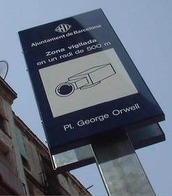 The sign says, in Catalan,